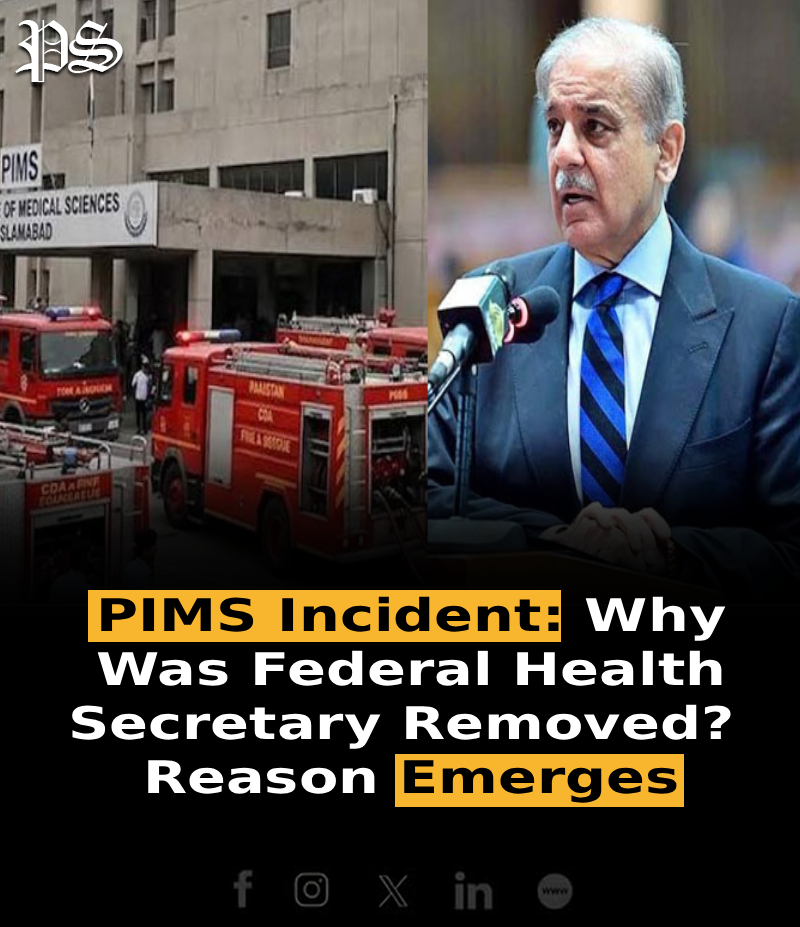
ISLAMABAD: The federal health secretary was removed from his post following the tragic fire at the Pakistan Institute of Medical Sciences (PIMS) in Islamabad because of an alleged failure to comply with repeated instructions from Prime Minister Shehbaz Sharif to personally inspect hospitals, particularly PIMS, according to an informed source.
The fire in the paediatric intensive care unit (ICU) resulted in the deaths of 14 children and triggered serious concerns about hospital management, safety arrangements and the quality of medical facilities.
According to the source, the prime minister had issued instructions to the federal health secretary on several occasions to visit hospitals in Islamabad personally and assess the situation on the ground.
The instructions reportedly covered a range of issues, including the standard of medical treatment, availability of healthcare facilities and overall arrangements for patients.
The health secretary was also specifically directed to ensure the availability of modern medical equipment and essential electromechanical equipment at hospitals. However, according to the source, the secretary failed to undertake the required visits.
The source said that the prime minister had issued the same instructions to the health secretary four days before the PIMS tragedy. Despite the directive, the visit did not take place.
Following the fire in the paediatric ICU and the deaths of 14 children, the prime minister took immediate action and removed the federal health secretary from his position.
However, the source clarified that the immediate removal of the secretary does not necessarily mean that the government has already established complete responsibility for the tragedy. The final determination of responsibility is expected to depend on the findings of the inquiry committee constituted to investigate the incident.
The government had established a high-level inquiry committee to examine the circumstances surrounding the PIMS tragedy. The committee is expected to identify shortcomings at different levels, determine responsibility and recommend further action.
The inquiry is particularly significant because questions have been raised about whether hospital authorities and senior officials adequately monitored the condition of critical healthcare facilities.
The committee is expected to examine the role of various officials and departments, including PIMS management and officers responsible for administrative affairs. Its recommendations could determine whether further disciplinary or administrative action is taken.
The possibility of action against additional officials has already become a subject of discussion following the removal of the health secretary. Questions are also being raised about whether Federal Health Minister Mustafa Kamal could face action after the inquiry is completed.
However, according to a source, no decision regarding the federal health minister has been made so far. Any action against the minister is expected to depend largely on the findings and recommendations of the inquiry committee.
The source said the inquiry committee would have to determine whether the federal minister or other senior officials should be held responsible for any administrative failures that contributed to the tragedy.
The source also pointed out that in cases involving serious administrative failures, senior officials are often removed from their positions quickly, sometimes within the first 24 hours, while subsequent action is generally taken after the findings of a formal inquiry become available.
The federal health minister is also facing pressure from various quarters following the deaths of the children. Calls for his resignation have emerged, although there has so far been no confirmation that he has been formally asked to step down.
The inquiry report is therefore expected to play a crucial role in determining the next phase of government action.
If the committee identifies additional failures, action could potentially extend to other senior officials, including those associated with PIMS administration and officers responsible for hospital management and oversight.
The tragedy has highlighted broader concerns about the effectiveness of monitoring mechanisms at major government hospitals. Questions are being raised about whether senior authorities were adequately supervising critical care facilities and whether regular inspections were being conducted as required.
The reported failure to carry out the prime minister’s instructions to inspect hospitals has become particularly significant in this context. Hospital inspections can allow authorities to identify shortages in equipment, weaknesses in emergency systems and other problems before they develop into serious incidents.
According to the source, the prime minister’s instructions specifically included reviewing the quality of treatment and ensuring that hospitals were equipped with modern medical and electromechanical equipment.
The failure to complete the required inspection before the PIMS incident has therefore been cited as an alleged administrative lapse.
At the same time, the government’s decision to remove the health secretary should not be viewed as the final determination of responsibility for the deaths, as the formal inquiry is still central to establishing what went wrong and who was responsible.
The inquiry committee is expected to assess failures at multiple levels, including hospital management, administrative oversight, staff performance, emergency preparedness and the availability of necessary facilities.
The PIMS tragedy has also raised questions about accountability within the federal healthcare system. The incident government’s immediate response was the removal of the federal health secretary, but the wider scope of accountability will become clearer once the inquiry committee submits its findings to has increased pressure on authorities to ensure that senior officials regularly monitor public hospitals and respond promptly to identified shortcomings.
The government’s immediate response was the removal of the federal health secretary, but the wider scope of accountability will become clearer once the inquiry committee submits its findings to the prime minister.
For now, attention remains focused on the inquiry report and whether it recommends action against additional officials. The report could determine whether responsibility extends beyond the health secretary to senior ministry officials, PIMS management and potentially other authorities.
The tragedy has ultimately exposed the importance of effective oversight of major public hospitals, particularly facilities providing critical care to vulnerable patients. The government is now under pressure not only to establish responsibility for the incident but also to implement measures that can prevent similar tragedies in the future.
About The Author