


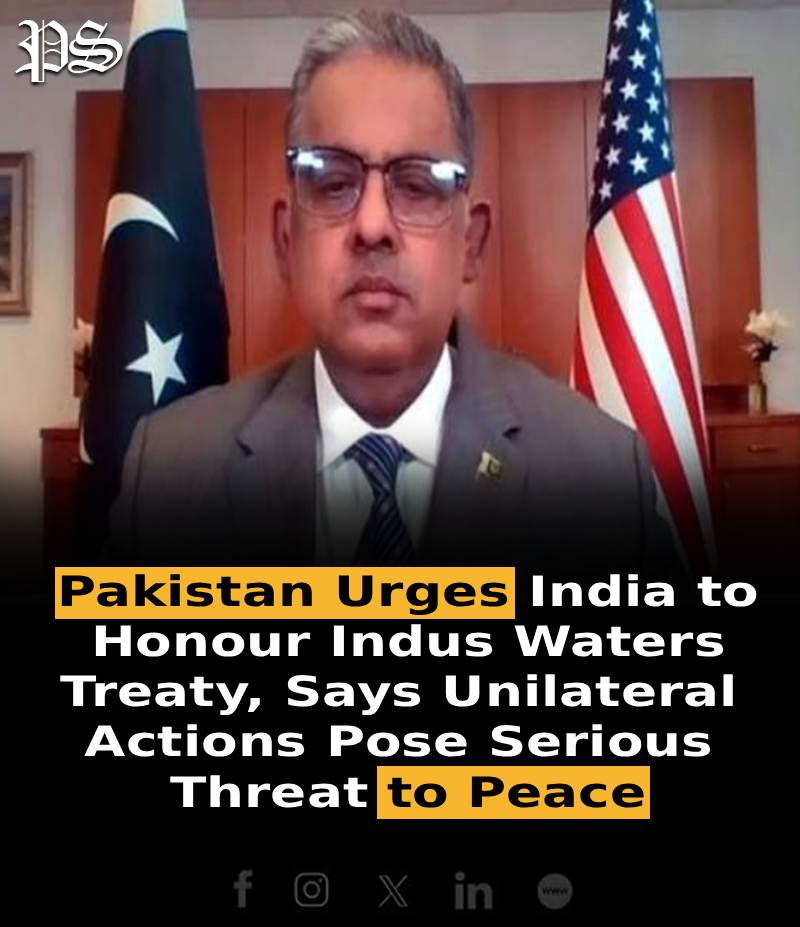
WASHINGTON: Pakistan’s Ambassador to the United States, Rizwan Saeed Sheikh, has urged India to comply with the six-decade-old Indus Waters Treaty, warning that unilateral Indian actions pose a serious threat to peace and security in South Asia.
In an article published in a US magazine, the Pakistani ambassador responded in detail to an article written by India’s ambassador to the United States. Rizwan Saeed Sheikh rejected what he described as repeated attempts by India to distort the history, structure, purpose and effectiveness of the Indus Waters Treaty.
The ambassador stressed that the treaty, signed in September 1960, was neither an act of generosity by India nor a concession granted to Pakistan. Instead, he said, it was the outcome of nearly a decade of negotiations between the two countries and constitutes a legally binding agreement that both parties are required to honour.
Under the treaty, India was allocated the use of the eastern rivers — the Ravi, Beas and Sutlej — while Pakistan was given rights over the waters of the western rivers, including the Indus, Jhelum and Chenab.
Rizwan Saeed Sheikh argued that describing the treaty as unfair to India ignores the circumstances and extensive negotiations that led to its creation.
He also rejected India’s allegation that Pakistan has attempted to obstruct Indian hydropower projects. The Pakistani ambassador said that legal proceedings have confirmed that hydropower projects on the western rivers must remain within the parameters and limitations established by the treaty.
According to the ambassador, seeking dispute resolution or arbitration in such circumstances does not constitute an obstruction to development. Rather, he said, it represents Pakistan’s legitimate exercise of rights available to it under the treaty.
He maintained that, from a legal perspective, the Indus Waters Treaty remains valid, effective, operational and binding on both countries.
The ambassador issued a strong warning against attempts to link the treaty with unrelated political or security disputes. He argued that no state can escape its obligations under an international agreement by raising unrelated political or security allegations.
Rizwan Saeed Sheikh said that allegations of terrorism or other bilateral disputes cannot provide India with a unilateral right to suspend, disregard or rewrite the Indus Waters Treaty.
He emphasised that the legal position was clear and that the treaty contains no provision allowing either party to unilaterally suspend or terminate it.
According to the Pakistani ambassador, the agreement cannot be terminated unless both governments enter into a formal and ratifiable agreement to that effect.
The comments come amid heightened tensions between Pakistan and India over water-sharing arrangements and the future of the Indus Waters Treaty. The agreement has remained one of the most important frameworks governing the use of the shared river system between the two neighbouring countries.
The treaty was negotiated with the assistance of the World Bank and established a detailed mechanism for the allocation and management of river waters. It also provides institutional and dispute-resolution mechanisms through which disagreements between the two countries can be addressed.
Pakistan has repeatedly maintained that disputes concerning water projects should be resolved through the mechanisms provided under the treaty rather than through unilateral action.
The Pakistani ambassador’s latest intervention similarly called on India to use the treaty’s established institutional framework. He urged New Delhi to fulfil its responsibilities under the agreement and engage in negotiations through the mechanisms created for resolving disputes.
Rizwan Saeed Sheikh said India should address disagreements at the institutional level and through the treaty’s dispute-resolution procedures.
He argued that the continued functioning of the agreement is important not only for Pakistan and India but also for regional stability. Any unilateral action affecting water-sharing arrangements could have wider consequences for relations between the two nuclear-armed neighbours.
The ambassador rejected the argument that political or security tensions could automatically alter the legal obligations created by the treaty. In his view, international agreements cannot simply be set aside by one party because of disputes arising in other areas of bilateral relations.
The Pakistani position is that the treaty establishes specific rights and responsibilities for both countries and that disagreements over projects or water usage should be dealt with through the mechanisms agreed upon by the parties.
The ambassador also sought to counter the narrative that Pakistan’s objections to Indian hydropower projects amount to opposition to India’s development. He said Pakistan’s position is based on ensuring that projects comply with the treaty’s technical and legal requirements.
According to him, the involvement of dispute-resolution institutions is not an attempt to prevent development but a means of ensuring that both sides adhere to the agreement.
The issue has assumed greater significance because the Indus river system is vital to Pakistan’s agriculture, drinking water supply and broader economy. The country relies heavily on the rivers covered by the treaty, particularly the western rivers allocated to Pakistan.
Any uncertainty surrounding the flow and management of these rivers therefore has the potential to create serious economic and political concerns in Pakistan.
At the same time, India has its own interests in developing hydropower and water infrastructure on rivers allocated to it under the treaty. The central point of disagreement has often been whether particular projects comply with the technical provisions governing India’s use of the western rivers.
Pakistan maintains that these disputes should be examined through the treaty’s established legal framework rather than through unilateral decisions.
Rizwan Saeed Sheikh concluded by calling on India to respect the agreement and engage with Pakistan through institutional and dispute-resolution mechanisms.
He stressed that the legal status of the Indus Waters Treaty remains clear and that unilateral suspension or termination is not provided for under the agreement.
The ambassador’s remarks underscore Pakistan’s position that the treaty remains legally binding and that compliance with its provisions is essential for maintaining stability between the two countries.
Pakistan has therefore urged India to honour its treaty obligations, avoid unilateral measures and return to negotiations through the mechanisms established under the agreement. According to Islamabad, preserving the treaty and resolving disputes through legal and institutional channels are essential not only for protecting water rights but also for preventing further deterioration in relations and safeguarding peace and security in South Asia.
About The Author