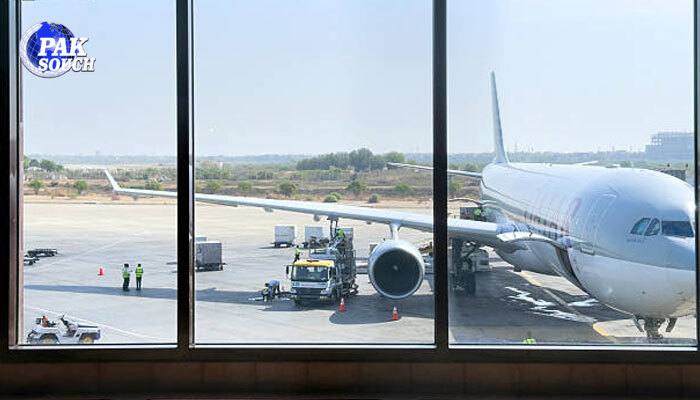
Following the sudden closure of Pakistan’s airspace amid heightened tensions in the Middle East, three foreign aircraft have remained parked at Jinnah International Airport since February 28. The aircraft belong to Qatar Airways, Flydubai, and Air Arabia, and their extended stay has drawn attention due to the unusual circumstances surrounding their arrival.
According to officials from the Pakistan Airports Authority (PAA), the airspace closure on February 28 was implemented abruptly in response to the evolving regional security situation. As a result, 27 flights that were transiting through Pakistani airspace were forced to land at Karachi. These included a mix of technical landings, diversions, and rerouted flights. The sudden influx of aircraft required immediate coordination and crisis management at the airport to ensure passenger safety and operational continuity.
A spokesperson for the PAA explained that during such emergencies, Operational Crisis Control Centers (OCC) are activated at airports in accordance with international aviation protocols set by the International Civil Aviation Organization (ICAO). These centers are responsible for managing diversions, coordinating ground handling services, and ensuring that stranded passengers receive assistance. On February 28 alone, more than 15 aircraft were diverted to Karachi as part of these contingency measures.
While 12 of the diverted aircraft were able to depart after necessary arrangements were made, three foreign aircraft have remained parked at Karachi airport’s designated parking bays. The continued presence of these planes is largely due to operational and logistical factors, including scheduling adjustments, airspace restrictions in the region, and coordination between the airlines and aviation authorities.
The unexpected landings have also had financial implications. The parking of these foreign aircraft has generated thousands of dollars in revenue for the Pakistan Airports Authority in the form of parking fees. Aviation experts note that while diversions can disrupt normal airport operations, they may also bring short-term financial benefits through service charges, ground handling fees, and extended parking payments. However, such benefits are typically outweighed by the broader economic impact of airspace closures, which can disrupt flight schedules and increase operational costs for airlines.
Passengers aboard the affected flights have faced significant inconvenience. Since February 28, many travelers have been accommodated in hotels across Karachi while awaiting onward travel arrangements. Airline representatives have been working to rebook passengers on alternative flights to their final destinations. In some cases, travelers have been rerouted through different countries or offered refunds and rescheduling options depending on availability and passenger preference.
Airport authorities have emphasized that safety remains the top priority. The swift activation of crisis management protocols ensured that all diverted aircraft landed safely and that passengers were provided with basic facilities. Ground staff, immigration officials, and airline representatives coordinated closely to manage the sudden surge in arrivals.
Aviation analysts point out that airspace closures, especially in geopolitically sensitive regions, can have ripple effects across international flight networks. Pakistan’s geographical location makes its airspace an important transit corridor for flights traveling between Asia, the Middle East, and Europe. When restrictions are imposed, airlines often have to reroute flights over longer paths, increasing fuel consumption and travel time. In some instances, diversions to alternate airports become necessary, as seen in this case.
The current situation also highlights the interconnected nature of global aviation. Events in one region can quickly affect flight operations thousands of miles away. Airlines must continuously monitor geopolitical developments and coordinate with international aviation authorities to adjust routes and ensure compliance with safety directives.
Despite the operational challenges, officials at Karachi airport have stated that normal flight operations within Pakistan continue as scheduled. Domestic flights and other international services are being managed alongside the parked aircraft without major disruption. Authorities remain in close contact with the concerned airlines to facilitate the eventual departure of the three aircraft once conditions permit.