

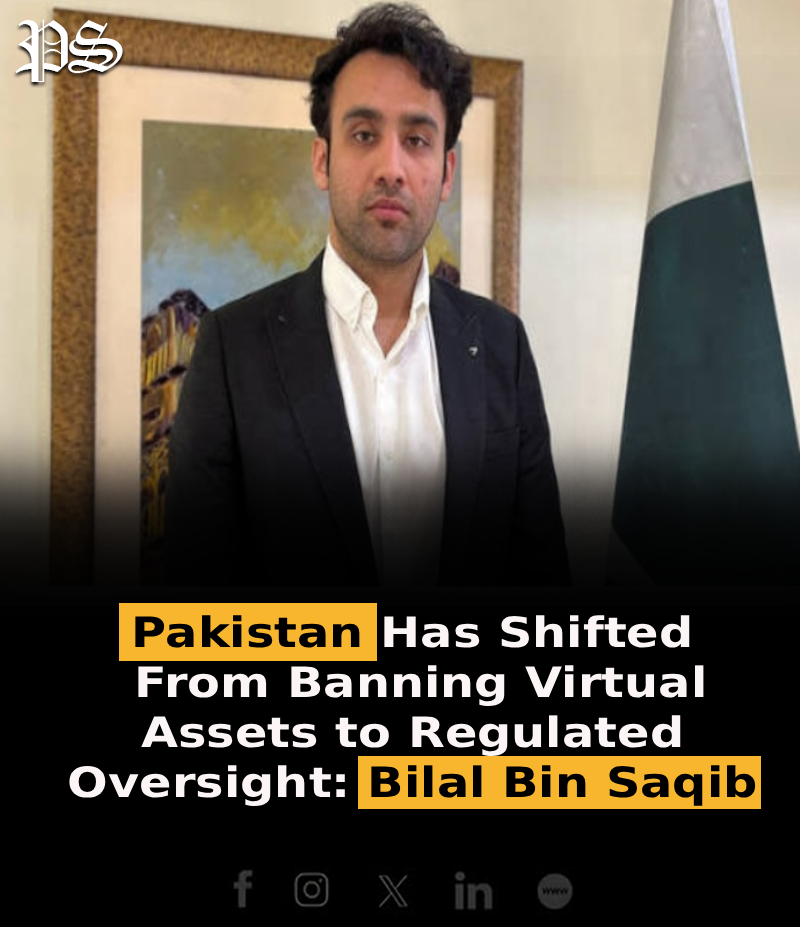
Tashkent: Chairman of the Pakistan Virtual Assets Regulatory Authority (PVARA) Bilal Bin Saqib has said that Pakistan has moved away from a policy of restricting virtual assets and is now shifting toward a framework based on regulated oversight.
Speaking at the Silk Road Finance and Technology Forum in Tashkent, Bin Saqib said governments needed to develop regulatory and institutional capabilities that could evolve at the same pace as rapidly changing technologies.
He said Pakistan now had significant opportunities to develop its digital financial infrastructure and that an effective regulatory framework for virtual assets could open the door to new investment opportunities.
According to Bin Saqib, the government’s approach represents a major shift in how virtual assets are handled in Pakistan. Rather than attempting to eliminate virtual-asset activity through restrictions, the country is moving toward bringing the sector under formal regulation and supervision.
He argued that governments needed regulatory institutions capable of understanding and responding to emerging technologies. Rapid developments in digital finance, blockchain and virtual assets require regulatory frameworks that can adapt to technological changes rather than relying solely on traditional financial regulations.
Bin Saqib also referred to Pakistan’s experience with restrictions introduced in 2018. He said those restrictions did not eliminate virtual-asset activity in the country. Instead, activities shifted toward offshore platforms and peer-to-peer channels.
According to him, this experience demonstrated that an outright prohibition was not sufficient to effectively manage the virtual-asset sector. Regulation and oversight, he said, are necessary to bring such activities into a transparent and accountable framework.
He said the establishment of PVARA under the Virtual Assets Act 2026 represented a significant step toward creating an institutional structure for regulating virtual assets in Pakistan.
The new regulatory framework is intended to bring virtual asset service providers under formal supervision and establish licensing requirements for companies operating in the sector.
Bin Saqib said PVARA had already implemented licensing regulations for virtual asset service providers and had also activated a licensing portal. The development is expected to provide businesses with a formal mechanism through which they can apply for authorization and operate within the country’s regulatory framework.
He also highlighted the importance of integrating the virtual-asset industry with the conventional financial system. In this regard, he said State Bank Circular 10 allows banks to maintain accounts for licensed virtual asset service providers.
The ability of licensed virtual asset companies to access banking services could be an important component of Pakistan’s broader effort to formalize the sector. It could also make it easier for regulators to monitor financial flows and ensure that businesses operating in the virtual-asset market comply with applicable rules.
Bin Saqib said Pakistan also sees opportunities for digital financial innovation beyond cryptocurrency trading. The country is examining tokenization as a possible way of modernizing access to sovereign debt and financial markets.
According to him, Pakistan is initially focusing on the tokenization of government securities. Tokenization involves representing ownership or rights to an asset digitally using blockchain or similar distributed-ledger technology.
The government’s interest in tokenized government securities reflects a broader effort to explore how emerging technologies could improve financial-market infrastructure. If implemented effectively, such systems could potentially make certain financial instruments easier to issue, transfer and access while maintaining appropriate regulatory controls.
Bin Saqib emphasized that the development of an effective virtual-asset regulatory system could create new opportunities for investment and innovation in Pakistan. He said the country had considerable potential to develop its digital financial infrastructure and participate more actively in the global digital economy.
The comments in Tashkent come as Pakistan seeks to establish itself as a jurisdiction with a clearer regulatory framework for virtual assets. The authorities are attempting to balance technological innovation and investment opportunities with the need for financial oversight, consumer protection and regulatory compliance.
The shift described by Bin Saqib marks a significant change from the approach associated with the restrictions introduced in 2018. His argument is that bringing virtual-asset activities into a regulated environment can provide authorities with greater visibility and control than attempting to prevent the activities altogether.
With PVARA’s licensing framework and portal now operational, virtual asset service providers are expected to increasingly operate through formal regulatory channels. At the same time, Pakistan’s exploration of tokenized government securities indicates that the government is considering applications of blockchain technology beyond conventional cryptocurrencies.
Bin Saqib said the broader objective was to develop regulatory institutions that could keep pace with technological change while creating an environment in which digital financial innovation can take place under effective oversight.
About The Author