

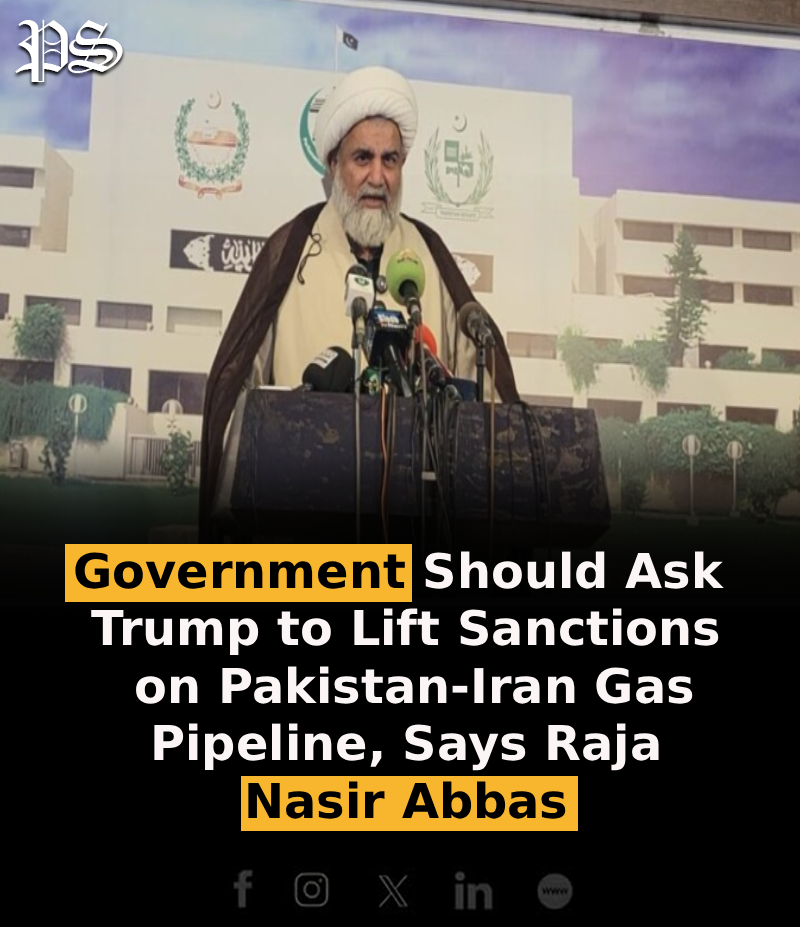
ISLAMABAD: Opposition Leader in the Senate Allama Raja Nasir Abbas has urged the Pakistani government to ask US President Donald Trump to remove sanctions that are preventing progress on the Pakistan-Iran gas pipeline project.
Speaking during a session of the Senate, Raja Nasir Abbas said the government should raise the issue with Washington and make it clear that Pakistan needs freedom to pursue the pipeline project in accordance with its national interests.
The Pakistan-Iran gas pipeline has remained a contentious issue for years because of sanctions imposed on Iran by the United States and the resulting legal, financial, and diplomatic risks for Pakistan. Although the project was conceived as an important source of energy for Pakistan, its implementation has repeatedly been delayed.
During his remarks in the Senate, Raja Nasir Abbas referred to comments by Petroleum Minister Ali Pervaiz Malik regarding the financial viability of the pipeline. He said the minister had previously stated that there were financial concerns surrounding the project and that Pakistan should therefore not proceed with construction.
Raja Nasir Abbas questioned this position, asking why the project had been formally pursued and why agreements had been signed at the highest level if it was considered unviable. He argued that Pakistan had lost valuable time by failing to complete the pipeline.
He said that if the gas pipeline had been constructed around two decades ago, Pakistan’s industrial sector could have benefited significantly from a more reliable supply of natural gas. In his view, the prolonged delay has contributed to the country missing an important opportunity to strengthen its energy security and support industrial development.
Raja Nasir Abbas also linked the issue to Pakistan’s relations with the United States. He argued that Islamabad should use its diplomatic engagement with Washington to seek relief from sanctions that could prevent Pakistan from moving forward with the Iran pipeline.
He urged the government to ask Donald Trump not to impose sanctions on Pakistan over the project, emphasizing that the country should be allowed to pursue its own energy requirements.
The opposition leader’s comments came in response to a detailed explanation from Petroleum Minister Ali Pervaiz Malik about the current status of the pipeline and the difficulties facing Pakistan.
The petroleum minister told the Senate that Iran had already completed substantial work on its side of the project. However, Pakistan had not been able to make similar progress because of the sanctions-related complications.
According to Ali Pervaiz Malik, the situation has also developed into a legal issue. Iran has approached an arbitration court over the implementation of the project, creating an additional challenge for Pakistan. The government is now attempting to find a solution that can be accepted by both countries.
The minister said Prime Minister Shehbaz Sharif had established a steering committee to examine the matter and work towards a solution. The committee includes Deputy Prime Minister and Foreign Minister Ishaq Dar, the Attorney General, and the petroleum minister himself.
Ali Pervaiz Malik explained that the legal proceedings surrounding the pipeline remain a major issue for Pakistan. The government is examining the potential consequences of the case while trying to identify a way forward that protects the country’s interests.
The Pakistan-Iran gas pipeline has long been regarded as a potentially important energy project for Pakistan. The proposed pipeline would connect Pakistan with Iranian gas supplies and could help diversify the country’s energy sources. However, international sanctions against Iran have made the project extremely difficult to implement.
The issue also involves a complicated balance between Pakistan’s energy requirements and its international diplomatic and financial commitments. Proceeding with the project without addressing the sanctions question could expose Pakistan to significant economic and legal risks, while continued delays could leave the country dependent on more expensive or limited energy sources.
The debate in the Senate therefore reflects a broader policy dilemma facing Islamabad. Pakistan needs additional and affordable energy supplies to support its industries and economy, but it must also consider the consequences of violating or triggering international sanctions.
Raja Nasir Abbas believes Pakistan should take a stronger diplomatic position and seek an explicit exemption or relief from Washington. His argument is that Pakistan’s energy needs should be given greater consideration in its discussions with the United States.
The government, meanwhile, appears to be taking a more cautious approach. The establishment of a steering committee indicates that Islamabad is examining the legal and diplomatic dimensions of the project before making a major commitment.
The arbitration proceedings initiated by Iran add another layer of complexity. Any settlement will need to take into account Pakistan’s contractual obligations, the sanctions environment, and the interests of both countries.
The project’s long delay has also become a source of political criticism. Supporters argue that Pakistan could have benefited from Iranian gas much earlier if the pipeline had been completed, while critics point to the substantial financial and diplomatic risks associated with proceeding under the current sanctions regime.
For Pakistan, the challenge is now to determine whether the pipeline can be revived without exposing the country to unacceptable international penalties. A diplomatic arrangement with the United States could potentially create more room for negotiations, while a mutually acceptable legal settlement with Iran could address the contractual dispute.
The Senate debate has once again brought the Pakistan-Iran gas pipeline into the national spotlight. Raja Nasir Abbas has called for direct diplomatic engagement with Donald Trump, while the government says it is examining the legal case and exploring a solution through a dedicated steering committee.
The future of the pipeline will ultimately depend on Pakistan’s ability to balance its energy needs, international relations, legal obligations, and economic interests. With the project already delayed for many years, the government now faces pressure to provide a clear policy direction and determine whether the pipeline can realistically be completed.
About The Author