

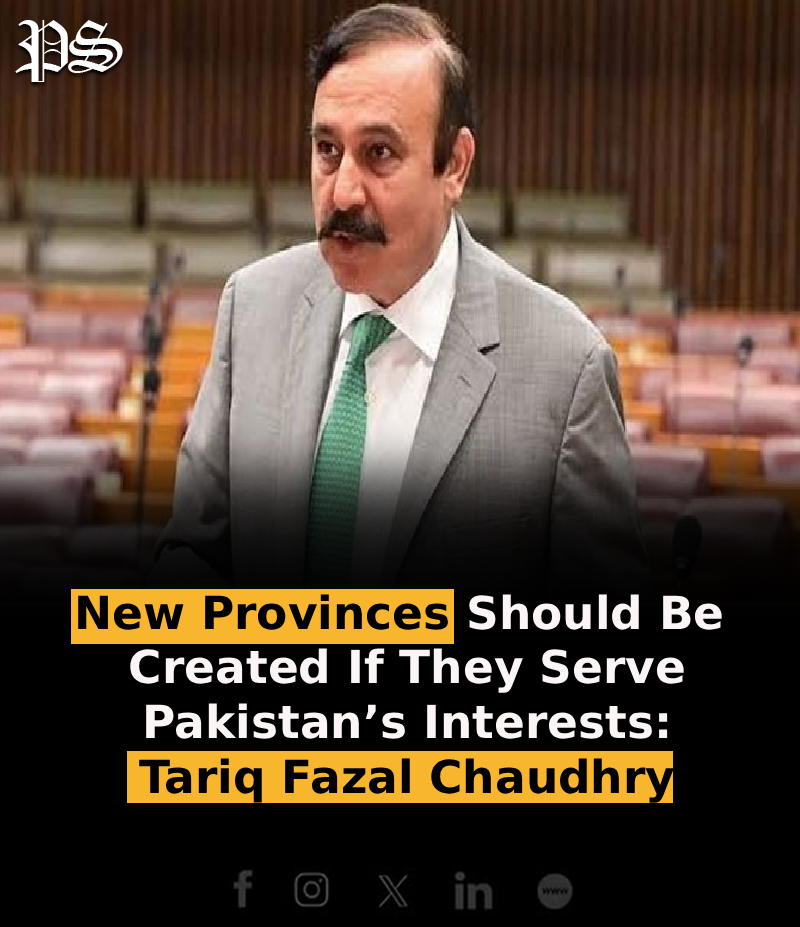
Federal Minister for Parliamentary Affairs Tariq Fazal Chaudhry has said that new provinces should be created in Pakistan if they are genuinely in the country’s best interest and can contribute to better governance, administration, and public welfare.
The minister’s remarks have added momentum to an ongoing national discussion about the possibility of creating new provinces or administrative units in Pakistan. Sharing a video clip from a television programme on social media, Chaudhry welcomed what he described as the beginning of a positive and healthy debate on the issue. He emphasized that political parties, civil society, and the general public should all participate in discussions concerning the future administrative structure of the country.
According to Chaudhry, the creation of new provinces is a major constitutional and national matter that cannot be decided unilaterally. He stressed that consensus among political forces is essential before any such decision is taken. Since the matter ultimately concerns Parliament and requires constitutional consideration, he said that it should be discussed thoroughly in both houses of Parliament.
The federal minister also urged political parties to rise above their individual interests and focus on the broader interests of Pakistan and its people. In his view, questions relating to governance, administration, and national development should be discussed on the basis of merit rather than narrow political considerations.
The debate over new provinces is not new in Pakistan. Over the years, demands for additional provinces have emerged from different parts of the country, including areas where people believe that existing provincial structures are too large to ensure effective administration and equal development. Supporters of new provinces argue that smaller administrative units could bring government institutions closer to citizens, improve service delivery, and allow local issues to receive greater attention.
However, opponents often raise concerns about the political, financial, and constitutional implications of creating additional provinces. They argue that the process could lead to further demands for territorial division and potentially create new political or ethnic tensions. For this reason, the issue remains highly sensitive and requires careful consideration.
Chaudhry referred to India’s experience while discussing the question of provincial reorganization. He noted that India established a commission in the early years after independence to examine the question of states and their boundaries. Subsequent reorganizations resulted in the creation of new administrative entities, including Himachal Pradesh, Haryana, and the reorganized Punjab region.
India’s experience demonstrates that the boundaries and structures of administrative units can evolve when governments believe that changes are necessary for effective governance. At the same time, every country has its own political, constitutional, social, and economic circumstances. Therefore, Pakistan would need to examine the issue according to its own national requirements rather than simply copying another country’s model.
The minister made it clear that he does not oppose the creation of new provinces in principle. His position is that if additional provinces can strengthen Pakistan, improve administration, and serve the public interest, there should be no hesitation in considering them. However, if the creation of new provinces risks increasing division, instability, or political confrontation, the matter should be examined from every possible angle before a final decision is made.
One of the most important aspects of the debate is therefore the need for comprehensive research. Any proposal for a new province should be assessed in terms of population, geographical accessibility, economic resources, administrative capacity, infrastructure, revenue generation, and the ability of the proposed province to function independently. Public opinion in the affected areas should also be taken into account.
The constitutional procedure is equally important. Creating a new province is not merely an administrative exercise; it involves changes to the constitutional framework and requires political agreement. Any attempt to impose such a decision without broad consultation could deepen political disagreements instead of resolving administrative problems.
Pakistan’s growing population and expanding urban centres have also increased pressure on existing provincial administrations. Large provinces contain areas with widely different geographic and socioeconomic conditions. Supporters of provincial reorganization believe that smaller units could make it easier for governments to plan development according to local needs.
On the other hand, administrative restructuring alone cannot guarantee development. New provinces would require substantial financial resources, new government institutions, infrastructure, and administrative machinery. If these challenges are not properly addressed, creating additional provinces could increase costs without necessarily improving governance.
For this reason, the debate initiated by Chaudhry should ideally focus on evidence and national interest. Political parties should present clear arguments regarding the benefits and possible disadvantages of new provinces. Experts in constitutional law, economics, public administration, and regional development should also contribute to the discussion.
Ultimately, the question should not simply be whether Pakistan should have more provinces, but whether creating them would produce better governance and a stronger federation. If new provinces can improve administrative efficiency, promote balanced development, and provide citizens with better access to government services, the idea deserves serious consideration.
At the same time, national unity, constitutional stability, and political consensus must remain central to the process. As Tariq Fazal Chaudhry has suggested, such a sensitive decision should be advanced through open debate, consultation, and agreement rather than confrontation.
The future of Pakistan’s administrative structure is ultimately a matter for Parliament and the people. A mature and informed national debate could help determine whether new provinces are necessary, where they should be created, and how they could strengthen the country rather than divide it. If undertaken carefully and in accordance with the Constitution, provincial reorganization could become an opportunity to improve governance and bring the state closer to its citizens.
About The Author