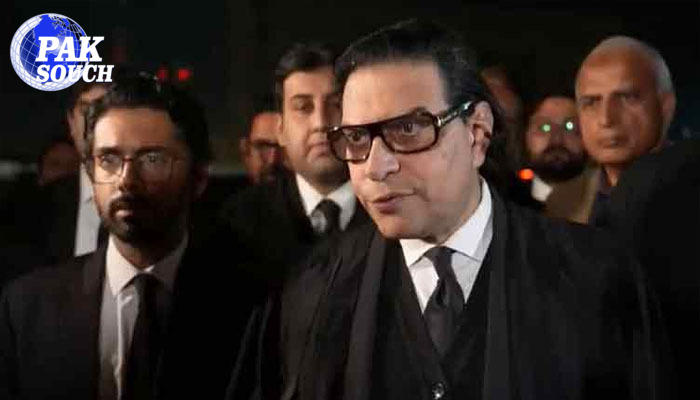
Pakistan Tehreek-e-Insaf (PTI) Secretary General Salman Akram Raja has strongly rejected a statement made by party chairman Barrister Gohar, terming it contrary to the party’s official stance and inappropriate in tone. The clarification comes amid ongoing controversy over restrictions on meetings with PTI founder Imran Khan.
Earlier, Barrister Gohar had stated that the situation had reached a point where PTI leaders were being forced to “beg” to meet Imran Khan, alleging that not only political opponents but also people from within the party were responsible for this state of affairs. His remarks sparked debate within party circles and drew criticism from several PTI leaders.
Responding to the statement, Salman Akram Raja said that the party had already distanced itself from Barrister Gohar’s remarks at the official level. Speaking to the media, he made it clear that the use of the word “begging” did not reflect PTI’s position and should not have been used.
“Barrister Gohar spoke in haste. We are not begging in any form,” Salman Akram Raja said. “The word ‘begging’ is completely inappropriate and does not represent our struggle or our stance.”
He emphasized that PTI believes it has done nothing wrong that could justify the restrictions placed on meetings with its founder. According to him, there is no legal, moral, or political basis to prevent party leaders from meeting Imran Khan, and such limitations are unjustified.
Salman Akram Raja reiterated that Imran Khan is being subjected to unfair and unlawful restrictions, and the denial of meetings is part of broader political pressure. “There has been no mistake on the part of PTI that could be used as an excuse to stop meetings with the party founder,” he stated.
He further clarified PTI’s position regarding any potential dialogue with the government. “Talks with the government will only take place when all illegal and unjustified restrictions imposed on the PTI founder are removed,” he said, drawing a clear line on the party’s conditions for engagement.
The statement underscores internal sensitivities within PTI at a time when the party is navigating legal, political, and organizational challenges. Observers note that the issue of access to Imran Khan remains a critical concern for PTI, as it affects internal coordination, political strategy, and morale among party workers.
Political analysts believe that Salman Akram Raja’s response was aimed at damage control, ensuring that Barrister Gohar’s remarks are not interpreted as a sign of weakness or desperation on the part of PTI. The party has consistently maintained that it is fighting a legal and constitutional battle and will not compromise on principles or dignity.
Meanwhile, PTI supporters on social media echoed Salman Akram Raja’s position, arguing that the party is seeking its lawful rights rather than pleading for favors. Many reiterated that meetings with legal counsel and party leaders are a fundamental right and should not be curtailed.
The episode highlights ongoing tensions within PTI leadership over messaging and strategy, particularly in a politically charged environment. While the party continues to present a united front on major issues, such statements reveal the pressure leaders face in articulating frustration without undermining the party’s core narrative.
As the situation develops, PTI maintains that its struggle will continue through constitutional and legal means, with its leadership insisting that respect, rule of law, and due process must prevail before any meaningful political engagement can take place.