

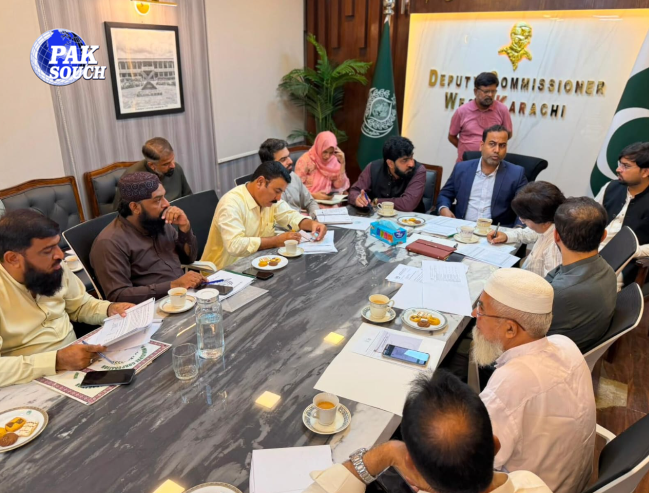
A fourth review meeting was held at the Deputy Commissioner Office, Karachi West, under the chairmanship of the Commissioner Karachi. The meeting reviewed the ongoing development schemes under the Annual Development Programme (ADP) for the fiscal years 2024–25 and 2025–26, along with matters relating to Property Tax, Sui Southern Gas Company (SSGC), Sindh Solid Waste Management, Maintenance & Repair, Road Cutting, Karachi Water & Sewerage Corporation (KWSC), and other development and administrative affairs. The performance of various departments, progress on ongoing projects, challenges being faced, and effective measures for their resolution were also discussed in detail.
The meeting was attended by Deputy Commissioner Karachi West Zulfiqar Ali Memon, Assistant Commissioner Orangi, Assistant Commissioner Manghopir, Assistant Commissioner Mominabad, Chairman of Town Municipal Corporation Manghopir Haji Nawaz Ali Brohi, Municipal Commissioner Agha Khaliq, Afaq Alam from the B&R Department, Deputy Director Administration Hafiz Muhammad Shoaib, In-charge Road Cutting Abdul Ghaffar Jatoi, Deputy Director Property tax , and other officers from the relevant departments.
During the meeting, Chairman Haji Nawaz Ali Brohi gave a comprehensive briefing on the ongoing development projects in Manghopir Town, ADP schemes, municipal services, improvement of civic infrastructure, construction and rehabilitation of roads, drainage, sanitation, parks, and other public welfare initiatives. He also informed the participants about the progress of ongoing schemes, measures taken for their timely completion, and the future development strategy.
Municipal Commissioner Agha Khaliq presented a detailed briefing on the technical progress of various development projects, administrative matters, and ongoing development activities. Deputy Director Property Tax briefed the meeting on property tax collection, assigned targets, revenue enhancement, and measures being taken to further strengthen the tax system.
On the occasion, Chairman Town Municipal Corporation Manghopir Haji Nawaz Ali Brohi stated:
“The development of Manghopir Town, the provision of quality municipal services to the public, and the sustainable resolution of civic issues remain our highest priorities. We are committed not only to initiating development projects but also to ensuring their timely, transparent, and high-quality completion. Our entire team is working tirelessly with a spirit of public service so that the benefits of development reach the people of every Union Council without discrimination.”
He further added:
“Our mission is to transform Manghopir Town into a modern, clean, organized, and developed municipal model. With the cooperation of the Commissioner Karachi, the district administration, and all relevant institutions, the pace of ongoing development projects will be further accelerated. There will be no compromise on transparency, quality, and timely completion. God willing, the trust of the people is our greatest strength, and we will continue to honor that trust by taking Manghopir Town to new heights of development and prosperity.”
During the meeting, the Commissioner Karachi directed all relevant departments to further accelerate the pace of ongoing development projects, ensure effective coordination and cooperation among institutions, and adopt a comprehensive strategy for the timely and sustainable resolution of public issues so that quality municipal services can be provided to citizens without delay.
At the conclusion of the meeting, the Commissioner Karachi, Deputy Commissioner Karachi West, and other concerned officers expressed satisfaction over the ongoing development activities in Manghopir Town, the progress of ADP schemes, and the comprehensive briefing presented by Chairman Haji Nawaz Ali Brohi. They reaffirmed their commitment to completing all ongoing development projects within the stipulated timeframe and ensuring the provision of improved, quality, and sustainable municipal services to the people of Manghopir Town.
Issued by:
Department of Information & Public Relations
About The Author