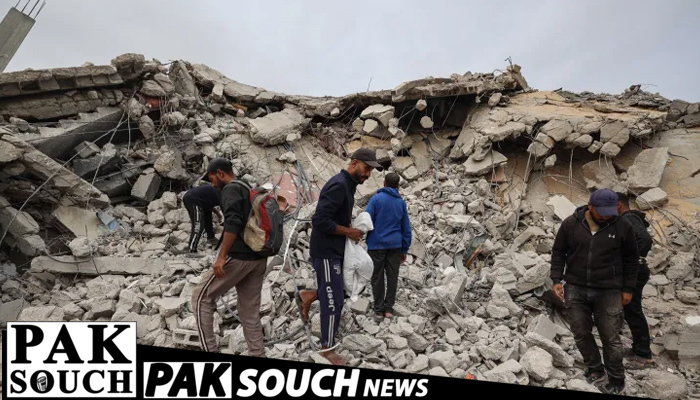
Despite a formal ceasefire agreement intended to halt hostilities in the Gaza Strip, Israel has continued to carry out attacks in various parts of the territory, resulting in the deaths of at least seven more Palestinians on Saturday. According to Al Jazeera, Israeli forces have persisted with drone strikes and machine-gun fire inside Gaza, raising serious concerns about the durability of the ceasefire arrangement and the growing humanitarian crisis.
Fresh violations despite ceasefire
Eyewitnesses and local reporters confirmed that the latest wave of Israeli actions targeted several neighborhoods in central and southern Gaza. Among those killed on Saturday were a 70-year-old woman and her 25-year-old son, both of whom were struck outside their partially damaged home. The attack took place in an area where residents had begun cautiously returning after the ceasefire announcement, believing the hostilities would subside.
Residents described moments of panic as drones circled overhead and sporadic bursts of gunfire echoed through the streets. “We thought the fighting had stopped,” a local resident told Al Jazeera. “But the drones never left, and today they fired again.”
Over 360 Palestinians killed since ceasefire announcement
The Ministry of Health in Gaza reported that since the ceasefire came into effect on 11 October, Israeli attacks have killed at least 367 Palestinians, including dozens of women, elderly individuals, and children. Health officials warn that the death toll may rise further as several injured people remain in critical condition and rescue workers continue to recover bodies from targeted sites.
Humanitarian organizations have condemned the ongoing attacks, stating that any military activity during a ceasefire period not only violates international law but also severely undermines efforts to stabilize the region and provide relief to civilians.
International mediators express alarm
Qatar and Egypt, the two primary mediators of the ceasefire agreement, expressed “grave concern” over Israel’s repeated violations. In a joint statement, the two countries emphasized that the ceasefire had entered a “critical and fragile phase” and warned that any further escalation could collapse the agreement entirely.
The mediators stressed the urgent need for the deployment of the “Gaza Stabilization Force,” a proposed international mechanism aimed at monitoring the ceasefire and ensuring that humanitarian corridors remain open for supplies, medical aid, and civilian movement. Discussions on the force have been ongoing for weeks, but its deployment has been delayed due to political disagreements.
Humanitarian crisis deepens
Aid groups report that basic services in Gaza—including water, electricity, and medical care—remain severely disrupted. Hospitals, already overwhelmed with casualties from months of conflict, are struggling to treat injuries sustained in the recent violations. Supplies of essential medicines, surgical instruments, and fuel for generators are rapidly depleting.
UN agencies have reiterated calls for uninterrupted access to Gaza to restore basic infrastructure and provide critical assistance. “A ceasefire must mean a complete stop to hostilities,” a UN official stated. “What we are seeing is not a ceasefire—it is a continuation of violence under a different name.”
Violence spreads to the West Bank
Alongside the situation in Gaza, there has been a marked escalation in violence in the occupied West Bank, where Israeli settlers have intensified attacks on Palestinian villages and farmlands. Rights groups say that settlers, often accompanied or protected by Israeli forces, have been raiding homes, torching property, and physically assaulting residents.
Several West Bank communities have reported being forced to flee their homes due to fear of attacks. Local leaders warn that the situation could deteriorate rapidly if the international community does not intervene. “What is happening in the West Bank is part of the same cycle of aggression,” one Palestinian activist said. “This is coordinated pressure on Palestinians across all territories.”
Regional reactions
Arab states, including Jordan, Saudi Arabia, and the UAE, have condemned Israel’s continued military actions during the ceasefire, urging the international community—particularly the UN Security Council—to hold Israel accountable. Statements from these countries emphasize that continued violations undermine regional stability and jeopardize efforts for long-term peace.
Turkey also issued a strongly worded condemnation, accusing Israel of “systematic and deliberate aggression” against Palestinian civilians and calling for international sanctions.
Israel’s position
Israel has not formally acknowledged violating the ceasefire but claims that certain “security operations” are necessary to prevent “imminent threats.” Israeli officials argue that militant groups in Gaza have attempted to regroup and reposition during the ceasefire, prompting targeted drone activity and engagements.
However, independent analysts note that no evidence has been presented to justify these actions, and Israel’s operations appear to be unilateral rather than defensive.
Ceasefire at risk of collapse
Diplomats warn that the situation is rapidly approaching a breaking point. Each new violation reduces trust between the parties and increases the likelihood that full-scale conflict could resume. Mediators are working to salvage the ceasefire, but with casualties mounting, public anger within Gaza is also growing.
Analysts explain that without robust monitoring mechanisms and accountability for violations, the ceasefire cannot hold. Pressure is building on the international community to step in more aggressively to enforce terms agreed upon by both sides.
Conclusion
As Israel continues its military activity in Gaza despite an announced ceasefire, the killing of seven more Palestinians—including elderly civilians—has deepened concerns over the fragility of the truce and the worsening humanitarian disaster. With over 360 Palestinians killed since the ceasefire began, regional mediators and international bodies are urging immediate action to stabilize the situation. Meanwhile, rising violence in the West Bank suggests a broader escalation that threatens the entire region’s security.