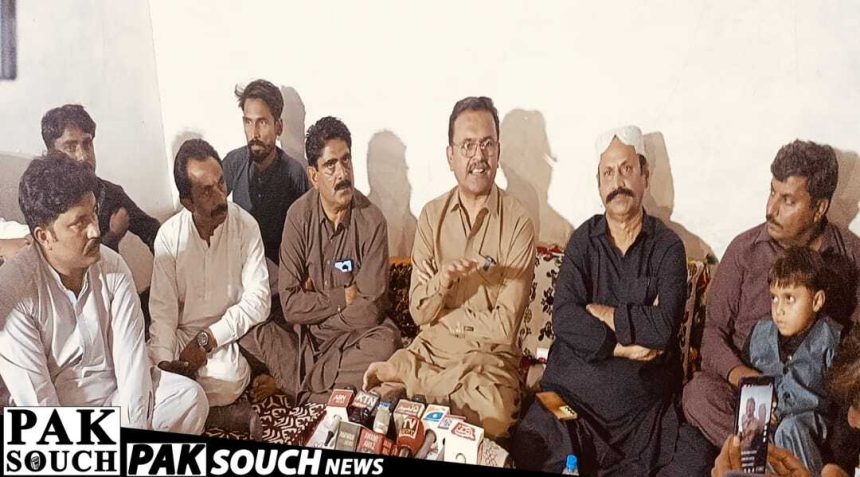
Sukkur — Syed Zain Shah, president of the Sindh United Party, arrived at Jagirani House near Bjarani Chawk, Qureshi Goth, Sukkur, on Sunday to preside over an important organizational meeting that energized party workers and office-bearers. The gathering, which drew a large turnout including local leaders Aeedin Jagirani and Majid Danwar, focused on strengthening the party’s internal structure, mobilizing grassroots outreach, and mapping a strategy for the months ahead.
In a detailed consultation, participants discussed the party’s organizational framework and tabled plans for an aggressive public-contact campaign designed to carry the Sindh United Party’s message “from village to village and town to town,” according to party sources. The meeting was described by attendees as a continuation of a series of worker-consultations intended to prepare the party for sustained political engagement across Sindh.
Addressing the press, Syed Zain Shah said he had travelled to Sukkur via Dadu, Kashmore and Ghotki, stressing the significance of meeting grassroots activists in different districts. He painted a bleak picture of Pakistan’s economic and security situation, saying the country’s economy was “on the brink of collapse” while the agriculture sector continued to deteriorate. He warned that mounting risks along the Afghan border and other frontiers were contributing to a worsening security environment.
“Law and order in Sindh has reached an alarming level,” Shah declared, adding that ordinary citizens no longer feel safe. He openly criticized the police, asserting they had “completely failed” in preserving peace and security. “We demand that law and order be restored, elections be held transparently, and the Peca amendment be repealed,” he said, referring to the Prevention of Electronic Crimes Act (PECA) amendments that have been controversial in political and civil society circles.
Shah appealed to all political parties to unite for the greater good of the country. “We want political forces to work together for the improvement of the nation,” he said. He emphasized that the current meeting was one link in an ongoing process of consultations with party workers and activists across the province. “We have set out to save the country,” he added emphatically, “and under no circumstances will we allow the constitution to be set aside.”
On possible political alliances, Shah clarified the Sindh United Party’s stance: “Our party will not align itself with the Muslim League-Nawaz, the Pakistan Peoples Party, or the MQM,” he stated. However, he made clear that the party remains open to collaborating with other political groups where doing so serves the broader national interest. This selective approach, Shah said, is intended to preserve the party’s distinct identity while enabling pragmatic cooperation on key national issues.
Shah also condemned state use of force against protesters and vowed robust resistance to what he described as violent repression. “We will strongly oppose any path of violence adopted by the government,” he asserted, asking that each institution operate strictly within its constitutional limits. “Those tasked with guarding the borders should secure those borders; those whose role is politics should confine themselves to political activity,” he said.
Participants at the meeting voiced full confidence in Shah’s leadership and pledged renewed efforts to expand the party’s reach across Sindh. Local workers described the session as spirited and constructive, with new volunteer recruitment drives, door-to-door campaigns, and constituency-level committees among the measures discussed to strengthen the party’s organizational base.
Observers note that Shah’s visit and the emphasis on reorganizing the party at the grassroots come at a critical time for regional politics. By highlighting economic distress, deteriorating law and order, and threats along border regions, the Sindh United Party appears to be positioning itself as a local alternative focused on Sindh’s particular grievances — especially among rural constituencies where agricultural distress is acute.
Shah’s insistence on repealing PECA amendments and restoring transparent electoral processes underscores a broader demand from multiple political actors and civil society groups for legal and electoral reforms. Meanwhile, his call for political unity on national issues indicates an aspiration to build coalitions outside the established party groupings.
As the meeting concluded, party workers expressed determination to translate the day’s deliberations into action. “We will carry this message to every village and town,” said one organizer, capturing the mood of resolve among attendees. The Sindh United Party plans to follow up the Sukkur meeting with further local gatherings, aiming to maintain momentum and present a coordinated program ahead of future electoral and political challenges.