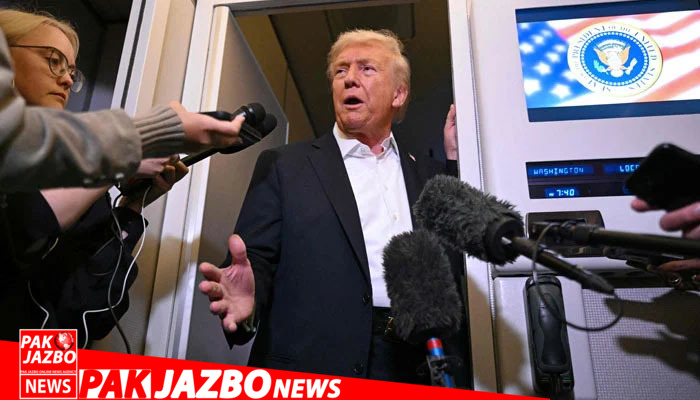
Washington: U.S. President Donald Trump has said that bringing an end to the ongoing conflict between Pakistan and Afghanistan would be “very easy” for him, expressing confidence in his ability to mediate and de-escalate regional tensions.
Speaking to reporters at the Oval Office, President Trump said he preferred making peace rather than waging wars. “I like to stop wars,” he remarked, adding that he was fully aware of the recent border tensions between Pakistan and Afghanistan. “I know what’s happening between Pakistan and Afghanistan — and ending that war would be very easy for me,” Trump declared confidently.
The U.S. president’s comments come amid heightened tensions along the Pakistan–Afghanistan border, where recent clashes and targeted strikes have led to multiple casualties. Trump’s statement appeared to signal a willingness to play a mediating role, though he did not elaborate on any specific plan or diplomatic initiative.
During the conversation, President Trump also revisited his earlier claim about mediating peace between Pakistan and India. He said that Prime Minister Shehbaz Sharif had personally acknowledged his efforts in helping avert war between the two nuclear-armed neighbors. “Prime Minister Shehbaz told me that by stopping the Pakistan–India war, I saved hundreds of thousands of lives,” Trump said, reiterating his belief that dialogue and restraint are the only sustainable paths to regional peace.
His comments align with his long-standing narrative that emphasizes personal diplomacy and direct engagement with world leaders. However, analysts note that despite such claims, Washington has not yet played an official mediating role in South Asian conflicts since Trump’s earlier tenure.
The renewed discussion about Pakistan–Afghanistan tensions follows recent events in which Pakistan carried out targeted operations inside Afghan territory, striking what it described as militant hideouts belonging to the Taliban and Kharijite (extremist) factions. According to reports, dozens were killed in these precision strikes, prompting strong reactions from the interim Taliban government in Kabul.
In response to the escalation, both sides agreed — reportedly at the Taliban leadership’s request — to observe a temporary ceasefire starting at 6 p.m., lasting for 48 hours. The ceasefire was aimed at allowing humanitarian access and preventing further loss of life while negotiations continued.
Sources in Islamabad and Kabul have since confirmed that the initial 48-hour truce has now been extended by mutual consent, raising hopes for a longer-term de-escalation. Officials familiar with the talks say that both governments have agreed to maintain communication through backchannel diplomacy to avoid further confrontation.
President Trump’s statement, while made informally, has added a new dimension to the ongoing situation. By suggesting that resolving the Pakistan–Afghanistan border conflict would be “easy,” he implied that the United States still retains significant diplomatic leverage in South Asia — though observers caution that the regional dynamics are far more complex than Trump’s remarks suggest.
Security experts argue that the Pakistan–Afghanistan dispute is deeply rooted in cross-border militancy, historical mistrust, and the Taliban regime’s struggle to assert full control over its territory. Pakistan maintains that armed proxies based in Afghanistan have repeatedly launched attacks across the border, while the Taliban accuse Pakistan of violating Afghan sovereignty through military incursions.