Peshawar, October 15, 2025 — Suhail Afridi, the newly elected Chief Minister of Khyber Pakhtunkhwa (KP), formally took the oath of office during a ceremony held at the Governor House in Peshawar, marking the beginning of a new political chapter for the province under his leadership.
The oath was administered by Governor Faisal Karim Kundi, in the presence of senior political figures, bureaucrats, and members of the Pakistan Tehreek-e-Insaf (PTI). The ceremony was attended by Speaker and Deputy Speaker of the Provincial Assembly, former Governor Shah Farman, PTI’s provincial president Junaid Akbar, PTI Secretary General Salman Akram Raja, Chief Secretary Shahab Ali Shah, Inspector General of Police Zulfiqar Hameed, Commissioner Peshawar, and several provincial secretaries and lawmakers.
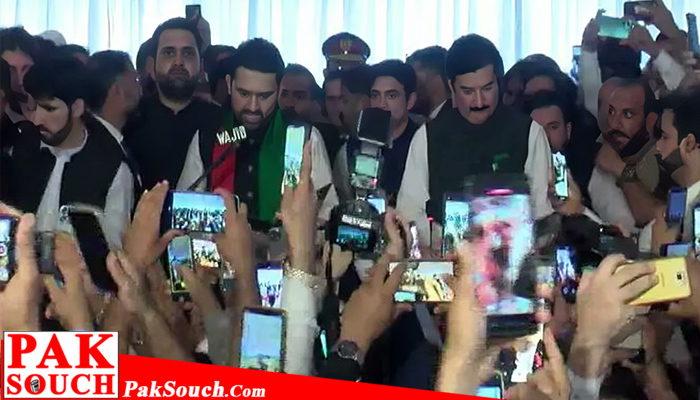
The atmosphere at the event was festive yet slightly chaotic as a large number of PTI supporters gathered outside the venue to celebrate their party’s return to power in the province. In a brief but noticeable moment, Governor Faisal Karim Kundi narrowly avoided falling down the steps due to a push from the crowd as he arrived for the ceremony, while Suhail Afridi himself was also jostled by enthusiastic supporters inside the compound.
Suhail Afridi, who rose from being a grassroots party worker to the province’s top executive, took the oath pledging to uphold the Constitution, serve the people of Khyber Pakhtunkhwa with integrity, and continue the reform agenda initiated under PTI’s earlier administrations.
According to PTI insiders, Imran Khan, the party’s founding leader, has given Afridi complete authority to form his cabinet. Afridi is expected to select members from among elected representatives and senior PTI ticket-holders, balancing loyalty, performance, and regional representation. The cabinet lineup is anticipated to be announced within the next few days.
Observers say Suhail Afridi’s elevation to the chief ministership reflects PTI’s strategy to empower a new generation of leaders in the province, as he is considered close to the party’s grassroots and has a reputation for organizational discipline and strong ties with local communities.
In his post-oath remarks, Afridi reaffirmed his commitment to good governance, transparency, and service delivery, vowing to prioritize issues such as education, healthcare, law and order, and economic revitalization. He also emphasized unity within the provincial assembly and cooperation with federal authorities for the province’s development.
Afridi’s leadership comes at a time when Khyber Pakhtunkhwa faces mounting challenges, including security concerns in border districts, unemployment, and post-flood rehabilitation needs. Political analysts suggest that Afridi’s ability to maintain cohesion within PTI ranks and navigate the province’s complex governance environment will define the success of his tenure.