


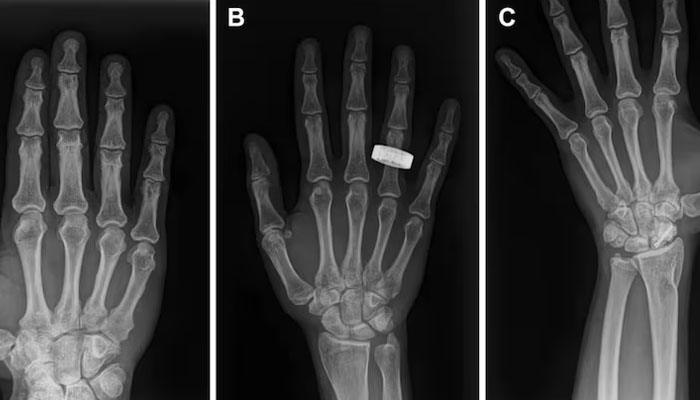
WASHINGTON: Astronauts have successfully captured X-ray images in space, including scans of their own hands and other body parts, marking a significant milestone in space medicine and diagnostic technology.
The achievement was detailed in a study published in the peer-reviewed journal Radiology, where researchers announced that X-ray images had been successfully acquired aboard a commercial spaceflight for the first time.
The breakthrough took place during SpaceX’s Fram2 mission, a privately funded polar-orbit mission launched in 2025. The spacecraft spent approximately three and a half days in orbit, providing researchers with an opportunity to test portable medical imaging technology in a microgravity environment.
According to the study, the astronauts used a commercial off-the-shelf portable digital X-ray generator along with a flat-panel detector to obtain diagnostic-quality images.
The crew successfully produced X-ray images of various parts of the human body, including the hands, arms, chest, abdomen, and hips. Researchers also conducted imaging of equipment aboard the spacecraft to assess the technology’s broader applications.
One of the most remarkable aspects of the experiment was that the Fram2 crew received only four hours of training before the mission. Despite the limited preparation, they were able to operate the portable imaging system successfully and obtain high-quality diagnostic images while in orbit.
A Long-Standing Goal for Space Medicine
Dr. Sheyna Gifford, Assistant Professor of Aerospace Medicine at the Mayo Clinic and the study’s lead researcher, described the achievement as a major step forward for healthcare during future space missions.
She explained that the ability to perform multiple types of medical imaging in space has long been one of the key objectives of aerospace medicine.
“For many years, it has been a dream of aerospace medicine to have multiple imaging modalities available for diagnosing illnesses and injuries in space,” Dr. Gifford said.
She noted that conventional X-ray systems used in hospitals are typically large, heavy, and energy-intensive, making them impractical for spacecraft. In addition, even slight patient movement can affect image quality when using traditional systems.
The new portable X-ray device overcomes many of these limitations. Researchers said it is lightweight, energy-efficient, fast, and capable of functioning effectively in microgravity, making it well suited for use during space missions.
Importance for Future Deep-Space Missions
The successful demonstration has important implications for future missions to the Moon, Mars, and beyond, where astronauts may need immediate medical diagnosis without access to Earth-based hospitals.
In deep-space missions, communication delays with Earth can make real-time medical consultation difficult. Having onboard diagnostic tools such as portable X-ray systems could enable astronauts to assess fractures, chest injuries, internal conditions, and equipment damage more quickly and accurately.
Dr. Gifford said the successful acquisition of the first X-ray images of humans and equipment in space demonstrates the feasibility of expanding radiographic and diagnostic capabilities in orbit.
According to the researchers, the technology could support not only astronaut healthcare but also scientific research and routine inspection of spacecraft hardware.
The findings represent an important advance in space medicine, highlighting how compact diagnostic equipment can improve medical preparedness during long-duration missions. As human space exploration expands, portable imaging systems like the one tested aboard the Fram2 mission are expected to become valuable tools for protecting astronaut health and ensuring mission safety.
About The Author