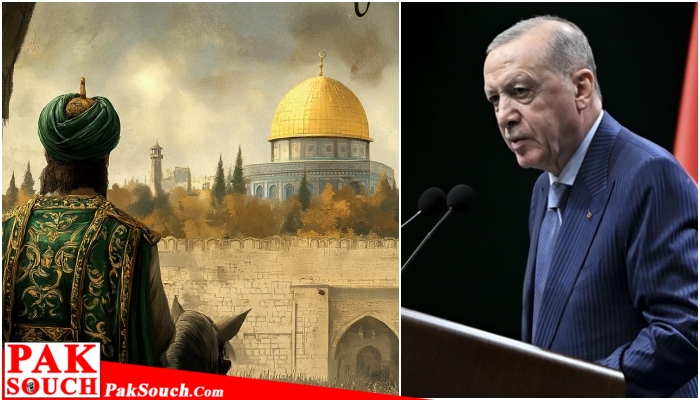
Ankara / Jerusalem — On the 838th anniversary of the recapture of Jerusalem by the legendary Muslim commander Salahuddin Ayyubi in 1187, Turkish President Recep Tayyip Erdogan issued a powerful message reaffirming his country’s enduring commitment to the holy city. In a statement released on social media, Erdogan paid tribute to Salahuddin and his soldiers, describing them as “heroes who restored dignity to Jerusalem” and vowing that Turkey would continue to fight for the city with “determination and steadfastness.”
Remembering Salahuddin Ayyubi’s Legacy
Erdogan’s remarks were timed to coincide with the annual commemoration of Salahuddin Ayyubi’s liberation of Jerusalem from Crusader rule on October 2, 1187. The recapture, achieved after the famous Battle of Hattin, marked a turning point in medieval history and remains an enduring symbol of Muslim resistance and unity.
“On this anniversary,” Erdogan said, “we honor Salahuddin and his courageous soldiers, whose sacrifice reminds us that Jerusalem is a sacred trust — entrusted to us by Prophet Muhammad (peace be upon him) and the prophets before him.”
The Turkish leader’s invocation of Salahuddin is particularly significant, as the Kurdish-born general is revered across the Muslim world for his piety, justice, and military genius. By recalling his legacy, Erdogan sought to highlight the deep historical roots of the Muslim claim to Jerusalem and underscore Turkey’s self-proclaimed role as a protector of the Palestinian cause.
Jerusalem’s Historical Crossroads
Jerusalem is one of the oldest continuously inhabited cities in the world and holds central importance for all three Abrahamic faiths — Islam, Christianity, and Judaism.
- In 638 CE, the city was peacefully captured by the second caliph, Umar ibn al-Khattab, marking the first Muslim rule over the city.
- In 1099, Crusaders seized Jerusalem in a brutal conquest, massacring tens of thousands of Muslim and Jewish inhabitants.
- On October 2, 1187, Salahuddin Ayyubi retook the city, restoring Muslim governance and allowing Christian pilgrims access to holy sites — a gesture of tolerance that earned him respect even among his foes.
- From that period until 1917, except for a brief interval, Jerusalem remained under Muslim rule, first by the Ayyubids, then the Mamluks, and later the Ottomans.
It was only on December 9, 1917, amid World War I, that British forces captured the city from the Ottoman Empire. At the time, Palestine’s Jewish population was around 60,000. But by 1948, at the creation of Israel, that figure had surged to approximately 800,000, fueled by waves of migration.
The Road to Occupation
Israel’s founding on May 14, 1948 immediately triggered a war with neighboring Arab states — Egypt, Jordan, Lebanon, and Syria. Although the Arabs fought to reclaim Palestinian land, Israel emerged victorious, gradually implementing plans to seize control over Jerusalem.
- 1948: West Jerusalem fell under Israeli control, while East Jerusalem, including the Old City and the Al-Aqsa Mosque, remained under Jordanian rule.
- 1967: During the Six-Day War, Israel captured East Jerusalem and the West Bank, effectively unifying the city under its control.
- 1980: Israel declared Jerusalem its “eternal and undivided capital,” a move condemned internationally and rejected by the United Nations.
The U.S. under President Donald Trump further deepened the controversy on December 6, 2017, by recognizing Jerusalem as Israel’s capital. On May 14, 2018, the U.S. embassy was moved from Tel Aviv to Jerusalem, a step celebrated in Israel but widely criticized by Palestinians and the international community.
Erdogan’s Message in Modern Context
Erdogan’s declaration that Turkey will continue to struggle for Jerusalem reflects both political and religious dimensions of Turkish foreign policy. For years, Erdogan has positioned himself as a vocal defender of Palestinian rights, often clashing with Israel over its treatment of Palestinians and its policies in East Jerusalem.
By linking the present struggle to Salahuddin’s historical victory, Erdogan seeks to inspire a sense of continuity between past and present, casting today’s geopolitical battle as part of a centuries-long defense of Islamic sanctities.
His statement also serves to rally domestic support in Turkey, where the Palestinian cause remains a deeply emotional issue for many citizens. Erdogan’s Justice and Development Party (AKP) has long leveraged this sentiment to strengthen its legitimacy among conservative and religious constituencies.
A Symbol of Muslim Unity
Salahuddin’s liberation of Jerusalem is often remembered not only as a military achievement but also as a symbol of Muslim unity. Historians note that Salahuddin consolidated fractured Muslim territories under his command before confronting the Crusaders — a lesson that resonates in today’s fragmented Middle East.
Erdogan, by invoking this legacy, appears to be calling for a similar unity in the Muslim world, especially at a time when regional divisions have often hindered a collective response to Israel’s actions.
Jerusalem Today
Today, Jerusalem remains one of the world’s most contested cities. Israel controls both East and West Jerusalem, while Palestinians continue to demand East Jerusalem as the capital of a future independent state. International law does not recognize Israel’s annexation, and most countries maintain their embassies in Tel Aviv.
Tensions around the city frequently erupt into violence, particularly around the Al-Aqsa Mosque compound, known to Muslims as Haram al-Sharif and to Jews as the Temple Mount. Each flare-up deepens mistrust and reinforces the city’s status as a flashpoint in the broader Israeli-Palestinian conflict.
Conclusion
President Erdogan’s statement on the 838th anniversary of Salahuddin’s victory over the Crusaders is more than a symbolic tribute; it is a pointed reminder of Turkey’s claim to moral leadership in the Muslim world. By pledging to continue the struggle for Jerusalem, Erdogan seeks to keep the Palestinian cause at the forefront of global attention, linking the historical memory of Salahuddin’s triumph with the modern struggle against occupation.
For Palestinians, Jerusalem remains both a city of faith and a symbol of resistance. For Turkey, it represents an enduring responsibility, framed by history, religion, and geopolitics. And for the international community, it remains one of the most complex and unresolved issues of our time — a city where the past, present, and future collide.