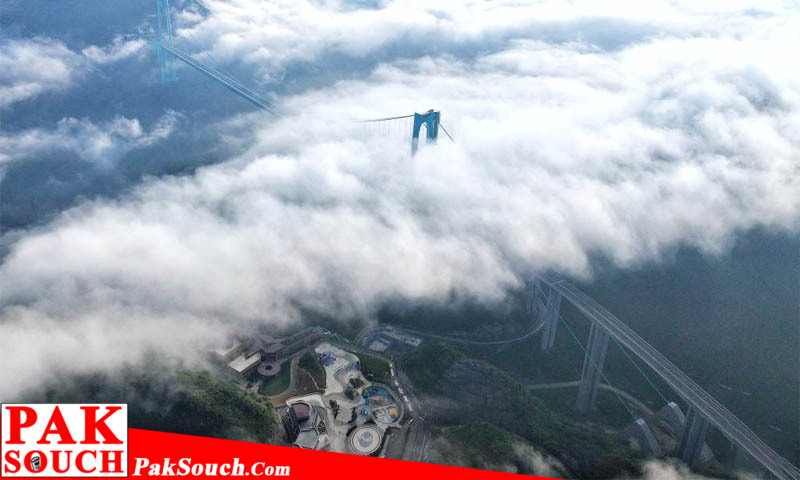
Guizhou, China — September 2025
China has added another record to its rapidly growing infrastructure portfolio with the official opening of the Huajiang Grand Canyon Bridge, the world’s tallest bridge, in the country’s mountainous southwestern Guizhou province. Towering 625 meters (around 2,050 feet) above the Beipan River, the engineering marvel has been hailed as both a technological triumph and a transformative addition to China’s transport network.
What once took two hours of treacherous driving across winding mountain roads can now be accomplished in just two minutes. The bridge, inaugurated on Sunday morning, is expected to redefine connectivity in the region while standing as a symbol of modern Chinese engineering.
A Marvel of Height and Span
The Huajiang Grand Canyon Bridge is not only the tallest bridge on Earth, but with a main span of 1,420 meters, it also ranks as the longest steel-truss girder suspension bridge ever built in a mountainous region. With a total length of 2,890 meters, the structure dwarfs even some of the most iconic bridges in the world. To put its scale into perspective, it is nine times taller than the Golden Gate Bridge in San Francisco.
The bridge stretches across the Huajiang Grand Canyon, ominously known as the “Earth’s Crack” for its depth and hazardous terrain. For decades, the canyon had posed one of the greatest natural challenges to road connectivity in southwestern China. Now, thanks to the bridge, the once-isolated regions on either side of the canyon are seamlessly linked.
Replacing Another Record Holder
Ironically, the previous holder of the “world’s tallest bridge” title also stands over the Beipan River, just 100 kilometers away. That bridge, completed in 2016, reached a height of 565.4 meters. The Huajiang Grand Canyon Bridge surpasses it by nearly 60 meters, underlining China’s relentless pursuit of infrastructure records.
Guizhou: The Land of Bridges
Guizhou, historically one of China’s less-developed provinces, has become the epicenter of the nation’s bridge-building boom. Over the past few decades, more than 30,000 bridges have been constructed across its rugged landscapes, dramatically altering its connectivity and economic potential. Astonishingly, about half of the world’s top 100 tallest bridges are located in Guizhou alone, highlighting the province’s unique geography and China’s resolve to conquer it through advanced engineering.
Economic and Social Impact
The opening of the Huajiang Bridge is expected to bring significant benefits beyond its engineering prestige. Local officials emphasized that reducing travel times will promote trade, tourism, and cultural exchange between previously remote areas. For local communities, what was once a grueling and risky journey is now a quick and safe commute.
Tourism authorities anticipate that the bridge itself will become a global attraction, drawing visitors eager to experience the thrill of crossing one of the world’s most spectacular man-made structures. Photographers and travelers are expected to flock to the region, adding new sources of income to the local economy.
Engineering Excellence and Safety
The bridge incorporates state-of-the-art safety and monitoring systems, including wind-resistant structures, seismic protection, and real-time traffic sensors. Engineers involved in the project explained that building at such extraordinary heights required unprecedented innovation, from transporting materials across the canyon to ensuring worker safety during construction.
Chinese officials highlighted the project as an example of the nation’s ability to overcome natural barriers through determination and advanced technology. They also stressed its role in achieving the government’s long-term goal of bringing economic balance between urban centers and historically underdeveloped provinces.
Part of a Bigger Picture
The Huajiang Grand Canyon Bridge is a prominent piece in China’s vast and ongoing infrastructure push. The country has been aggressively investing in highways, railways, and bridges to knit together its enormous and geographically diverse landscape. These projects not only support domestic mobility but also enhance China’s international reputation as a leader in mega-infrastructure development.
Looking Forward
While the bridge already stands as a monumental achievement, experts suggest its significance will be measured over time by its impact on the lives of ordinary people. By transforming an arduous two-hour journey into a mere two-minute drive, the Huajiang Grand Canyon Bridge demonstrates how modern infrastructure can fundamentally reshape both geography and society.
With this opening, China has not only raised the bar for global engineering but also set a new standard for how infrastructure can fuel development, connectivity, and pride. The Huajiang Grand Canyon Bridge is destined to be remembered as more than just the world’s tallest bridge—it is a towering symbol of progress, ambition, and the power of human ingenuity to conquer nature’s most formidable challenges.