

Pakistan’s Deputy Prime Minister and Foreign Minister Ishaq Dar has said that militant organizations operating from Afghanistan continue to pose a serious threat to Pakistan’s national security, while calling for stronger international cooperation to combat terrorism and promote regional stability.
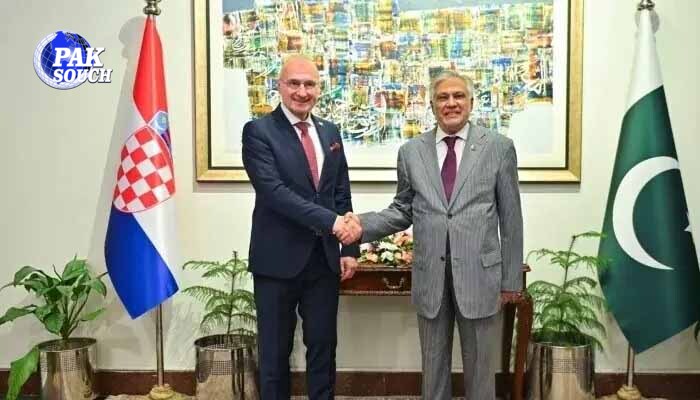
Speaking at a joint press conference in Islamabad alongside Croatian Foreign Minister Gordan Grlić Radman, Dar emphasized the need for coordinated global efforts against terrorism and urged that no country’s territory be allowed to serve as a base for attacks against another state.
Welcoming the Croatian foreign minister and his delegation to Pakistan, Dar described the visit as an important milestone in strengthening bilateral relations between the two countries.
“I warmly welcome the Foreign Minister of Croatia and his delegation to Pakistan. This visit represents an important step in enhancing our bilateral relationship,” Dar said.
He noted that Pakistan and Croatia enjoy longstanding ties based on goodwill, mutual trust, and cooperation, adding that there is considerable potential to expand collaboration in trade, investment, and other sectors.
Dar encouraged Croatian businesses to take advantage of Pakistan’s investment-friendly policies, saying the country offers significant opportunities for foreign investors in various areas of the economy.
Turning to regional security, the deputy prime minister said the international community must intensify collective efforts to eliminate terrorism.
He stated that terrorist organizations based in Afghanistan continue to threaten Pakistan’s security and stressed that Afghan territory should not be used for activities against Pakistan or any other country.
“The international community must strengthen joint efforts against terrorism. Terrorist groups present in Afghanistan remain a continuous threat to Pakistan’s security, and Afghan territory should not be allowed to be used against any country, particularly Pakistan,” Dar said.
Pakistan has repeatedly expressed concerns over cross-border militancy and has urged the Afghan authorities to prevent armed groups from operating from Afghan soil. Afghan officials have previously rejected such allegations, maintaining that they do not allow their territory to be used for attacks against neighboring countries.
During the press conference, Dar also criticized India’s unilateral suspension of the Indus Waters Treaty, describing the move as a violation of international law and treaty obligations.
He said using water as a political or strategic tool is contrary to internationally accepted legal principles and undermines commitments made under bilateral agreements.
“India’s unilateral suspension of the Indus Waters Treaty and the use of water as a weapon violate international law and established treaty obligations,” he said.
The Indus Waters Treaty, signed in 1960 with the mediation of the World Bank, governs the sharing of water resources between Pakistan and India and has remained one of the few enduring agreements between the two neighboring countries despite periods of political and military tension.
Dar also referred to the Islamabad Memorandum of Understanding, describing it as an important development for promoting peace and stability in the region.
Although he did not elaborate on specific provisions of the memorandum during the press conference, he said it represents meaningful diplomatic progress toward reducing regional tensions and encouraging dialogue.
Croatian Foreign Minister Gordan Grlić Radman welcomed the opportunity to visit Pakistan and expressed optimism about expanding cooperation between the two countries.
He said his visit would help further strengthen bilateral relations and deepen collaboration in areas of mutual interest.
“My visit to Pakistan will play an important role in strengthening our bilateral relations. The relationship between Pakistan and Croatia is built on mutual respect and trust,” the Croatian foreign minister said.
Both sides reaffirmed their commitment to enhancing political dialogue, increasing economic cooperation, and exploring new opportunities in trade, education, tourism, and cultural exchanges.
The meeting also reflected broader efforts by Pakistan to strengthen diplomatic engagement with European countries while promoting investment and expanding international partnerships.
Pakistan and Croatia established diplomatic relations in 1994 and have maintained friendly ties through regular diplomatic contacts and cooperation in international forums.
Officials from both countries expressed confidence that continued high-level exchanges would contribute to stronger bilateral cooperation and open new avenues for collaboration in the future.
The discussions took place against the backdrop of evolving regional security challenges and ongoing diplomatic initiatives aimed at promoting stability in South Asia and beyond.
While Pakistan continues to raise concerns about cross-border militancy and regional security, it has also emphasized the importance of dialogue, international cooperation, and adherence to international agreements as key elements in addressing shared challenges.
The statements made during the joint press conference reflect Pakistan’s official position on regional security, terrorism, water-sharing issues, and bilateral relations with Croatia. The comments regarding militant groups in Afghanistan and the Indus Waters Treaty represent the government’s stated views on these matters.
About The Author