


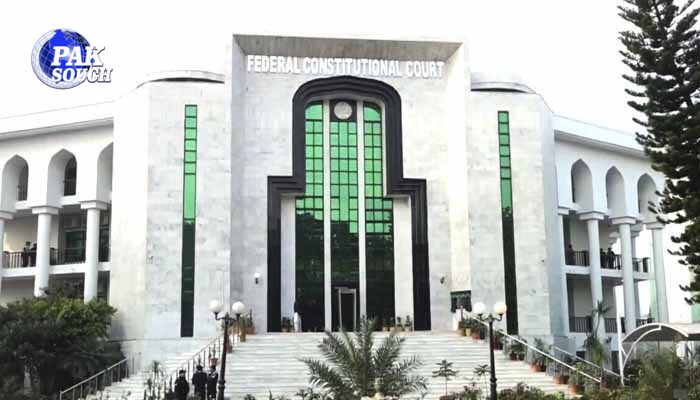
Islamabad: The Federal Constitutional Court has ruled that the Registrar’s Office does not have the authority to declare constitutional petitions non-maintainable or return them on that basis, emphasizing that only the court itself can determine whether a petition is admissible for hearing.
The decision came in a chamber appeal filed against objections raised by the Registrar’s Office. Justice Hassan Azhar Rizvi issued a detailed six-page judgment, setting out the limits of the Registrar’s administrative powers and reaffirming the exclusive judicial authority of the court in deciding the maintainability of constitutional petitions.
According to the judgment, the Registrar’s Office is restricted to examining petitions for administrative or procedural compliance. It cannot decide legal questions or make judicial determinations regarding whether a petition is competent, maintainable, or deserves to be heard. Such issues fall exclusively within the jurisdiction of the constitutional court.
The court observed that the power to assess the maintainability of a petition is a judicial function that cannot be delegated to an administrative office. It stressed that the Registrar’s role is limited to ensuring that petitions comply with the procedural rules governing court filings. If a petition is found to be in violation of prescribed rules or filing requirements, the Registrar’s Office may return it for rectification. However, it has no authority to reject a petition on substantive legal grounds.
Justice Hassan Azhar Rizvi noted that allowing an administrative officer to exercise judicial powers would violate the constitutional principle of separation of powers. The judgment highlighted that judicial authority rests solely with judges, while administrative officers are responsible only for facilitating court procedures and maintaining the proper functioning of the judicial system.
The court further ruled that the Registrar’s Office cannot declare a constitutional petition to be frivolous, non-serious, or legally incompetent. Such conclusions require judicial examination and can only be reached by the court after considering the relevant facts, legal arguments, and applicable constitutional provisions.
The judgment reinforces an important constitutional safeguard by ensuring that litigants are not deprived of access to justice through administrative decisions. It clarifies that individuals filing constitutional petitions have the right to have questions regarding the admissibility of their petitions decided by judges rather than court officials.
The case arose after the Registrar’s Office returned a constitutional petition filed by Razia Aslam on February 14, raising an objection that the petition was not maintainable. Challenging this action, the petitioner filed a chamber appeal against the Registrar’s objections, arguing that the office had exceeded its legal authority.
After hearing the matter, the Federal Constitutional Court agreed with the petitioner’s position and held that the Registrar’s Office had acted beyond its jurisdiction by making a determination that only the court was empowered to make.
The ruling is expected to serve as an important precedent for future constitutional litigation, clearly defining the respective roles of the Registrar’s Office and the judiciary. Legal experts believe the judgment will prevent administrative overreach and ensure that constitutional petitions are assessed on their legal merits by judges rather than being screened out through administrative decisions.
The court’s interpretation also strengthens the constitutional principle of due process by guaranteeing that litigants receive a judicial hearing whenever questions arise regarding the maintainability of their petitions. It underscores that administrative scrutiny should be confined to procedural matters, such as compliance with filing rules, documentation requirements, and other technical formalities.
By drawing a clear distinction between administrative and judicial functions, the Federal Constitutional Court has reaffirmed that decisions affecting fundamental legal rights must remain within the exclusive domain of the judiciary. The judgment is likely to influence future court practices by ensuring that the Registrar’s Office operates strictly within its administrative mandate while leaving all questions of law and constitutional interpretation to the court itself.
About The Author