


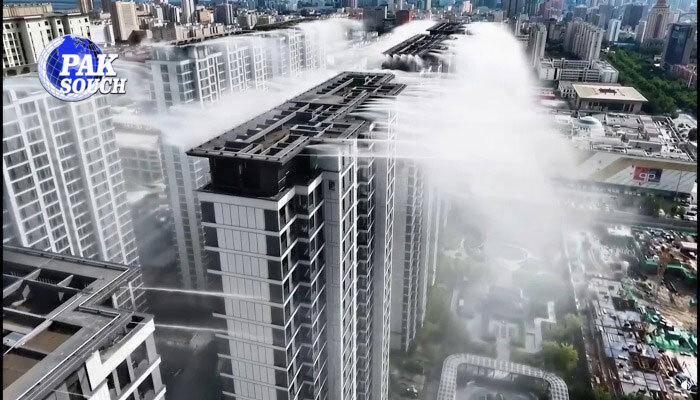
YUNCHENG, China: As countries around the world continue to rely heavily on air conditioners to combat rising summer temperatures, China is experimenting with innovative cooling technologies that consume significantly less energy. One such system, recently showcased in Yuncheng City in Shanxi Province, has attracted widespread attention after videos of an apartment building appearing to produce “artificial rain” went viral online.
According to Chinese media reports, residents of a high-rise apartment complex in Yuncheng are benefiting from a sensor-controlled misting system installed on the building’s rooftop. Instead of conventional air conditioning, the system releases a fine spray of water through specially designed nozzles, creating an effect that resembles light rainfall.
The mist falls around the building and quickly evaporates, helping reduce the surrounding air temperature as well as the temperature of nearby surfaces. Reports indicate that the system can lower the ambient temperature by approximately 5 to 8 degrees Celsius within a matter of minutes under suitable weather conditions.
The technology operates on the well-established scientific principle of evaporative cooling. Tiny droplets of water are dispersed into the air, where they absorb heat from the surrounding environment as they evaporate. This process removes thermal energy from the air, creating a cooling effect.
Scientists often compare evaporative cooling to the way the human body regulates temperature. When sweat evaporates from the skin, it absorbs heat and cools the body. The rooftop misting system applies the same principle on a larger scale to cool outdoor spaces around residential buildings.
According to reports, the system has been specifically designed to operate during periods of intense heat. High temperatures allow the water droplets to evaporate rapidly, making the cooling process more effective. Sensors reportedly monitor weather conditions and activate the misting system when temperatures reach predetermined levels.
Unlike traditional air conditioning systems, which consume large amounts of electricity to cool indoor spaces, mist-based cooling systems require comparatively less energy. As a result, they are viewed as a more energy-efficient option for reducing outdoor temperatures in densely populated urban environments.
The system does not replace indoor air conditioning in every situation but helps lower the temperature around the building, reducing heat buildup and improving comfort for residents in outdoor areas such as entrances, courtyards, and walkways.
Chinese cities have increasingly explored environmentally friendly technologies to address the challenges posed by rising temperatures, urban heat islands, and growing electricity demand during the summer months.
According to Chinese media, similar misting systems have already been installed in public parks, plazas, bus stops, and other outdoor public spaces across different parts of the country. These installations are intended to provide relief for pedestrians and visitors during periods of extreme heat.
Urban planners and environmental experts note that evaporative cooling systems can be particularly effective in hot and relatively dry conditions, although their performance may be less pronounced in areas with high humidity, where water evaporates more slowly.
As climate change contributes to more frequent and intense heatwaves worldwide, many countries are exploring innovative cooling solutions that reduce electricity consumption while improving public comfort. Technologies such as rooftop misting systems, reflective building materials, green roofs, and shaded public spaces are increasingly being incorporated into urban planning strategies.
The rooftop misting project in Yuncheng highlights China’s efforts to develop practical and energy-efficient methods of coping with extreme summer temperatures. While conventional air conditioners remain essential for indoor cooling, technologies based on evaporative cooling may offer an effective supplementary solution for reducing heat in outdoor urban environments while lowering overall energy consumption.
About The Author