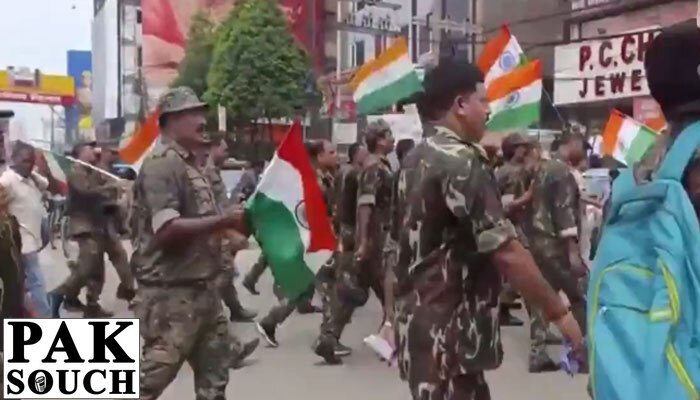
A new wave of dissent has erupted within India’s armed forces as soldiers have taken to the streets to protest against what they describe as the government’s failure to meet their essential needs and provide promised benefits. The rare public demonstration by serving personnel has sparked widespread attention and could potentially escalate into a larger crisis for the Modi government if not addressed swiftly.
According to Indian media reports, the protests began in the state of Bihar, where army personnel in several cities—including the capital Patna—staged demonstrations demanding the fulfillment of basic requirements and better welfare provisions. The soldiers alleged that repeated appeals to both the state government of Bihar and the central government in New Delhi had fallen on deaf ears, leaving them with no choice but to voice their grievances publicly.
Soldiers’ Grievances
The protesting soldiers have complained of a lack of adequate facilities, insufficient allowances, and neglect of long-standing welfare demands. They argued that despite their commitment to national security and the difficult conditions under which they serve, the government has failed to ensure they are properly looked after.
One soldier, speaking during the Patna protest, was quoted as saying, “We have written applications and raised our concerns through official channels, but the government has shown no interest. When our pleas are ignored, we are left with no other option but to come out on the streets.”
The soldiers further warned that if their demands are not addressed immediately, they would extend their agitation beyond Bihar and organize protests across the country. This threat of a nationwide movement is being seen as an unprecedented challenge, considering the Indian Army’s traditional policy of discouraging public demonstrations by its personnel.
Rare Public Demonstration by Military Personnel
It is extremely unusual for Indian soldiers to take to the streets in protest. The armed forces generally maintain strict discipline, with grievances expected to be resolved internally through official channels. However, this episode highlights growing frustration within the ranks, where soldiers feel abandoned by the very government they serve.
Analysts point out that such public demonstrations risk setting a precedent that could undermine military discipline if not addressed quickly. At the same time, the situation underscores the seriousness of the soldiers’ concerns, which they believe have been neglected for too long.
Political Implications for the Modi Government
The timing of the protests could not be more sensitive for Prime Minister Narendra Modi’s government. With general elections looming in the near future and the opposition looking for opportunities to attack the ruling Bharatiya Janata Party (BJP), the image of disgruntled soldiers openly criticizing the government could prove politically damaging.
The opposition has already seized upon the issue, with several leaders questioning how the government can claim to champion national security while ignoring the welfare of those who serve on the frontlines. Critics argue that while the government has often highlighted its strong stance on defense and security in political campaigns, the reality on the ground reflects systemic neglect of soldiers’ welfare.
Voices from the Ground
Local media coverage of the protests in Patna showed soldiers chanting slogans and carrying placards demanding fair treatment. Many expressed disappointment that despite repeated assurances from both state and central authorities, tangible action had yet to be taken.
A soldier interviewed during the protest remarked, “We are not asking for luxuries. We are asking for basic facilities and fair allowances. The government talks of patriotism, but how can they expect us to serve wholeheartedly when our families back home struggle to survive?”
Escalation Threat and Security Concerns
The soldiers’ warning of expanding their protests nationwide has raised concerns among security experts. If demonstrations spread to other states, the issue could quickly snowball into a national controversy, potentially affecting morale within the armed forces and sparking wider public debate about how India treats its soldiers.
Security analysts caution that while soldiers’ demands may be legitimate, the government must act swiftly to prevent protests from becoming politicized or exploited by rival parties. A prolonged standoff could weaken the army’s cohesion and erode public confidence in the government’s ability to manage both defense and welfare simultaneously.
Government’s Possible Response
So far, there has been no official response from the Ministry of Defence or the Bihar state government. However, sources suggest that high-level discussions are underway to defuse tensions. Experts argue that the government may attempt to engage the protesting soldiers through backchannel negotiations, promising immediate relief or forming committees to address their concerns.
Yet, critics warn that temporary assurances will not be enough. Unless the government takes concrete action—such as increasing allowances, improving living conditions, and ensuring timely fulfillment of welfare benefits—the unrest may continue to grow.
Historical Context
This is not the first time Indian soldiers have expressed dissatisfaction. In recent years, there have been sporadic reports of discontent over pay, pensions, and living standards, particularly after the implementation of the Seventh Pay Commission. Veterans have also staged protests in the past, most notably under the “One Rank, One Pension” (OROP) movement. However, serving personnel rarely come out in public, making the current protests particularly noteworthy.
The fact that soldiers in uniform are willing to risk disciplinary action to make their voices heard suggests a deep level of frustration. Analysts argue that if left unresolved, this could have long-term implications for military morale and the government’s relationship with the armed forces.
Conclusion
The protests by Indian soldiers in Bihar mark a rare and troubling development in the country’s civil-military relations. What began as localized demonstrations over unmet needs and denied benefits now carries the potential to escalate into a nationwide crisis if the government fails to act.
For the Modi administration, the stakes are high: ignoring the soldiers’ grievances risks further unrest and political fallout, while addressing them requires significant investment and policy shifts. Ultimately, how the government responds will determine not only the future of these protests but also the broader trust between India’s armed forces and the state they serve.