

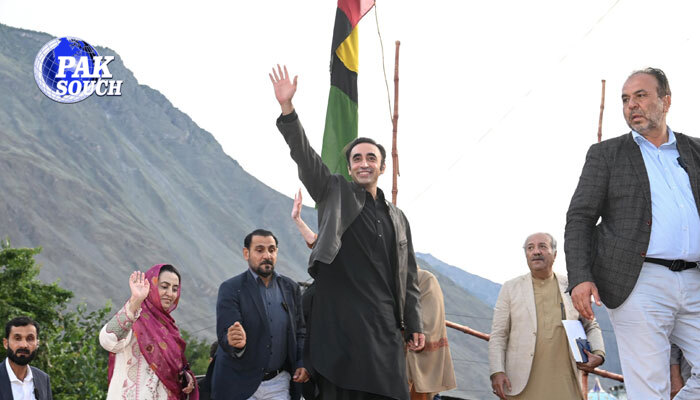
Gilgit: The Pakistan Peoples Party (PPP) has reportedly initiated contacts with the leadership of Pakistan Tehreek-e-Insaf (PTI) and Majlis Wahdat-e-Muslimeen (MWM) as efforts intensify to form the next government in Gilgit-Baltistan following the recently held assembly elections.
According to political sources, the PPP is exploring the possibility of forming a coalition with opposition parties at the federal level to secure a governing majority in the Gilgit-Baltistan Assembly.
Consultations Expected Within 24 Hours
Sources said discussions regarding government formation are expected to continue over the next 24 hours, during which opposition leaders will hold consultations and attempt to finalize a strategy for assembling the required numbers in the regional legislature.
The contacts are part of broader political negotiations taking place after no single party emerged with an overwhelming majority in the assembly.
Potential Opposition Bloc
According to sources, one MWM-backed candidate and two independent candidates supported by PTI have been elected to the Gilgit-Baltistan Assembly.
If these members align with the PPP, the opposition bloc could strengthen its position in the house. Sources further indicated that, after the allocation of reserved seats for women and technocrats, the opposition camp may have a total of five votes in addition to its directly elected members.
Political observers note that negotiations over reserved seats often play a crucial role in determining the final balance of power in regional assemblies.
Election Results So Far
Based on results announced for 22 of the 24 constituencies in the Gilgit-Baltistan Assembly, the party positions are as follows:
- Pakistan Peoples Party (PPP): 10 seats
- Pakistan Muslim League-Nawaz (PML-N): 5 seats
- Istehkam-e-Pakistan Party (IPP): 4 seats
(after four successful independent candidates joined the party) - Independent candidates: 2 seats
- Majlis Wahdat-e-Muslimeen (MWM): 1 seat
The remaining constituencies and reserved seats are expected to further shape the final composition of the assembly.
PML-N Opts for Opposition Benches
The government-formation process gained additional significance after Prime Minister Shehbaz Sharif publicly invited the PPP to form the government in Gilgit-Baltistan.
At the same time, the Pakistan Muslim League-Nawaz reportedly decided to sit in the opposition rather than pursue its own claim to form the regional government.
The move has opened the door for the PPP to lead coalition-building efforts and seek support from smaller parties and independent lawmakers.
Coalition Negotiations Underway
Political analysts believe that coalition discussions in the coming days will determine the future political landscape of Gilgit-Baltistan. With no party holding a dominant majority, alliances and agreements among various groups are expected to play a decisive role.
The PPP’s outreach to PTI-linked independents and MWM reflects an effort to broaden its support base and secure the numbers required to establish a stable government.
Focus on Governance and Stability
As political parties continue consultations, attention remains focused on the formation of a government capable of addressing development priorities, infrastructure needs, and administrative challenges in Gilgit-Baltistan.
The outcome of the negotiations is likely to become clearer once discussions among party leaders conclude and the allocation of reserved seats is finalized.
For now, the PPP appears to be at the center of government-formation efforts, with key decisions expected in the coming days as political stakeholders work toward building a majority in the Gilgit-Baltistan Assembly.
About The Author