

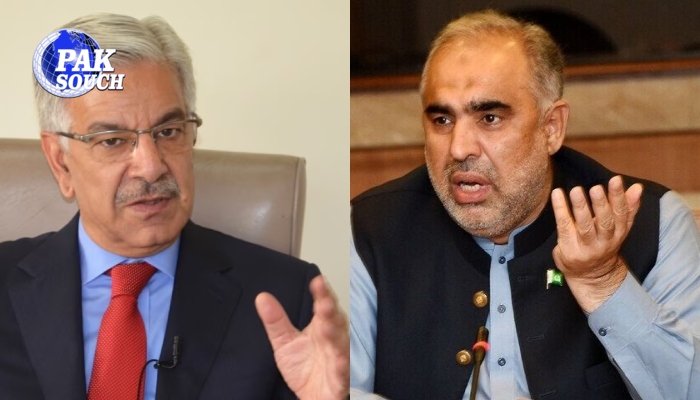
Islamabad: Former National Assembly Speaker Asad Qaiser has responded to Defence Minister Khawaja Asif’s remarks regarding meetings with intelligence officials, stating that ISI officers were providing input on legislation related to FATF during parliamentary discussions.
The exchange took place during a session of the National Assembly, where political leaders debated the role of various institutions in legislative processes and past parliamentary proceedings.
Asad Qaiser’s Clarification in Parliament
Speaking on the floor of the House, Asad Qaiser rejected the impression that any informal or inappropriate meetings were being held, and clarified that discussions were part of the legislative process concerning important financial and regulatory reforms.
He stated that ISI officials were present in connection with bills related to FATF (Financial Action Task Force) compliance and anti–money laundering laws, and were providing technical input on the legislation.
“Speaker’s House, Not My Personal Residence”
Responding to Khawaja Asif’s remarks about meetings being held at his residence, Asad Qaiser clarified that the venue in question was not his private home but the Speaker’s official residence, which is used for parliamentary and official engagements.
He emphasized that such meetings were part of institutional coordination during a critical period when Pakistan was working on FATF-related legislative requirements.
Role in Parliamentary Coordination
The former speaker said his role at the time was to facilitate coordination between the government and opposition parties to ensure smooth passage of FATF-related bills.
“I was only facilitating understanding between the government and the opposition on FATF legislation,” he said, adding that the objective was to meet international compliance obligations.
Reference to Intelligence Input
Asad Qaiser further stated that intelligence officials were involved in providing input on anti–money laundering and FATF-related laws, which required technical and security-related considerations.
He maintained that such engagement was part of the broader institutional process and should not be misinterpreted as anything beyond legislative consultation.
Political Exchange Continues
The remarks came in response to Khawaja Asif’s earlier statement, and reflect ongoing political exchanges between ruling and opposition parties over past parliamentary decisions and institutional interactions.
The discussion highlights continued debate over the role of state institutions in legislative processes, particularly during Pakistan’s efforts to comply with FATF requirements.
Conclusion
Asad Qaiser’s clarification in the National Assembly seeks to frame past meetings as part of formal legislative coordination on critical financial legislation. The exchange underscores persistent political اختلافات over the nature and context of institutional engagement during the FATF reform process.
About The Author