

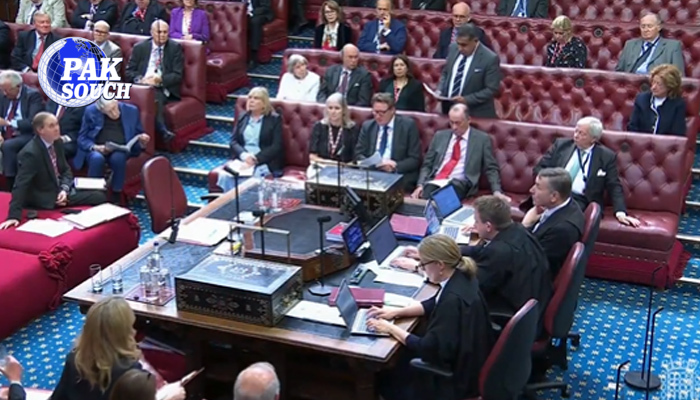
London: Pakistan’s diplomatic role in facilitating a reported ceasefire understanding between the United States and Iran received public appreciation in the British Parliament, where members of the House of Lords praised Islamabad’s contribution to easing tensions between the two countries.
During a parliamentary discussion, several lawmakers highlighted Pakistan’s efforts in encouraging dialogue and supporting diplomatic channels at a time of heightened regional uncertainty. The remarks reflected growing international acknowledgment of backchannel diplomacy and third-party mediation in complex geopolitical disputes.
Praise Raised in the House of Lords
Lord Ahmad, speaking in the upper house, said he was confident that members of Parliament, including government ministers, would recognize the significance of Pakistan’s involvement in facilitating communication between Washington and Tehran.
He noted that Pakistan’s role demonstrated how constructive diplomatic engagement can help reduce tensions between major international actors. According to him, such contributions are important in preventing escalation and encouraging peaceful resolution of disputes.
His remarks suggested that Pakistan’s efforts had not gone unnoticed within British political circles, particularly among lawmakers closely following developments in the Middle East.
Appreciation from Other Members
Baroness Chapman also expressed gratitude toward Pakistan, stating that Islamabad played a meaningful role in helping bring the United States and Iran closer to a position where dialogue and understanding became possible.
She emphasized the importance of diplomatic efforts that prioritize de-escalation, especially in regions where tensions can quickly escalate into wider conflict. Her comments were seen as a recognition of Pakistan’s attempts to support stability through engagement rather than confrontation.
Another member, Lord Barber, went further and called on the British government to formally acknowledge Pakistan’s contribution. He urged Prime Minister Keir Starmer to extend congratulations to Pakistani Prime Minister Shehbaz Sharif for what he described as a significant diplomatic achievement.
Lord Barber also praised Pakistan’s continued commitment to long-term peace efforts, noting that sustained diplomacy is essential for maintaining stability in regions affected by persistent geopolitical tensions.
Pakistan’s Mediation Role Highlighted
The discussion in the House of Lords reflects increasing attention in international forums toward Pakistan’s role as a potential facilitator in global diplomatic efforts. While detailed official confirmation of mediation specifics remains limited, Pakistan has been repeatedly referenced in political and media narratives as playing a constructive role in encouraging dialogue between the United States and Iran.
Supporters of such engagement argue that countries with balanced relationships across different blocs can serve as effective intermediaries during periods of crisis, helping bridge communication gaps when direct negotiations become difficult.
Pakistan, in particular, has historically maintained diplomatic relations with both Western countries and regional powers, positioning it as a potential channel for indirect communication in sensitive situations.
Significance of Third-Party Diplomacy
Foreign policy analysts often emphasize that third-party mediation can play a crucial role in reducing tensions between rival states. When direct diplomatic channels are strained or inactive, neutral intermediaries can help facilitate discussions, reduce misunderstandings, and create space for negotiation.
In this context, the references made in the British Parliament highlight the broader importance of diplomatic engagement by regional actors in preventing escalation between major powers.
If accurate, Pakistan’s involvement in supporting dialogue between the United States and Iran would represent an example of such intermediary diplomacy, aimed at reducing the risk of conflict in a strategically sensitive region.
Broader International Attention
The remarks in London add to a series of international reactions that have highlighted Pakistan’s reported diplomatic engagement. While official details of the US–Iran ceasefire process remain limited and subject to interpretation, the recognition in the UK Parliament signals that the development has drawn attention beyond the immediate parties involved.
Lawmakers stressed the importance of continued international cooperation and dialogue, particularly in addressing conflicts that carry global implications, including energy security, trade routes, and regional stability in the Middle East.
Call for Recognition and Continued Engagement
Several members of the House of Lords emphasized that diplomatic contributions that help prevent escalation should be formally acknowledged by governments. They argued that recognizing such efforts encourages continued engagement and strengthens the role of diplomacy in resolving international disputes.
Lord Barber’s suggestion that the UK government congratulate Pakistan’s leadership reflects this perspective, underscoring the belief that positive reinforcement of diplomatic efforts can support long-term peace initiatives.
Conclusion
The discussion in the British Parliament illustrates how international diplomatic efforts, even when conducted behind the scenes or through indirect channels, can gain recognition at high political levels.
Pakistan’s reported role in facilitating dialogue between the United States and Iran has now entered parliamentary discourse in the United Kingdom, where lawmakers have expressed appreciation and called for formal acknowledgment of its efforts.
While the full details of the mediation process remain unclear, the debate underscores a broader message echoed by multiple speakers: sustained diplomacy, engagement, and cooperation remain essential tools for managing global tensions and preventing conflict escalation.
About The Author