

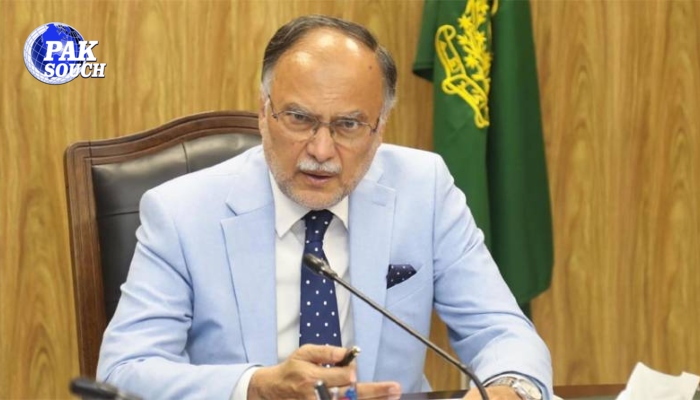
ISLAMABAD: Federal Minister for Planning and Development Ahsan Iqbal has warned that Pakistan is facing a continuous decline in resources available for development projects, making it increasingly difficult for the federal government to complete ongoing infrastructure and public welfare initiatives.
Speaking at a meeting of the Annual Plan Coordination Committee (APCC), the minister highlighted the growing financial challenges confronting the country’s development sector and stressed the need for better prioritization of projects amid limited fiscal space.
Continuous Decline in Development Funding
Ahsan Iqbal stated that funding for development projects has been steadily decreasing since the fiscal year 2018. According to him, the federal government is struggling to maintain investment levels needed to support economic growth, infrastructure expansion, and public service improvements.
He noted that public investment as a percentage of Gross Domestic Product (GDP) has dropped significantly, falling from 2.6 percent to less than 0.6 percent, reflecting the mounting fiscal constraints facing the country.
The minister said this downward trend has adversely affected the pace of development and limited the government’s ability to launch and complete critical projects across various sectors.
Massive Funding Gap for Ongoing Projects
Highlighting the scale of the challenge, Ahsan Iqbal revealed that projects worth approximately Rs 5 trillion are currently under implementation through approved Planning Commission documents (PC-1s).
However, he added that completing these projects would require nearly Rs 10 trillion, a figure far beyond the resources currently available to the federal government.
The minister warned that without adequate funding, many projects could face delays, cost overruns, or prolonged completion timelines, potentially affecting economic growth and public service delivery.
Ministries Requested Rs 3 Trillion
According to Ahsan Iqbal, federal ministries and departments collectively requested around Rs 3 trillion for development projects in the upcoming fiscal year.
Despite these demands, the federal government’s development program remains constrained at approximately Rs 1 trillion, limiting its ability to accommodate all proposed projects.
He explained that under these circumstances, the government would be compelled to focus only on selected priority projects that are considered essential for national development and economic progress.
“This situation means that only carefully chosen projects can move forward,” he said, emphasizing the importance of strategic planning and efficient resource allocation.
Provinces Have Greater Development Capacity
The planning minister pointed out that while federal development resources have declined, provincial governments have experienced growth in their development budgets.
He remarked that provinces have effectively become financially stronger in terms of development spending because their allocations have increased over the years.
This shift reflects broader changes in Pakistan’s fiscal framework, particularly after constitutional and financial reforms that enhanced provincial control over public spending and revenue distribution.
As a result, provinces now play a larger role in funding and implementing development initiatives within their respective jurisdictions.
Major Allocation for N-25 Highway
Ahsan Iqbal announced that, on the instructions of Prime Minister Shehbaz Sharif, Rs 125 billion has been allocated for the improvement and development of National Highway N-25 in Balochistan.
The highway is considered a strategically important route that connects various regions of the province and plays a crucial role in trade, transportation, and regional connectivity.
The minister said the allocation demonstrates the federal government’s commitment to improving infrastructure in underserved regions despite financial limitations.
Funds Reserved for Balochistan, AJK, Gilgit-Baltistan and Merged Districts
The minister further disclosed details of proposed allocations for less-developed regions of the country.
According to him:
- Rs 100 billion has been earmarked for development projects in Balochistan.
- Around Rs 150 billion has been proposed for Azad Jammu and Kashmir (AJK), Gilgit-Baltistan, and the merged districts of Khyber Pakhtunkhwa (formerly FATA).
These allocations are intended to address regional disparities, improve infrastructure, and support socioeconomic development in areas that require additional government investment.
New Projects Worth Rs 720 Billion Proposed
Ahsan Iqbal said proposals for new development projects worth Rs 720 billion have also been submitted for consideration in the upcoming fiscal year.
However, he reiterated that limited financial resources mean not all proposed initiatives can be approved immediately.
The government will therefore prioritize projects based on their economic impact, strategic importance, and potential benefits for the public.
Need for Long-Term Economic Stability
The planning minister stressed that sustainable economic growth and long-term development require stronger investment levels and greater fiscal stability.
He argued that Pakistan must improve its economic fundamentals, increase investment, and expand revenue generation to create the financial capacity needed for large-scale development.
Without addressing these structural challenges, he warned, the country may continue to face difficulties in financing infrastructure, education, health, transportation, and other critical sectors.
As budget preparations continue for the next fiscal year, the government faces the difficult task of balancing development needs with financial realities while attempting to maintain momentum on key national projects.
About The Author