


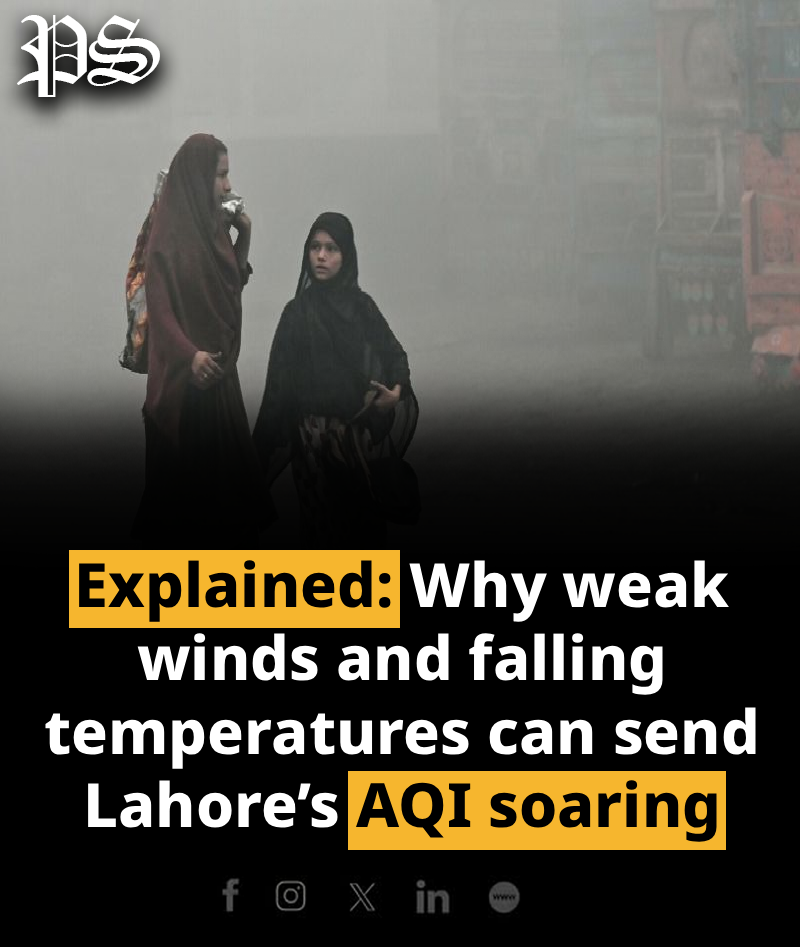
Lahore’s Air Quality Index (AQI) climbing to 458 as temperatures fell and air movement weakened may sound counterintuitive: how can colder weather or a lack of wind make pollution suddenly worse when the city’s emissions have not necessarily increased?
The answer lies largely in what happens to pollutants after they enter the atmosphere.
AQI itself does not rise simply because the temperature falls. It rises when concentrations of pollutants near the ground increase. In Punjab, fine particulate matter, or PM2.5, is a key component of air-quality monitoring, with Punjab EPA reports using PM2.5 concentrations to calculate AQI readings.
These tiny particles come from multiple sources, including vehicles, industry, construction, combustion and the burning of biomass or crop residue. Research conducted in Lahore has identified traffic, biomass burning, construction and industrial emissions among contributors to PM2.5 during severe haze episodes.
Why does weak wind make pollution worse?
Think of the atmosphere above a city as a room in which pollutants are continuously being released. When air is moving, that room is being ventilated.
Wind carries pollutants away from their sources, while atmospheric turbulence mixes polluted air with cleaner air above it. The US National Oceanic and Atmospheric Administration says the atmospheric boundary layer, the lowest part of the atmosphere, plays a central role in air quality because wind transports pollutants while turbulence mixes and dilutes them.
When winds become very weak, that ventilation slows down. Cars, factories, kilns and other sources can continue emitting pollutants, but those pollutants are dispersed less efficiently.
The US Environmental Protection Agency similarly notes that stronger winds generally dilute and disperse pollutants, while stagnant air allows concentrations to build up.
This is why Lahore can experience a sharp deterioration in air quality during relatively calm mornings even without a sudden surge in emissions.
Research specific to Pakistan supports this relationship as well. A 2025 study examining PM2.5 and weather conditions in Pakistani cities found that meteorological factors including wind speed, temperature and humidity affected particulate concentrations, while recent research focused on Lahore also found weather variables important for predicting PM2.5 levels.
How falling temperatures trap pollution
Temperature becomes particularly important during the night and early morning because of a phenomenon known as a temperature inversion.
Normally, warmer air near the ground rises and mixes with cooler air above, helping carry pollution upwards. But on cold, calm nights the ground can cool rapidly, cooling the air immediately above it while relatively warmer air remains higher up.
That produces an inversion: warmer air sitting above colder surface air.
Instead of pollution rising and dispersing, the warm layer effectively acts like a lid. The EPA explains that during an inversion, cooler air and pollution can become trapped close to the ground beneath warmer air above.
This process is particularly relevant to Lahore. A recent study examining winter smog across the Indo-Gangetic Plain found that Lahore’s severe pollution episodes were associated with persistent temperature inversions and weak near-surface winds, conditions that restrict both vertical and horizontal dispersal of pollutants.
That helps explain the EPA’s expectation that conditions could improve after 11am.
As sunlight warms the ground, the cold surface layer begins heating up. The inversion can weaken or break, the atmospheric mixing layer becomes deeper and turbulence increases. NOAA notes that vertical mixing generally increases as sunlight strengthens during the day, allowing pollutants that were concentrated near breathing level to disperse through a much larger volume of air.
If wind speeds also increase, pollutants can be carried away more rapidly.
There is an important caveat: higher temperatures do not always mean cleaner air. Heat and sunlight can accelerate chemical reactions that produce pollutants such as ground-level ozone. EPA guidance notes that high temperatures can favour ozone formation.
But during Lahore’s winter smog episodes dominated by particulate pollution and atmospheric stagnation, a cold, calm morning can create almost ideal conditions for pollution to accumulate, while daytime heating and stronger air movement can temporarily provide the ventilation the city lacks.
PAK SOUCH MEDIA GROUP
Daily Pak Souch Newspaper Sukkur – Daily Pak Special Newspaper Karachi – Daily Pak Today Newspaper Karachi – Daily Pak Jazbo Newspaper Sukkur
Head Office : Ayub Gate Shaikh Muhalla Near Rabbania Masjid Sukkur
Karachi Office : Office No. 1901-B, 19th Floor Saima Trade Tower (B) Block I.I Chandigarh Road Near Jung Press, Shaheen Complex & National Museum of Pakistan Karachi Sindh Pakistan.
Contact : 03009319022
Website 1 : https://paksouch.com/
Website 2 : https://sindhi.paksouch.com/
Website 3 : https://pakjazbo.com/
Website 4 : https://urdu.pakjazbo.com/
About The Author