

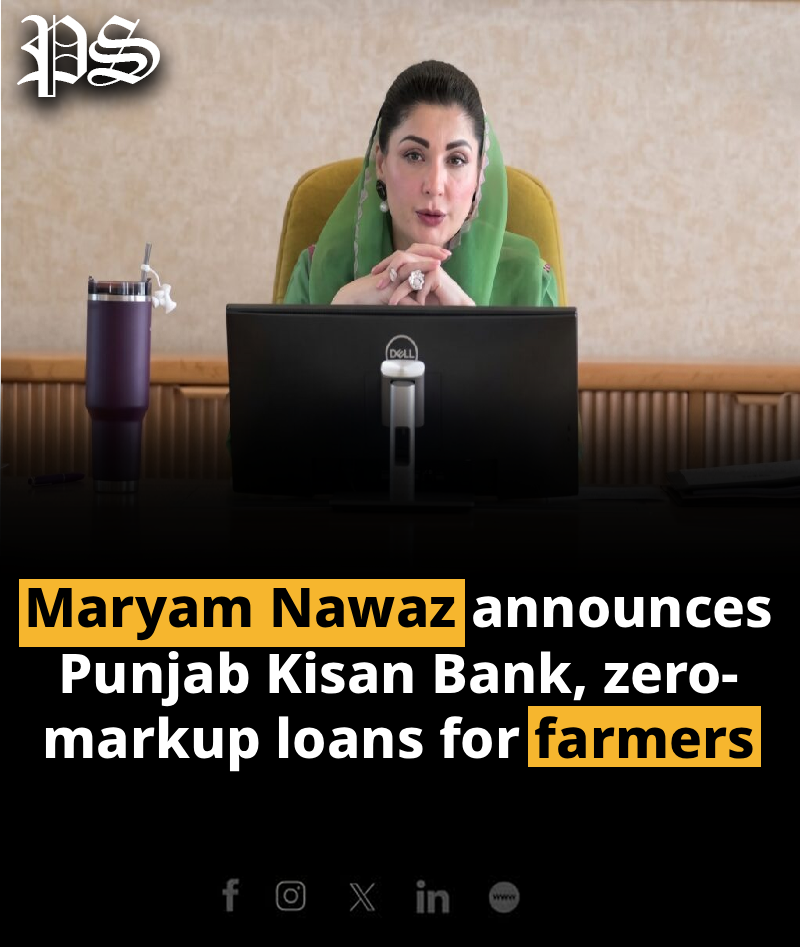
LAHORE: Punjab Chief Minister Maryam Nawaz on Wednesday announced the establishment of the province’s first Kisan Bank, interest-free loans of up to Rs10 million for farmers, and subsidised financing for larger loans, as part of a package aimed at improving agricultural productivity and farmers’ incomes.
Under the announced financing structure, farmers will be able to obtain loans of up to Rs10 million at zero markup, while loans of up to Rs30 million will carry a two per cent markup and those of up to Rs50 million a five per cent markup, Maryam said while addressing representatives of small, medium and large farmers from across Punjab.
She also announced an increase of Rs3,500 in the per-acre financing limit under the Kisan Card, taking it from Rs30,000 to Rs33,500, citing higher fertiliser prices. The government would provide Rs17 billion in subsidised loans to farmers, she said.
Maryam said the government would ensure implementation of the Rs4,500-per-40kg wheat support price under a plan being pursued in coordination with the federal government. She also announced a special package to promote olive cultivation, measures to improve irrigation and water management, and plans to provide land and promote livestock farming.
“Pakistan’s economic wheel cannot move forward without Punjab’s farmers,” she said, describing the province as the country’s food basket and saying it met around 70 per cent of the country’s food requirements.
The chief minister said her government was committed to improving farmers’ access to finance, agricultural inputs and modern machinery, while helping them secure better returns through processing and exports.
Further details of the Kisan Bank, including its operational framework and eligibility requirements, were not immediately available.
Kisan Card, fertiliser prices and wheat support
Maryam said more than one million small farmers were benefiting from the Kisan Card, which had been introduced to help them purchase seeds, fertilisers and pesticides without having to depend on middlemen.
She said the programme had enabled farmers to obtain financial assistance directly, adding that the digital system had helped ensure that loans were distributed on merit.
The government had also achieved almost complete recovery of the loans extended to farmers, she said, attributing the repayment record to mutual trust between the government and the farming community.
Maryam said the government had resisted pressure from the International Monetary Fund over the imposition of agricultural income tax, arguing that the interests of farmers needed to be protected.
She also said the government had curbed the black marketing of fertilisers and was ensuring their availability at officially prescribed prices.
Under the Apna Khet, Apna Rozgar initiative, farmers were being offered incentives and financial assistance for wheat cultivation, she said.
The chief minister said the government would soon formally launch its wheat procurement plan and introduce an online portal to digitise the process.
She said the administration would work under the prime minister’s leadership to ensure implementation of the announced wheat support price of Rs4,500 per 40kg.
Tractor subsidies and agricultural mechanisation
Maryam said the government had already distributed around 25,000 tractors to farmers under subsidised schemes and planned to expand the programme over the next two years.
She said the broader Green Tractor Scheme envisaged the distribution of 50,000 tractors at subsidised rates.
The scheme had helped revive the tractor manufacturing industry, while investment in agricultural machinery was encouraging the establishment of factories producing farm equipment, she added.
The government was allocating Rs70 billion to high-tech agricultural mechanisation, Maryam said, citing demand for equipment such as happy seeders, which allow wheat to be sown in fields with crop residue and can help reduce the need for residue burning.
She said Pakistan’s manufacturers were producing around 30,000 tractors, while a harvester assembly plant and a tractor manufacturing plant were being established in Punjab.
The government had also deployed 1,500 agricultural interns in the field, each receiving a monthly stipend of Rs70,000, to support farmers and improve agricultural services, she said.
Agro-processing parks to boost exports
Maryam said the government was developing agro-processing parks in Sargodha, Bhakkar, Khanewal and Okara to help farmers obtain better prices for their produce.
The facilities would support the grading, processing and storage of crops and fruits, including mangoes, kinnow, oranges and potatoes, she said.
The chief minister said the government wanted to increase agricultural output and export surplus produce after adding value through processing.
She said greater production of wheat could also create opportunities to export value-added products, including pasta, rather than relying solely on sales of raw agricultural commodities.
The government was pursuing a broader industrial agriculture plan intended to improve the connection between farming, processing and export markets, she added.
Maryam also announced a special package to encourage olive cultivation, saying Punjab’s olives had the potential to compete in international markets. Subsidies were already being provided to promote olive production, she said.
She congratulated Pakistan on becoming a permanent member of the International Olive Council after previously holding observer status.
Water management and irrigation
The chief minister said the government would continue its campaign against water theft across Punjab to ensure that irrigation water reached farmers at the tail end of canals.
“Whether a farmer is small or large, poor or influential, every field will receive water up to the tail end,” she said.
She said the government was taking action against water theft and would also undertake canal desilting and maintenance to improve water flows.
The administration planned to line watercourses to reduce wastage and was providing farmers with high-powered irrigation systems, she added.
Maryam said around 400 mini dams were being developed in the Potohar region to improve water availability.
She said farmers cultivating land on lease or under tenancy arrangements would also be considered for inclusion in the Kisan Card programme.
The government was also preparing to launch mobile soil-fertility and water-testing laboratories to help farmers assess soil conditions and use water and agricultural inputs more efficiently.
Livestock development and smog prevention
Maryam said the government had supported the fattening of around 400,000 animals over the past year and planned to prepare a further 600,000 livestock animals for the market during the current year.
The livestock initiative was part of efforts to strengthen the rural economy and expand opportunities for farmers beyond crop cultivation, she said.
The chief minister also urged farmers to cooperate with the government in tackling smog by refraining from burning crop residue.
She said farmers’ support was necessary to reduce air pollution while protecting agricultural productivity.
Farmers’ proposals and government response
Maryam met representatives of small, medium and large farmers from across Punjab and assured them that their proposals and recommendations would be considered and implemented gradually.
She described Agriculture and Livestock Minister Ashiq Hussain Kirmani as an important representative of farmers within the government, saying his own experience as a farmer helped him understand their problems and needs.
Kirmani said the chief minister had increased the provincial agriculture budget from Rs15 billion to Rs400 billion and thanked her for dedicating her birthday to meeting farmers.
He said the government was launching value-addition projects to help farmers obtain better prices for their produce and that new agricultural machinery manufacturing facilities would support the sector.
Farmers attending the meeting praised the Kisan Card initiative and the government’s agricultural programmes. Farmer Hassan Raza welcomed the announced wheat support price, while Amir Hayat Bandesha praised the Kisan Card and other provincial initiatives.
Farmer Bilal Khan said Punjab’s olive crop could become suitable for export within two to three years, while Sajjad Ali welcomed the campaign against water theft.
Maryam reiterated that the government would continue supporting farmers, expanding agricultural financing and promoting modern farming practices to increase productivity, improve rural incomes and strengthen Punjab’s contribution to the national economy.
PAK SOUCH MEDIA GROUP
Daily Pak Souch Newspaper Sukkur – Daily Pak Special Newspaper Karachi – Daily Pak Today Newspaper Karachi – Daily Pak Jazbo Newspaper Sukkur
Head Office : Ayub Gate Shaikh Muhalla Near Rabbania Masjid Sukkur
Karachi Office : Office No. 1901-B, 19th Floor Saima Trade Tower (B) Block I.I Chandigarh Road Near Jung Press, Shaheen Complex & National Museum of Pakistan Karachi Sindh Pakistan.
Contact : 03009319022
Website 1 : https://paksouch.com/
Website 2 : https://sindhi.paksouch.com/
Website 3 : https://pakjazbo.com/
Website 4 : https://urdu.pakjazbo.com/
About The Author