

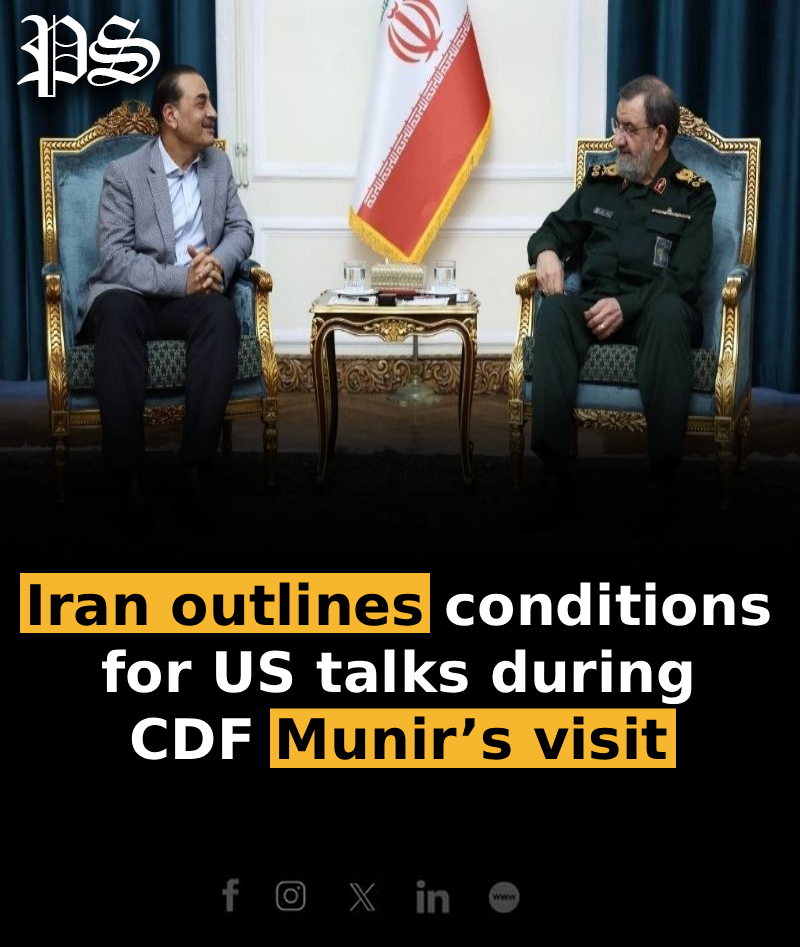
TEHRAN: Pakistan’s latest diplomatic outreach to Iran has brought renewed focus to the conditions Tehran says must be met before talks with Washington can resume, as Chief of Defence Forces (CDF) Field Marshal Syed Asim Munir held a series of meetings with senior Iranian leaders in Tehran.
During the discussions, Iranian officials reiterated that any return to negotiations would depend on progress on Tehran’s demands, while also maintaining that the country’s enriched uranium would remain inside Iran.
Field Marshal Munir met Iranian President Masoud Pezeshkian, parliament speaker Mohammad Baqer Ghalibaf and Secretary of the Supreme National Security Council of Iran Mohsen Rezaei on Tuesday as Pakistan continued efforts to mediate between Iran and the United States. President Pezeshkian discussed mediation efforts and regional developments with the Pakistani military chief, according to Iranian media.
The visit came amid a renewed Pakistani push to revive diplomacy after months of stalled engagement between Washington and Tehran. Pakistan has emerged as one of the main intermediaries between the two sides, with Field Marshal Munir making his fifth trip to Tehran since a Pakistan-brokered agreement was reached in June.
Tehran sets conditions for any return to talks
Ghalibaf told CDF Munir that the United States could not regain Iran’s trust unless it first met seven conditions Tehran has set for reopening the Strait of Hormuz and resuming wider negotiations.
The conditions include lifting the US blockade on Iranian ports, ending sanctions on Iranian oil exports and bringing hostilities on regional fronts to an end. Tehran has insisted that these measures must precede any meaningful return to negotiations.
Iranian media quoted Ghalibaf as saying that Tehran had “nothing new to say” and that military pressure or threats would not alter Iran’s strategic decisions.
Rezaei, secretary of Iran’s Supreme National Security Council, delivered a similar message during a separate meeting with CDF Munir, saying there would be no negotiations until Washington took steps to rebuild trust and fulfilled Iran’s conditions.
The position marks a hardening of Tehran’s public stance as diplomatic efforts remain stalled despite repeated mediation attempts by Pakistan and other regional states.
Iran rules out sending enriched uranium abroad
Rezaei also told CDF Munir that Iran would not allow its enriched nuclear material to leave the country.
“Not even a tiny bit of enriched nuclear material will leave Iran,” he said, according to Iranian state media, describing the stockpile as a national asset intended for domestic use.
Iran has enriched uranium to 60 per cent purity, significantly above levels required for most civilian purposes and closer to the roughly 90 per cent level associated with weapons-grade material.
The United States and its allies have long accused Tehran of seeking the capability to build nuclear weapons, a charge Iran denies.
US Vice President JD Vance said earlier this month that Iran would need to make a “meaningful” reduction in its uranium enrichment capacity for Washington’s concerns to be addressed.
Tehran has previously ruled out transferring enriched material abroad, although Iranian officials had indicated that dilution within Iran could potentially form part of a future arrangement.
Pakistan continues mediation efforts
CDF Munir’s visit is part of Pakistan’s wider diplomatic engagement between Iran and the United States.
Pakistan has played a key mediating role throughout the conflict, with Prime Minister Shehbaz Sharif, Deputy Prime Minister and Foreign Minister Ishaq Dar, Interior Minister Mohsin Naqvi and Field Marshal CDF Munir holding repeated contacts with Iranian and US officials.
Earlier mediation efforts produced the Islamabad Memorandum of Understanding in June, which was intended to create a framework for de-escalation and a more permanent settlement. The agreement, however, quickly faltered as fighting between Iran and the United States resumed weeks later.
Negotiations have remained largely deadlocked since then, including during indirect contacts held around the United Nations General Assembly.
Pakistan’s mediation has increasingly focused on the Strait of Hormuz, whose disruption has had major implications for international energy markets and shipping.
Iran has offered to reopen the strategic waterway within seven days if Washington accepts its conditions, but talks remain stuck over the sequencing of concessions and US demands relating to Iran’s nuclear programme.
The Strait of Hormuz was a central subject in CDF Munir’s previous engagements with Iranian leaders, which focused on de-escalation, reopening the waterway and preventing further expansion of the conflict.
Conflict enters eighth month
The current conflict began in late February after the United States and Israel launched strikes on Iran while Washington and Tehran were engaged in negotiations over Iran’s nuclear programme.
A ceasefire was later followed by the Pakistan-mediated June agreement, but hostilities resumed and tensions surrounding the Strait of Hormuz have persisted.
Iran has blamed Washington for instability around the waterway, while the United States has maintained pressure through sanctions and restrictions on Iranian shipping and oil exports.
The war and disruption to the strait have also affected global energy markets, with oil prices remaining sensitive to signs of either escalation or diplomatic progress. On Tuesday, crude prices eased after news emerged of Pezeshkian’s meeting with CDF Munir and renewed mediation efforts.
Despite the latest Pakistani initiative, the meetings in Tehran showed that significant differences remain between Washington and Tehran, particularly over sanctions, the Strait of Hormuz and Iran’s nuclear programme.
PAK SOUCH MEDIA GROUP
Daily Pak Souch Newspaper Sukkur – Daily Pak Special Newspaper Karachi – Daily Pak Today Newspaper Karachi – Daily Pak Jazbo Newspaper Sukkur
Head Office : Ayub Gate Shaikh Muhalla Near Rabbania Masjid Sukkur
Karachi Office : Office No. 1901-B, 19th Floor Saima Trade Tower (B) Block I.I Chandigarh Road Near Jung Press, Shaheen Complex & National Museum of Pakistan Karachi Sindh Pakistan.
Contact : 03009319022
Website 1 : https://paksouch.com/
Website 2 : https://sindhi.paksouch.com/
Website 3 : https://pakjazbo.com/
Website 4 : https://urdu.pakjazbo.com/
About The Author