

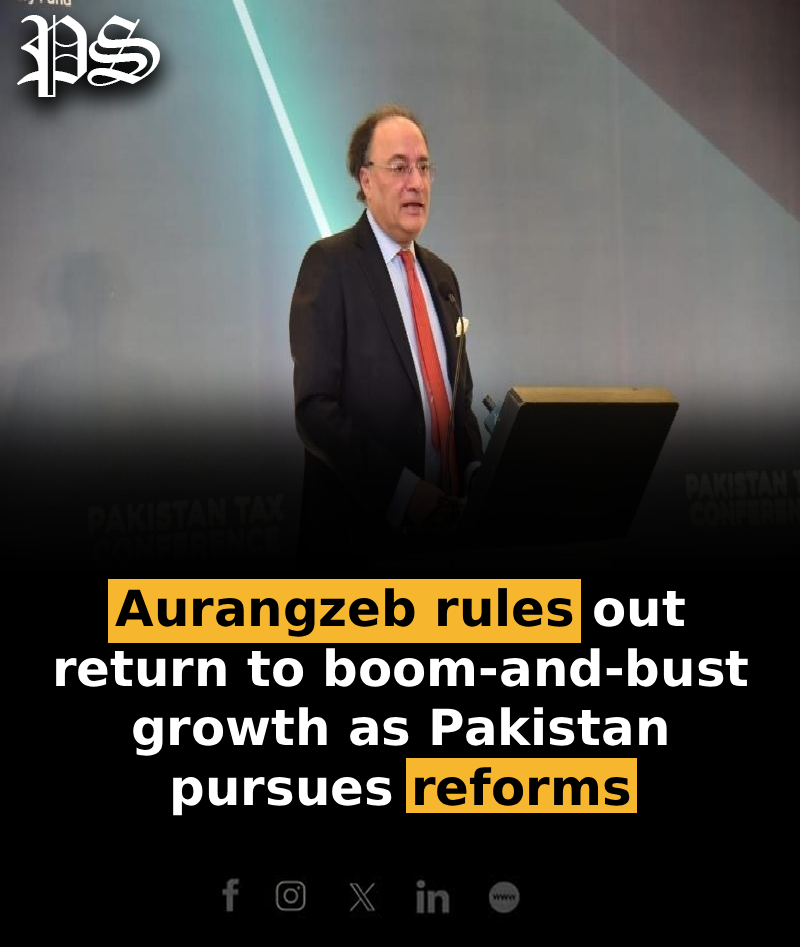
Finance Minister Muhammad Aurangzeb has ruled out a return to consumption-driven economic growth, saying Pakistan will focus on sustainable, export-led expansion as fiscal consolidation and tax reforms help stabilise the economy.
“We will not let that repeat,” Aurangzeb said on Tuesday, referring to past boom-and-bust cycles fuelled by liquidity and consumption.
Addressing a workshop on tax system reforms organised by the Ministry of Finance on Tuesday, he said Pakistan’s combined fiscal and external deficit had declined from 12.5% of gross domestic product (GDP) a few years ago to 2.6% at the close of the last fiscal year. Pakistan’s economic growth slowed to two per cent in the fourth quarter of FY26, down from 6.07% in the same period a year earlier, with a sharp contraction in industry weighing on overall performance, according to the Pakistan Bureau of Statistics (PBS).
The finance minister said the country had recorded its lowest fiscal deficit in 22 years and achieved three consecutive years of primary budget surpluses.
“A big part of this has been fiscal consolidation,” he said, crediting improved revenue collection and enforcement measures for the progress.
Tax-to-GDP ratio rises to 10.3%
Aurangzeb said the Federal Board of Revenue’s (FBR) tax-to-GDP ratio had increased from 8.8% to 10.3%, while revenues had risen by 40% over the past two fiscal years.
He said 0.9 percentage points of the 1.5-percentage-point increase in the tax-to-GDP ratio over the past two to two-and-a-half years came from enforcement, while 0.6 percentage points resulted from new policy measures.
“Enforcement simply means we have stopped leakage, we have stopped theft, we have stopped corruption,” he said.
Aurangzeb said the government would strengthen enforcement further while expanding the tax base and simplifying the taxation system.
He also highlighted the FBR’s transformation programme, covering staffing, processes and technology, which he said was being overseen by Prime Minister Shehbaz Sharif through weekly reviews.
Tax reforms remain a key part of the government’s broader structural reform agenda, alongside changes in the energy sector, state-owned enterprises, privatisation, public finances, pensions and tariffs.
Government prioritises export-led growth
Aurangzeb said Pakistan had made progress since its economy contracted, with growth recovering to around 3.7%. However, he stressed that sustainable expansion mattered more than the headline growth rate.
“It not only has to be growth, it has to be sustainable growth,” he said, warning that consumption-led expansion had contributed to economic instability in the past.
The finance minister said tax policy should be guided by economic value rather than designed primarily to meet revenue targets.
“We have to continue to have a tax design which is led by economic value considerations, not by making the math work,” he said.
He added that recent budget measures had recalibrated taxation for exports and export-oriented industries, and called for further reforms to broaden the tax base and simplify tax laws.
Aurangzeb also stressed the need for predictable policies to encourage private investment.
“We cannot continue to give surprises to private sector investment at every single budget,” he said, calling for policy continuity and stability.
He identified political consensus, stronger institutions, taxpayer trust and clearer communication as key requirements for successful reform.
Reserves improve as Pakistan pursues stability
Aurangzeb said Pakistan’s foreign exchange reserves had recovered from a level equivalent to around two weeks of import cover to more than three months.
He argued that the quality of reserves was as important as their size, saying the improvement had not been built on the same scale of external borrowing seen in earlier years.
According to the finance minister, Pakistan’s external debt stock had increased by around $4 billion over the past four years, compared with annual increases of $6 billion to $7 billion between 2015 and 2022.
“The important thing is not only the quantum of these reserves but the quality of these reserves,” he said.
Aurangzeb said the workshop would review progress on structural reforms and identify further measures to help Pakistan move from economic stabilisation towards sustainable growth.
PAK SOUCH MEDIA GROUP
Daily Pak Souch Newspaper Sukkur – Daily Pak Special Newspaper Karachi – Daily Pak Today Newspaper Karachi – Daily Pak Jazbo Newspaper Sukkur
Head Office : Ayub Gate Shaikh Muhalla Near Rabbania Masjid Sukkur
Karachi Office : Office No. 1901-B, 19th Floor Saima Trade Tower (B) Block I.I Chandigarh Road Near Jung Press, Shaheen Complex & National Museum of Pakistan Karachi Sindh Pakistan.
Contact : 03009319022
Website 1 : https://paksouch.com/
Website 2 : https://sindhi.paksouch.com/
Website 3 : https://pakjazbo.com/
Website 4 : https://urdu.pakjazbo.com/
About The Author