

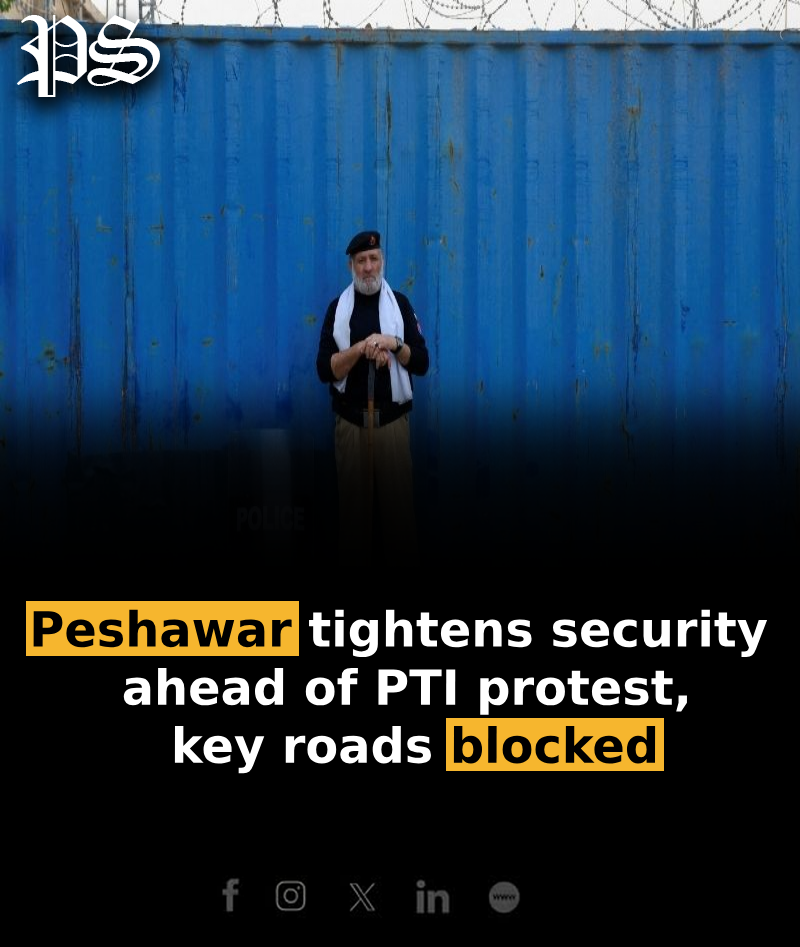
PESHAWAR: Security was tightened in Peshawar ahead of the Pakistan Tehreek-e-Insaf’s (PTI) protest call for noon, with containers blocking routes across Peshawar Cantonment, movement restricted in sensitive areas and educational institutions closed, a day after the federal government declared an emergency and imposed governor’s rule in Khyber Pakhtunkhwa (KP).
Army personnel have been brought in from Punjab under Article 245 of the Constitution and will be stationed in districts where a security emergency has been imposed. No troops are currently deployed in Peshawar city, where police are managing security. Mobile phone and Wi-Fi services, suspended the previous day, have been restored.
Centre suspends provincial government
The federal government has suspended the PTI-led provincial administration, federal ministers announced. Law Minister Azam Nazeer Tarar, Information Minister Attaullah Tarar and Interior Minister Mohsin Naqvi said President Asif Ali Zardari had invoked Articles 232 and 234 of the Constitution. A proclamation under Article 245 was also issued to strengthen the armed forces’ assistance to civil authorities in counterterrorism efforts.
The offices of the chief minister and the provincial cabinet stand suspended, and several PTI figures have been placed in preventive custody, according to the announcement.
Containers block routes across Peshawar Cantt
Movement across Peshawar Cantt has been restricted, with containers placed at entry and exit points. Routes leading towards the Governor House and connecting the Red Zone with Saddar and Taxila have also been blocked.
Containers have been shifted to the sides of some roads to allow limited traffic, while police personnel remain deployed alongside the barricades. The route towards the airport remains open, but travellers are being allowed through only after strict security checks.
An entry route into Peshawar near Tarnab Farm has also been closed. Some commuters are using alternative routes through nearby villages to reach their destinations.
Schools closed, public transport suspended
Schools, colleges and universities remain closed, while public transport is not operating in the city.
Police are trying to prevent groups of people from gathering amid concerns that the protest could lead to clashes or damage to government installations. Strict checks are being conducted at checkpoints, with movement through certain areas allowed only after security screening.
M-1 Motorway from Peshawar to Islamabad open
The M-1 Motorway from Peshawar to Islamabad is open to traffic, while traffic has also been restored on the Swat Expressway from Colonel Sher Khan Interchange to Chakdara, according to the Motorway Police. The M-14 Motorway from Hakla to Dera Ismail Khan is partially closed due to rain last night, while the GT Road from Peshawar to Islamabad remains open as usual.
Government cites failed talks and rising violence
The ministers said the decision followed months of negotiations with the provincial leadership over a coordinated security strategy, which ultimately failed. They said the provincial administration had not implemented the federal government’s counterterrorism proposals or agreed to a joint operational framework.
Naqvi said militant violence had surged by 195 per cent in recent months and that 518 police personnel had been casualties. He said residents of 12 districts faced targeted attacks and restrictions on movement, which he cited as the reason for intervention.
The ministers rejected suggestions that the move was politically motivated. They said the transitional arrangements were meant to restore public order, streamline governance and combat militancy, not to divide the province.
What the Constitution provides
Article 232 allows the proclamation of an emergency in cases of war, external aggression or internal disturbance threatening the security of Pakistan or part of it. Article 234 applies when a provincial government cannot be carried on in accordance with the Constitution. Article 245 governs the deployment of the armed forces in aid of civil power.
Advisory council to run the province
To manage the province in the interim, the government has set up an 11-member advisory council under Governor Faisal Karim Kundi. A separate secretariat will cover the 12 districts most affected by terrorism and will operate under an additional chief secretary, who will direct targeted resources and reconstruction efforts.
The council includes professionals from a range of fields. Kifayatullah Khan will handle home affairs, and Tariq Mahmood Pasha finance. Amir Javed will take law, and Dr Syed Amir Abdullah education. Retired Lt Gen Nigar Johar will oversee health, and Dr Sarfaraz Ali Shah mines and minerals. Dr Muhammad Irshad will look after industries and commerce, and Tayyab Qureshi religious affairs. Osman Saifullah Khan will be responsible for energy, and Samar Haroon Bilour for information and broadcasting. Asif Rafiq Afridi will handle communications, works, local government, housing and transport.
Months of tension with the PTI-led government
The move follows weeks of rising tension between Islamabad and Peshawar. The PTI began its long march towards Islamabad from Lakki Marwat on October 4, after talks between the government and the opposition collapsed over access to jailed party founder Imran Khan and cooperation on counterterrorism in the province.
The PTI said its objection was to how counterterrorism operations were planned, arguing that they should be agreed jointly by the federal and provincial governments with the backing of political parties and tribal elders. Naqvi had blamed Chief Minister Sohail Afridi for backing away from commitments on counterterrorism, an account the PTI rejected.
Kundi and Afridi also clashed over a security meeting the governor convened with the chief secretary and police chief, which Afridi called unconstitutional. In his latest remarks, Afridi said the province was being “scared” with emergency and governor’s rule, and that any reaction would come from the people rather than from him. He also said he would oppose any proposal for a military operation.
Pakistan People’s Party Chairman Bilawal Bhutto Zardari said on Friday that the federal government had been prepared to impose governor’s rule or an emergency, but that his party had urged the Centre to treat such measures as a last resort and pursue dialogue.
PTI rejects emergency rule in KP, warns of political fallout
PTI has rejected the imposition of governor’s rule and emergency measures in KP, accusing the federal government of undermining the province’s electoral mandate and disrupting negotiations on counterterrorism. Addressing a press conference in Islamabad, PTI Secretary General Salman Akram Raja described October 11 as a “black day” in Pakistan’s history, warning that political alienation and coercive measures could lead to consequences similar to those witnessed in Balochistan.
Raja drew a parallel with the dismissal of Sardar Ataullah Mengal’s provincial government in 1973, arguing that political grievances could have lasting consequences. He urged Pakistanis to raise their voices against what he described as undemocratic measures, saying peaceful public mobilisation could challenge the existing political order.
Raja maintained that the PTI supported efforts to eliminate terrorism but opposed counterterrorism operations without consultation with political parties and affected communities. He said negotiations with the federal government had been progressing and included discussions on revising the Parachinar agreement and establishing a mutually agreed framework for security operations.
According to Raja, the PTI had sought implementation of previously agreed decisions rather than introducing new demands. He said discussions involving opposition leaders, including Mahmood Khan Achakzai and Raja Nasir Abbas, had been aimed at achieving political consensus. However, he alleged that the government demanded unconditional support for its proposed operations, which the party could not accept.
The PTI insisted that counterterrorism policies should be developed through consultation and protect civilians. Raja also maintained that the party’s proposed long march would proceed, saying its announcement remained unchanged. He said peaceful protest, rather than violence, would be the party’s response.
PTI and opposition alliance challenge federal measures
PTI Chairman Barrister Gohar Ali Khan also criticised the emergency measures, arguing that they undermined provincial autonomy and the mandate of KP voters. He questioned why governor’s rule had been imposed in a province where the PTI claimed a two-thirds majority in the provincial assembly.
Gohar raised concerns over reported arrests of Chief Minister Sohail Afridi, the provincial assembly speaker, party workers and Imran Khan’s sisters. He claimed around 1,500 PTI workers were detained in Punjab’s prisons and alleged that three party ministers had been arrested after being fired upon. These claims were not independently verified during the press conference.
Gohar said the party had pursued parliamentary and legal avenues and held approximately 15 meetings with the government, followed by two days of negotiations. He also maintained that access to incarcerated PTI founder Imran Khan was essential to decisions concerning the party’s political strategy and long march.
The Tehreek-i-Tahafuz-i-Ayeen Pakistan (TTAP), an opposition alliance, described the federal measures as unconstitutional and an infringement of provincial rights. It questioned the different approaches adopted towards KP and Balochistan and announced plans to consult allies on a joint response.
The federal government, meanwhile, defended its decision, citing worsening security conditions and the provincial administration’s alleged failure to tackle militancy effectively. President Asif Ali Zardari approved the measures under Articles 232 and 234 of the Constitution, on the advice of Prime Minister Shehbaz Sharif and the federal cabinet. The measures transfer provincial executive functions to the governor and place the administration under an 11-member advisory council.
The dispute highlights continuing divisions over provincial autonomy, security policy and the conditions required for political negotiations to resume.
PAK SOUCH MEDIA GROUP
Daily Pak Souch Newspaper Sukkur – Daily Pak Special Newspaper Karachi – Daily Pak Today Newspaper Karachi – Daily Pak Jazbo Newspaper Sukkur
Head Office : Ayub Gate Shaikh Muhalla Near Rabbania Masjid Sukkur
Karachi Office : Office No. 1901-B, 19th Floor Saima Trade Tower (B) Block I.I Chandigarh Road Near Jung Press, Shaheen Complex & National Museum of Pakistan Karachi Sindh Pakistan.
Contact : 03009319022
Website 1 : https://paksouch.com/
Website 2 : https://sindhi.paksouch.com/
Website 3 : https://pakjazbo.com/
Website 4 : https://urdu.pakjazbo.com/
About The Author