

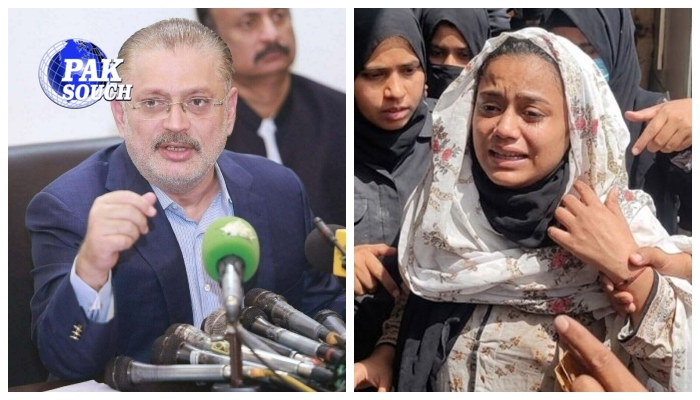
Sindh Senior Minister Sharjeel Inam Memon has expressed serious concern over the increasing spread of narcotics in society, saying that the country failed to treat the drug problem with the seriousness it deserved.
Speaking to the media after visiting the BRT Red Line project in Karachi, Sharjeel Memon referred to the case of alleged drug dealer Anmol, also known as “Pinky,” and claimed that she was part of a larger network involved in narcotics distribution.
“Anmol alias Pinky was selling poison,” the senior minister said. “There is an entire network behind this, but unfortunately we never took the issue of drugs seriously.”
He clarified that he was not blaming any single government and stressed that narcotics have become a nationwide and even global challenge.
“I am not talking about one government only, this has become an issue across the country,” he stated. “Drug abuse is a major problem worldwide.”
Sharjeel Memon said drug trafficking has become a profitable business for many people and appealed to the media not to glamorize drug-related cases or individuals involved in narcotics activities.
“I do not want to damage anyone’s reputation unnecessarily, but I request the media not to glamorize such people because drugs are costing precious lives every day,” he added.
The minister also highlighted the devastating social impact of drug addiction, particularly among young people. He mentioned a disturbing incident in Karachi where a drug-addicted child reportedly opened fire on family members.
According to Sharjeel Memon, parents now carry a major responsibility in protecting children from narcotics.
“When children become addicted to drugs, they turn like zombies and become difficult to control,” he warned.
He further stated that the Sindh government is working on several rehabilitation centers to help drug addicts recover, though he admitted that the issue remains a major challenge.
Alongside discussing the drug crisis, Sharjeel Memon also spoke about ongoing development projects in Karachi and said the provincial government would continue focusing on public welfare despite political criticism.
“Those who want to do politics and criticism may continue, but we will keep working,” he said.
He noted that work was underway on modern state-of-the-art hospitals, universities, and major public infrastructure projects across Karachi.
Speaking about transport development, the senior minister said construction on the BRT Red Line project was continuing day and night, while Frontier Works Organization (FWO) was rapidly progressing on another section of the project.
Sharjeel Memon also announced that Shahrah-e-Bhutto would be fully inaugurated on May 23.
“We are going to fully inaugurate Shahrah-e-Bhutto on May 23,” he confirmed.
He acknowledged that transport and infrastructure work in Karachi is particularly difficult because of the city’s massive population and urban congestion.
“Karachi is not just a city; it is like a country,” he remarked. “Millions of people live around University Road, and we cannot deprive them of basic facilities during development work.”
The minister said authorities were trying to complete work on the mixed traffic lane by August to reduce inconvenience for commuters.
Sharjeel Memon also highlighted several transport initiatives launched by the Sindh government, including Pakistan’s first Pink Bus and Pink Scooty programs designed to improve transportation facilities, especially for women.
“Our effort is to provide maximum facilities to the public through improved transport services,” he said.
His remarks come amid growing concerns in Pakistan about the spread of narcotics among youth, rising addiction rates, and the role of organized drug networks operating in urban areas.
Law enforcement agencies and provincial governments have recently intensified anti-drug operations, while health experts continue to stress the need for rehabilitation, awareness campaigns, and stronger preventive measures to tackle the issue effectively.
About The Author