

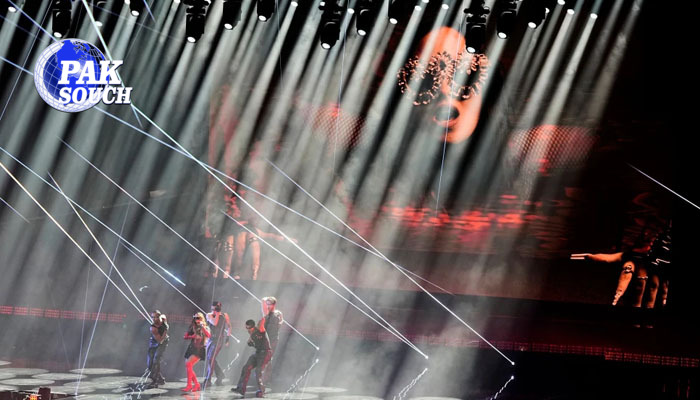
Spain has reportedly boycotted the annual Eurovision music competition in protest against Israel’s participation, with the country’s state broadcaster airing a message in support of Palestine during the event.
According to international media reports, Spain’s public broadcasting network chose not to air the Eurovision Song Contest 2026 in its traditional format and instead broadcast alternative programming. The move marked a significant political and cultural statement linked to ongoing international criticism of Israel’s actions in Gaza and the broader Palestinian issue.
Reports said this was the first time since 1961 that Spain did not fully broadcast the famous European music competition in its usual form.
As the Eurovision final began in Vienna, the Spanish television channel reportedly displayed a message expressing solidarity with Palestinians and calling for peace and justice.
In an official statement, Spain’s state broadcaster said:
“Eurovision is a competition, but human rights are not. There is no room for indifference. We demand peace and justice for Palestine.”
The broadcaster’s remarks reflected growing public and political pressure in several European countries regarding Israel’s inclusion in international cultural and sporting events amid the ongoing Middle East conflict.
According to media reports, Spain was not alone in its stance. Ireland, the Netherlands, Slovenia, and Iceland were also said to have joined the boycott movement or expressed opposition to Israel’s participation in the competition.
The controversy surrounding Eurovision has intensified in recent years as artists, activists, and some political groups have argued that international cultural events should not remain separate from humanitarian concerns and global conflicts.
Supporters of the boycott believe participation by Israel in major international events should be reconsidered because of the humanitarian situation in Gaza and allegations of human rights violations.
On the other hand, critics of such boycotts argue that cultural and artistic platforms should remain independent from political disputes and should continue promoting dialogue and international unity through music and entertainment.
Eurovision is one of Europe’s largest annual entertainment events, attracting millions of viewers worldwide. Although primarily a music competition, it has frequently intersected with political debates due to the participation of countries involved in international controversies.
The latest boycott highlights the increasing politicization of international cultural events and the growing influence of public opinion on broadcasters and participating nations.
Spain’s decision also follows earlier reports suggesting criticism of Israel’s participation in other international events, including discussions around sporting competitions.
Social media reactions to the boycott were divided. Supporters praised Spain and other countries for publicly supporting Palestinian rights, while others criticized the move as unnecessarily politicizing a music competition.
The European Broadcasting Union (EBU), which organizes Eurovision, has historically maintained that the contest is a non-political event intended to unite audiences through music. However, controversies involving participating countries have repeatedly challenged that position.
As international attention remains focused on the conflict in the Middle East, cultural events such as Eurovision are increasingly becoming platforms for political expression and public activism.
The incident demonstrates how global political tensions are continuing to influence entertainment, sports, and international cultural diplomacy across Europe and beyond.
About The Author