

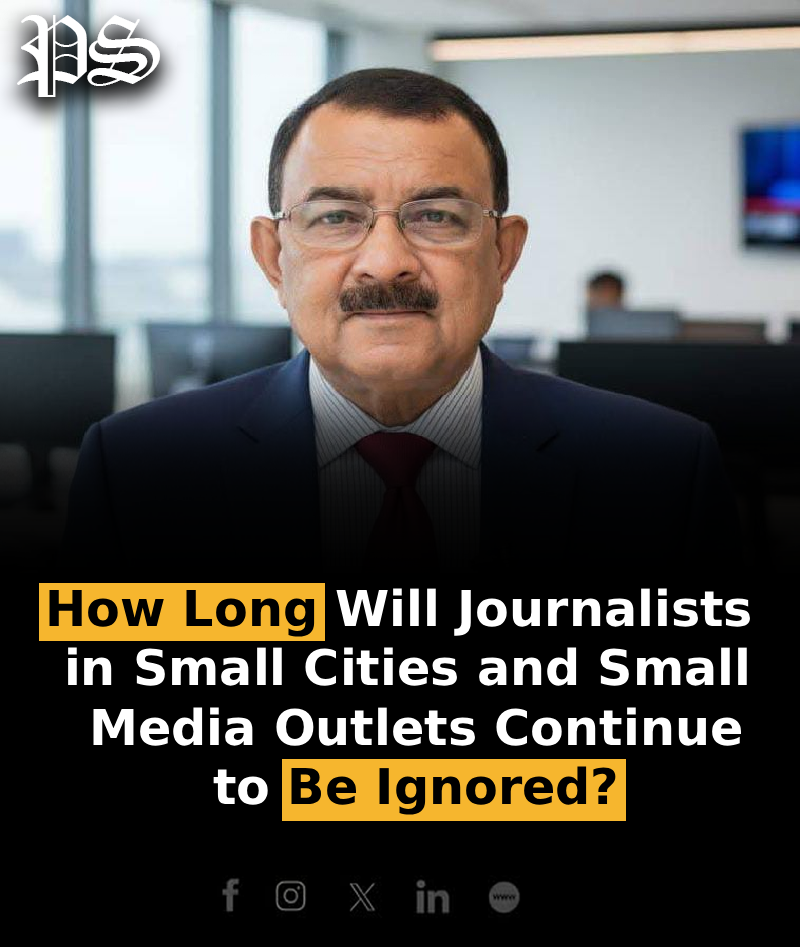
Journalism is often described as the fourth pillar of the state, but a bitter question remains unanswered: what support do the journalists in small cities have, who work every day to keep this pillar strong?
Journalists who raise their voices from morning until night about public issues, government inefficiency, corruption, law and order, inflation, health, education, electricity, water, and the lack of basic facilities—who will raise their voice about their own problems? Those who turn the suffering of others into news—when will their own suffering become news?
This question is not only directed at the government, but also at the Information Department, media organizations, press clubs, journalists’ unions, and all those leaders who claim on every forum to be champions of journalists’ rights.
A journalist is supposed to be a protector of the rights of others, yet journalists in both small and large cities themselves face deprivation. They speak out for the basic rights of the public but often remain deprived of basic rights themselves. They report on the lack of facilities in government hospitals, but when they themselves fall ill, they may not have the resources to afford expensive treatment.
They report on the hardships caused by inflation, while managing their own households on limited incomes can be a struggle. They publish stories about unemployed young people, yet many journalists themselves face uncertain employment.
The most painful situation arises when a journalist suffers from a prolonged illness. When treatment costs millions of rupees and income is limited—or nonexistent—the journalist is left with only two choices: endure the illness or seek help by asking others for assistance.
Is a person who has spent years serving society really deserving of such helplessness when illness strikes?
Why Is Recommendation Needed Even for Medical Treatment?
At different times, welfare packages, financial assistance, health cards, and other facilities have been announced for journalists. But the real question is: how accessible are these facilities to ordinary journalists?
If a journalist has to seek recommendations, rely on personal connections, or knock on the doors of influential people to obtain government assistance for medical treatment, then questions about the effectiveness of the welfare system are only natural.
PAK SOUCH MEDIA GROUP
Daily Pak Souch Newspaper Sukkur – Daily Pak Special Newspaper Karachi – Daily Pak Today Newspaper Karachi – Daily Pak Jazbo Newspaper Sukkur
Head Office : Ayub Gate Shaikh Muhalla Near Rabbania Masjid Sukkur
Karachi Office : Office No. 1901-B, 19th Floor Saima Trade Tower (B) Block I.I Chandigarh Road Near Jung Press, Shaheen Complex & National Museum of Pakistan Karachi Sindh Pakistan.
Contact : 03009319022
Website 1 : https://paksouch.com/
Website 2 : https://sindhi.paksouch.com/
Website 3 : https://pakjazbo.com/
Website 4 : https://urdu.pakjazbo.com/
About The Author