ISLAMABAD: Director General of Inter-Services Public Relations (DG ISPR) Lt Gen Ahmed Sharif Chaudhry said on Thursday that the Indian narrative of painting Pakistan as a source of terrorism had been “buried forever.”
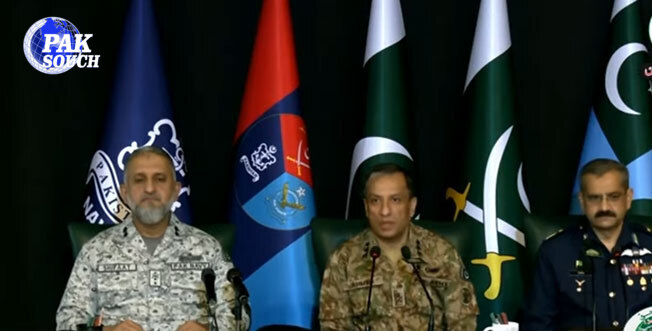
Addressing a press conference alongside Deputy Chief of Naval Staff (Operations) Rear Admiral Shifaat Ali Khan and Deputy Chief of Air Staff (Projects) Air Vice Marshal Tariq Mahmood Ghazi to mark one year of Marka-e-Haq, the DG ISPR shared details of the strategic consequences of the operation.
He said the Indian narrative of painting Pakistan as a source of terrorism had been buried forever, as the international community now fully understands that Pakistan is not a perpetrator but a victim of Indian-sponsored terrorism.
“For decades, India tried to create a narrative that Pakistan was involved in terrorism in India without presenting evidence,” he said.
The second strategic consequence, the DG ISPR said, is the consolidation of Pakistan as a net security stabilizer in the region, in line with the vision of the founding father, Muhammad Ali Jinnah, that Pakistan is a peace-loving country seeking peace within and beyond its borders.
During Marka-e-Haq, he said, everyone witnessed who was controlling the escalation, how dangerously India escalated based on a lie and fabricated narrative, and how maturely Pakistan and its armed forces handled the situation.
- Fitna-e-Hindustan and Fitna-Al-Khawarij attacks saw rise in Pakistan after India’s crushing defeat in Marka-e-Haq
- Field Marshal and Pakistan’s names have become nightmares for them (Indians): DG ISPR
- Afghanistan’s foreign minister was the first to visit India after their defeat in Marka-e-Haq: DG ISPR
- Marka-e-Haq and Bunyanum Marsoos showed the world Pakistan will respond befittingly in attacked: DG ISPR
- Pakistan started Operation Ghazab Lil Haq to crush the rise of India-sponsored terror after Marka-e-Haq : DG
ISPR - Indian media provided some quality entertainment to the masses during Marka-e-Haq
- Indian media even ‘constructed’ a port in Lahore
- This multifaceted war (waged by India) is being fought in cyber domain, information domain and working boundary
- Pakistan downed four Indian Rafale jets, one MiG-29, one Su-30, one Mirage 2000 and one multi-role unmanned aerial vehicle during Marka-e-Haq
Indian army has unfortunately been politicized
The third strategic consequence is “unfortunately” related to the eastern neighbour, that is, the politicization of Indian military leadership and the militarization of Indian political leadership, Lt Gen Ahmed Sharif Chaudhry said.
He noted that India once had a professional army, but that within a year it had unfortunately become politicised.
“You heard their air chief marshal a few months after Marka-e-Haq claiming that India had also downed some planes. That, he said, is politicisation of military leadership. ‘Why are you trying to make jokers out of your admirals, generals and marshals? Don’t do that,’ he stated.
On the other hand, no officer of the Pakistan Army made any political statement over the past year. ‘We have placed the facts as they are.’
He added that, at the same time, Indian politicians appeared to be acting like jingoists, raising slogans of ‘Akhand Bharat’ (Undivided India) and Hindutva slogans. DG ISPR described this trend as dangerous.
Fourth consequence
The fourth strategic consequence, the DG ISPR said, is the global acknowledgment of India’s efforts to externalize its internal problems and internalize its external problems, while using terrorism as a state tool.
Regarding India’s internal issues, he cited examples of persecution of Muslims, Dalits, Christians and tribal communities across India, particularly in Indian Illegally Occupied Jammu and Kashmir (IIOJK) and Manipur.
He said this stems from a “false sense of entitlement and a hubristic attitude.” The DG ISPR stated that India does not seek to resolve its internal problems and instead externalises them by accusing Pakistan of involvement in terrorism. He added that India should address these issues politically and internally.
He further clarified that Kashmir is not an internal matter of India but an internationally recognised dispute that has remained on the agenda of the United Nations for decades.
He said India, out of frustration, supports “Fitna al-Khawarij (FAK)” and “Fitna al-Hindustan (FAH).” He further alleged that the Indian government has at times carried out acts of terrorism within its own country in order to falsely accuse Pakistan.
Indian media – the fifth consequence
He said the fifth consequence is the “exposure of the true face of the Indian media and its discredited information operations.
He jibed that the Indian media and its information apparatus had provided considerable “entertainment” to the public, beginning with Indian media claims regarding the capture of Lahore port.
The DG ISPR also noted that the Indian government had started blocking Pakistani mainstream media and social media platforms during Marka-e-Haq, and that the practice was still continuing. He advised the Godi media to speak the truth.
Transformed character of warfare
He said the sixth strategic consequence is the transformed character of warfare, including multi-domain operations, non-contact warfare, synergy, the use of proxies and information warfare.
He said warfare has evolved beyond the Line of Control (LoC) and traditional borders, expanding into multiple domains.
“It has reached the streets, cities and villages. It is on land, at sea, in the air, in cyberspace, in information and in the minds. It is cognitive as well,” he said.
The world, he added, witnessed during Marka-e-Haq that Pakistan’s armed forces were fully prepared for warfare across all these domains.
“It was everywhere, including in the proxy domain, because India did not abandon its proxies even during the conflict. They are still using proxies,” he alleged.
However, he maintained that Pakistan was prepared then and remains prepared today as well.
Pakistan’s proven resilience
The seventh strategic consequence, he said, is Pakistan’s proven potential and resilience in combatting multifaceted challenges posed by both traditional and non-traditional security threats.
“In simple words, it is the belief in ourselves,” he said. Addressing the adversary, he added: “Play whatever tricks you want — we are resilient. Do whatever you want to do, go ahead. Nothing can undo Pakistan.”
No space for war between nuclear neighbours
The eighth strategic consequence, he added, is the loud and clear re-establishment of deterrence and reaffirmation of the fact that there is no space for war between two geographically contiguous nuclear neighbour states.