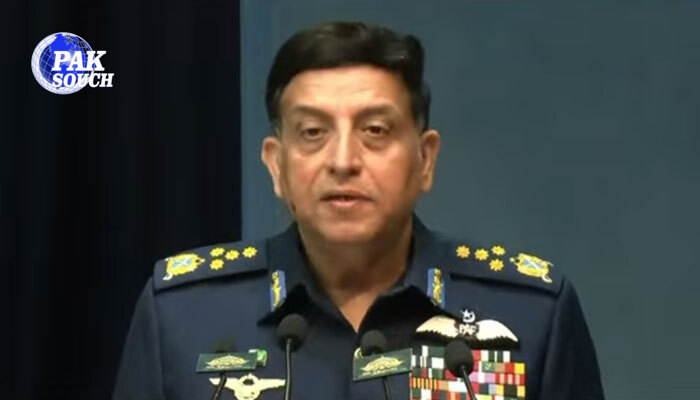
ISLAMABAD: Chief of Air Staff Air Chief Marshal Zaheer Ahmed Baber Sidhu has said that the Pakistan Air Force (PAF) delivered a crushing response to Indian aggression during the “Battle of Truth,” teaching the enemy a “humiliating lesson” from Srinagar to Bathinda through coordinated air, electronic, and cyber warfare operations.
The Air Chief made these remarks while addressing a ceremony at Air Headquarters in Islamabad marking the first anniversary of the success of “Maarka-e-Haq” (Battle of Truth), the military confrontation that Pakistan describes as a decisive defensive operation against Indian aggression.
During his speech, Air Chief Marshal Zaheer Ahmed Baber Sidhu said the conflict began after what he described as the “Pahalgam false flag operation,” following which India allegedly leveled baseless accusations against Pakistan.
“Pakistan offered India an impartial investigation after the Pahalgam incident, but despite our offer, India chose aggression,” he said.
The Air Chief stated that the Pakistan Air Force responded firmly and effectively to the Indian military action and inflicted severe damage on India’s air defense systems. According to him, the PAF played a central role in delivering a “decisive and unforgettable defeat” to the enemy.
“The Pakistan Air Force taught the enemy a lesson from Srinagar to Bathinda,” he said. “Our role in national defense has been historic.”
He further claimed that Pakistan successfully outperformed India not only in aerial combat but also in electronic and cyber warfare. Praising Pakistan’s cyber capabilities, he said the country’s “cyber falcons” effectively disrupted and damaged the enemy’s cyber security infrastructure during the conflict.
“Pakistan defeated the enemy in air warfare, electronic warfare, and cyber warfare,” the Air Chief said. “The Indian Air Force suffered a humiliating and disgraceful defeat.”
The ceremony at Air Headquarters was attended by senior military officials, officers, and personnel of the Pakistan Air Force. The event commemorated what Pakistani military officials describe as a defining moment in the country’s recent defense history.
Air Chief Marshal Sidhu emphasized that the PAF’s success was the result of years of preparation, modernization, and professional training. He praised the courage, professionalism, and operational readiness of Pakistan’s pilots, engineers, technical teams, and support staff.
According to the Air Chief, the conflict demonstrated the effectiveness of Pakistan’s integrated warfare capabilities and its ability to respond rapidly across multiple domains. He said modern warfare is no longer limited to conventional combat and that Pakistan had successfully adapted to the evolving nature of military conflict.
He also highlighted the importance of indigenous capabilities, advanced technology, and strategic coordination in securing Pakistan’s airspace and national interests.
“The bravery and professionalism displayed by our personnel will remain a proud chapter in the history of the Pakistan Air Force,” he added.
The Air Chief reiterated that Pakistan remains committed to peace but warned that any future aggression would be met with a swift and forceful response. He said the armed forces are fully prepared to defend the country’s sovereignty and territorial integrity under all circumstances.
The “Battle of Truth” anniversary has been observed across Pakistan with military ceremonies, official statements, and tributes to the armed forces. Pakistani leaders and military officials have repeatedly described the operation as proof of national unity, military preparedness, and strategic capability.
The Pakistan military maintains that the operation strengthened the country’s deterrence posture and sent a clear message that Pakistan would not compromise on its sovereignty or security.
Concluding his address, Air Chief Marshal Zaheer Ahmed Baber Sidhu said the Pakistan Air Force would continue to modernize and strengthen its capabilities in order to meet future security challenges and ensure the defense of the nation against any external threat.