


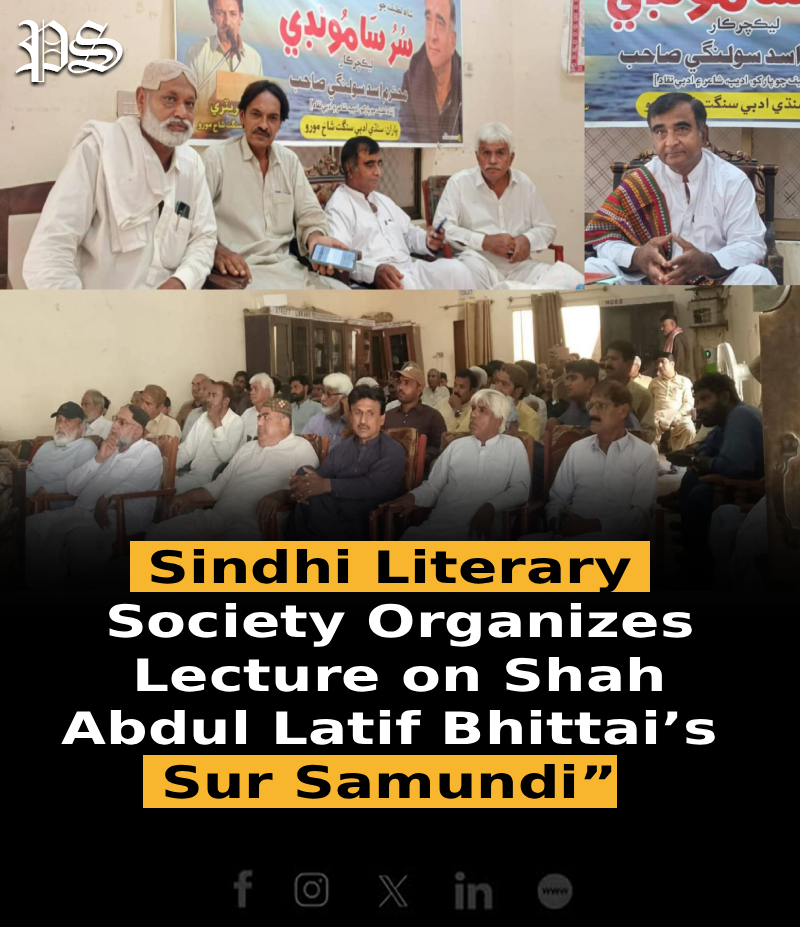
NAUSHAHRO FEROZE: The Sindhi Adabi Sangat organized an informative and well-attended lecture programme on the renowned Sindhi Sufi poet Shah Abdul Latif Bhittai’s celebrated poetic composition, “Sur Samundi.” The programme attracted more than a hundred members of the literary community, including poets, writers, critics and intellectuals from several branches of the organization.
The lecture was delivered by renowned scholar, poet, writer and critic Asad Solangi, who is widely regarded as an authority on the poetry and thought of Shah Abdul Latif Bhittai. The proceedings of the programme were conducted by branch secretary and noted critic Khaliq Bughio.
Prominent poet and intellectual Khadim Baladi welcomed the guests and expressed gratitude to all participants. He also highlighted the basic objectives of the Sindhi Adabi Sangat and emphasized the importance of organizing literary and intellectual programmes to promote Sindhi language, literature, culture and critical thought.
On the occasion, Ashraf Solangi presented a traditional lungi to the guest lecturer as a gesture of respect and appreciation.
The programme also featured performances of Shah Latif’s poetry. Bala Baloch beautifully performed a wai from “Sur Samundi” in a melodious voice and received enthusiastic applause from the audience. Another noted admirer and scholar of Shah Latif’s poetry, Syed Muhammad Yaseen Shah, presented selected verses from “Sur Samundi” and explained their historical and cultural backgrounds.
The branch’s Joint Secretary Ashraf Solangi also introduced the guest lecturer, Asad Solangi, to the audience and highlighted his contribution to the study and interpretation of Shah Latif’s poetry.
The event was attended by more than 100 members of the literary society. Members and office-bearers from the Naushahro Feroze, New Jatoi, Mithiani, Shahpur Jahaniyan and Diparaja branches also participated in large numbers. Among the visiting literary figures were Naveed Mallah, Anees Ansari and Abdul Jabbar Khoso.
Other artists and poets, including Inayat Solangi, Latif Khaskheli and Aziz Sabqi, also performed wais, adding a cultural and musical dimension to the literary gathering.
Delivering his detailed lecture, Asad Solangi explored various dimensions of “Sur Samundi,” explaining the background, context, vocabulary, cultural elements, observations and experiences reflected in Shah Latif’s verses.
He described “Sur Samundi” as a composition deeply associated with feelings of longing, emotional pain and waiting. According to him, Shah Latif presented in this sur his observations of changing seasons and the experiences of sailors and traders travelling across the sea.
Solangi explained that Shah Latif masterfully captured the departure of merchants and sailors, the season associated with Diwali, and the customs, traditions and social practices prevalent during that period. Through these details, the poet transformed ordinary social experiences into powerful literary and cultural imagery.
The lecturer also discussed the meanings of several important words appearing in Shah Latif’s poetry. He explained that the word “Mualim” in the verses should not necessarily be understood as referring to a conventional teacher. Rather, in the context of the sea and waterways, it could refer to people possessing specialized knowledge of the sea, water and seasons.
Solangi also examined the word “chein,” explaining its historical and cultural associations. He said the term had connections with an ancient practice and that its usage had continued in Sindh in different contexts over time.
Discussing verses such as “Sar Lohira Ghabhya” and “Kusar Nasriya,” he provided interpretations concerning nature, seasonal changes and the relationship between human life and the environment.
He said that Shah Latif was a poet deeply concerned with the original nature of things and that his observation of the natural world was one of the remarkable qualities of his poetry.
According to Solangi, the imagery in “Sur Samundi” is so vivid that painters could create entire works of art based on the visual scenes presented in Shah Latif’s verses.
He also discussed the word “Khedan,” explaining its association with an action similar to ploughing the earth with oxen. Shah Latif, he said, employed this imagery in relation to boats moving through the sea, creating a distinctive form of poetic landscape and visual representation.
The lecturer further referred to “Aith,” a star appearing in Shah Latif’s poetic imagery, and explained how such references demonstrate the poet’s close observation of nature, the sky and the traditional knowledge of his era.
Solangi emphasized that Shah Latif’s artistic expression and intellectual thought were part of a continuing tradition within Sindhi poetry. He argued that Latif’s creative work was influenced by and connected with earlier poets and literary traditions.
He cited Shah Inayat of Nasrpur as one of the figures whose influence could be observed in the development of “Sur Samundi.” He also referred to “Sur Kapaiti” as another example of Shah Latif’s connection with earlier poetic traditions and highlighted its remarkable use of alliteration and sound patterns.
Following the lecture, an extensive question-and-answer session was held. Participants asked detailed and important questions concerning Shah Latif’s poetry, vocabulary, historical references, cultural context and literary techniques. The lecturer responded to the questions and further elaborated on various aspects of the sur.
Guests and participants congratulated the current office-bearers of the Sindhi Adabi Sangat branch, particularly Secretary Khaliq Bughio, for organizing what they described as a dignified, informative and successful literary programme.
The event concluded with the distribution of nangr (community food) among all participants and guests.
The programme was widely appreciated by members of the literary community and demonstrated the continuing interest in Shah Abdul Latif Bhittai’s poetry, particularly among scholars seeking to explore its linguistic, cultural, historical and philosophical dimensions.
The organizers said such programmes would continue to provide opportunities for literary discussion, critical analysis and the preservation and promotion of Sindhi cultural heritage.
About The Author