

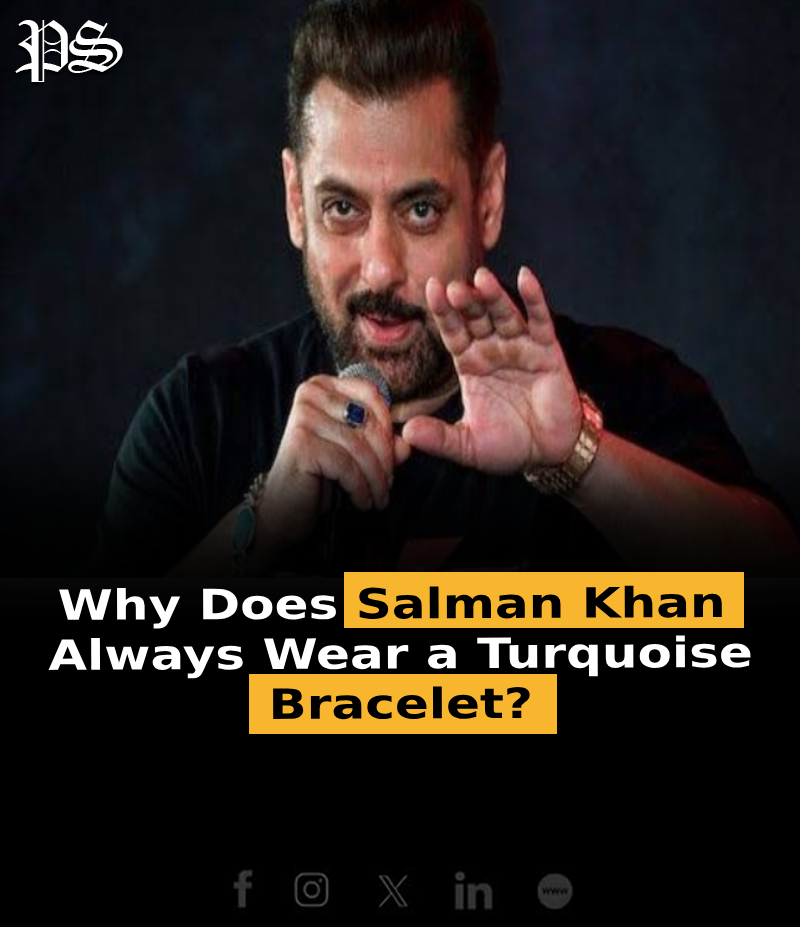
Salman Khan ’s signature turquoise bracelet has once again attracted the attention of fans and social media users. The Bollywood superstar is frequently seen wearing the bracelet on his right wrist, including at public appearances and special events.
The bracelet has become closely associated with Salman Khan’s personal style, with fans often wondering why he continues to wear it so consistently.
Salman Khan himself has previously explained the story behind the bracelet in an old interview, which has resurfaced on social media.
According to the actor, his father, veteran screenwriter Salim Khan, used to wear a similar bracelet. Salman said that as a child he would play with his father’s bracelet. Later, after entering the film industry, his father gave him one of his own.
Over the years, the bracelet became a permanent part of Salman Khan’s appearance and personal style.
The actor has also spoken about his belief in the significance of the turquoise stone. He believes that the stone absorbs negative effects and helps protect the mind from stress and tension.
This personal belief is one reason fans associate the bracelet with Salman beyond its value as a fashion accessory.
The bracelet has consequently become one of the most recognizable elements of Salman Khan’s public image. While he regularly changes his clothes and overall styling for films, award shows and other appearances, the turquoise bracelet has remained a remarkably consistent part of his look.
For many fans, the bracelet is therefore more than just jewelry. It represents a personal connection between Salman and his father and has remained with the actor throughout his decades-long career in Bollywood.
It has also developed into something of a trademark. Whenever Salman Khan appears in public, fans frequently notice the bracelet before discussing other aspects of his appearance.
The story behind it also explains why the actor continues to wear it even on major occasions. Rather than being simply a fashion choice, the bracelet carries sentimental value because it was connected to his childhood and gifted to him by his father.
Salman’s comments about turquoise also reflect his personal belief in the stone’s protective qualities. Such beliefs about turquoise are common in various traditions, although claims that the stone can absorb negative energy or protect against stress are not scientifically established.
Nevertheless, for Salman Khan, the bracelet appears to have both emotional and personal significance. What began as a childhood connection with his father’s bracelet eventually became one of the actor’s most recognizable trademarks.
Thus, the reason Salman Khan continues to wear the turquoise bracelet is essentially a combination of family sentiment, personal belief and long-standing personal style.
About The Author