


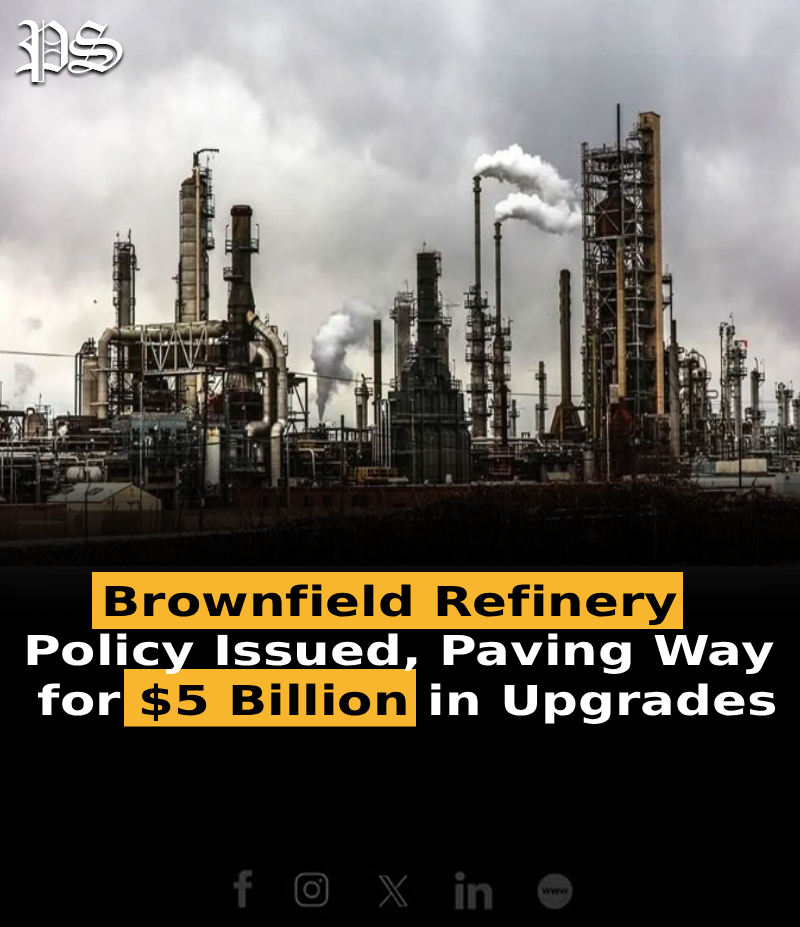
ISLAMABAD: The government has issued its long-awaited Brownfield Refinery Policy, paving the way for refinery upgradation projects estimated at around $5 billion.
Under the new policy, existing oil refineries will have to enter into upgrade agreements by October 1. Refineries that fail to sign the required agreements within the deadline will face a further reduction in the deemed duty applicable to high-speed diesel (HSD).
The policy sets another important deadline of part of its efforts to ensure that existing refineries undertake major modernization and expansion projects rather than continuing to operate with outdated infrastructure planned investments could significantly upgrade refinery operations and help improve the country’s ability to meet November 15. If a refinery fails to enter into an agreement by that date, its deemed duty will be completely withdrawn.
The government has introduced the deadlines as part of its efforts to ensure that existing refineries undertake major modernization and expansion projects rather than continuing to operate with outdated infrastructure.
The brownfield policy is aimed at encouraging investment in Pakistan’s existing refining capacity and improving the production of higher-value petroleum products. The planned investments could significantly upgrade refinery operations and help improve the country’s ability to meet domestic fuel requirements.
According to the policy, refineries will also be required to maintain adequate crude oil inventories. They must maintain stocks equivalent to 20 days of imported crude oil and 15 days of locally produced crude oil.
The inventory requirement is intended to strengthen fuel security and ensure that refineries have sufficient raw material available in case of disruptions to crude oil supplies.
The government has been pushing for modernization of Pakistan’s aging refinery sector for several years. Existing refineries require substantial investment to improve efficiency and increase the production of products such as petrol and diesel while reducing the production of lower-value furnace oil.
The new policy provides a framework for these investments while linking financial incentives to the implementation of upgrade agreements.
The withdrawal of deemed duty for refineries that fail to meet the November 15 deadline is expected to create additional pressure on companies to commit to their modernization plans.
The estimated $5 billion investment pipeline could represent one of the largest rounds of investment in Pakistan’s petroleum refining sector. The projects are expected to improve refining efficiency, enhance fuel quality and increase the production of petroleum products needed by the domestic market.
The policy also seeks to provide greater clarity to refinery operators regarding the incentives and obligations associated with modernization.
The deadlines of October 1 and November 15 will now be key milestones for the industry. Refineries that secure agreements within the prescribed period will be able to retain the relevant policy benefits, while those that fail to comply will face reductions or complete withdrawal of deemed duty.
The government expects the brownfield policy to encourage long-term investment in domestic refining capacity and reduce Pakistan’s reliance on imported refined petroleum products.
If implemented successfully, the planned upgrades could also strengthen the country’s energy security, improve the quality of locally produced fuels and modernize an important part of Pakistan’s petroleum infrastructure.
About The Author