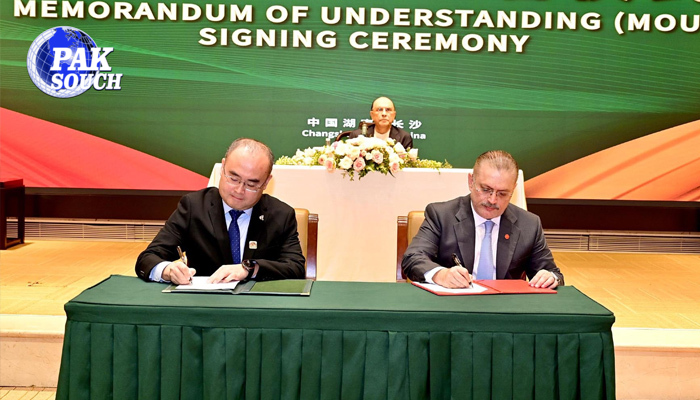
Pakistan and China have signed three Memorandums of Understanding (MoUs) aimed at enhancing cooperation in key sectors, including a major project to make seawater usable for Karachi, along with agreements in agricultural technology and the tea industry.
The signing ceremony was held in Changsha, the capital of China’s Hunan province, and was attended by President Asif Ali Zardari. The agreements reflect growing bilateral collaboration focused on infrastructure development, technology transfer, and economic cooperation.
The first MoU was signed between the Sindh Local Government Department and China’s Loxian Environmental Technology Group. This agreement focuses on developing a seawater desalination project to help address Karachi’s chronic water shortage. The initiative aims to increase the city’s water supply by converting seawater into potable water.
Senior Sindh Minister Sharjeel Inam Memon and Yu Hui, Chairman and Party Secretary of the Chinese company, signed the agreement on behalf of their respective sides.
The second MoU was signed between the Sindh Local Government Department and Longping High-Tech Information Company. This agreement centers on cooperation in agricultural technology, with the goal of improving farming practices, increasing productivity, and introducing modern techniques in Pakistan’s agriculture sector. Sharjeel Inam Memon and Chen Zhixin, Chairman of the Chinese company, formalized the agreement.
The third MoU relates to the tea sector and was signed between Musk and Fimti Trading Company, Hunan Tea Group, and Jialong International Technology (Hainan). Representing Pakistan, Senator Saleem Mandviwalla signed the agreement, while Zhou Chongwang, Party Secretary and Chairman of Hunan Tea Group, and Hao Jialong, Chairman of Jialong International Trade Technology, signed on behalf of the Chinese side.
This agreement aims to promote cooperation across various aspects of the tea industry, including production, processing, trade, and technological development. It also seeks to strengthen economic ties, boost trade relations, and enhance people-to-people connections between the two countries.
Officials noted that these MoUs are part of broader efforts to deepen Pakistan-China strategic partnership and expand collaboration beyond traditional sectors. The desalination project, in particular, is seen as a significant step toward addressing Karachi’s long-standing water crisis.