


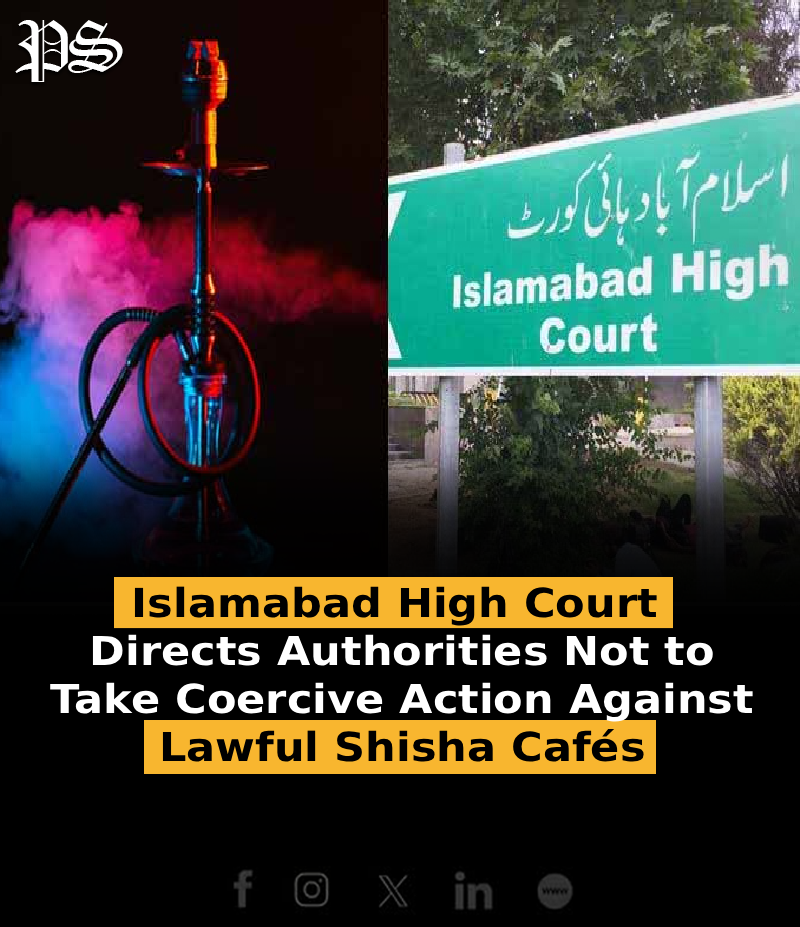
ISLAMABAD — The Islamabad High Court has issued an order concerning shisha cafés, directing authorities not to take coercive action against establishments that are operating legally under the existing law and valid permits.
The court also sought a response from the federal government in a case concerning shisha cafés and directed the authorities to establish and implement a proper regulatory framework for such businesses.
According to the court order, the Islamabad High Court instructed the relevant authorities to enforce rules governing shisha cafés within one month. The federal cabinet was also directed to expedite approval of legislation and regulations concerning restrictions on shisha smoking.
The court directed the Advocate General for Islamabad and the Additional Attorney General to raise the matter before the relevant government authorities and ensure that the court’s directions were communicated to the concerned departments.
The Islamabad High Court observed that protecting young people from drugs and shisha smoking is a responsibility of the government. It expressed concern over the absence of a clear and comprehensive legal framework regulating shisha cafés.
The court directed the authorities to finalize the relevant rules within one month and submit a compliance report regarding the steps taken to implement them.
At the same time, the court made an important distinction between legal and illegal establishments. It directed the Islamabad Police to continue strict action against illegal shisha cafés while ensuring that restaurants and cafés operating in accordance with the law are not subjected to unlawful or coercive measures.
The court said that establishments functioning legally under applicable laws and permits should not be targeted through illegal action. However, where a café or restaurant violates the law or the terms of its permit, the authorities may take strict legal action against it.
The court also directed the Anti-Narcotics Force to cooperate with the police in efforts to eliminate the use and distribution of narcotics. The direction reflects the court’s broader concern about the potential connection between drug use and certain shisha café activities.
The order emphasizes that enforcement agencies must operate within the framework of the law while addressing concerns related to public health, drug use and the protection of young people.
The court’s observations came during the hearing of petitions concerning shisha cafés. The petitioners had approached the court over actions being taken against such establishments and issues relating to their regulation.
The Islamabad High Court’s directions seek to balance enforcement against unlawful shisha cafés with protection for businesses that are operating legally. Rather than permitting blanket action against all shisha cafés, the court directed authorities to distinguish between establishments that comply with legal requirements and those that violate them.
The court noted that the lack of a clearly defined regulatory framework was a matter of concern and instructed the government to address the issue within a specific timeframe.
Under the directions, the federal government has been given one month to finalize the relevant rules and regulations and submit a report demonstrating compliance with the court’s instructions.
The federal cabinet has also been directed to move quickly on legislation or rules aimed at regulating and restricting shisha smoking. The process is expected to provide greater clarity for both enforcement agencies and businesses operating in the sector.
The court further instructed the Advocate General for Islamabad and the Additional Attorney General to take up the matter with the relevant authorities. This is intended to facilitate coordination among the federal government, Islamabad administration, police and other agencies responsible for implementing the regulations.
The Islamabad Police was specifically directed to continue taking strict action against illegal shisha cafés. At the same time, the court stressed that lawful restaurants should not face unlawful measures merely because they offer shisha-related services within the scope of applicable permits and regulations.
The court also warned that violations of the law or permit conditions would justify strict legal action. Businesses therefore remain responsible for ensuring that their operations comply fully with existing legal requirements.
The Islamabad High Court ordered that all related petitions be clubbed together so that the issues surrounding shisha cafés could be considered collectively.
The hearing was subsequently adjourned until October 13, when the court is expected to review the government’s progress and compliance with its directions.
The ruling places responsibility on the government to establish a clear legal framework while requiring enforcement agencies to ensure that their actions remain within the law. It also highlights the court’s concern about protecting young people from drug abuse and the potential health and social risks associated with shisha smoking.
The case is expected to remain significant for shisha cafés and restaurants in Islamabad, particularly as the government works on formalizing rules governing their operation. Businesses that comply with the law and valid permit conditions have been assured protection from unlawful or coercive action, while establishments operating illegally remain subject to enforcement.
The next hearing on October 13 is likely to provide further clarity on the implementation of the proposed regulatory framework and the federal government’s response to the court’s directions.
About The Author