


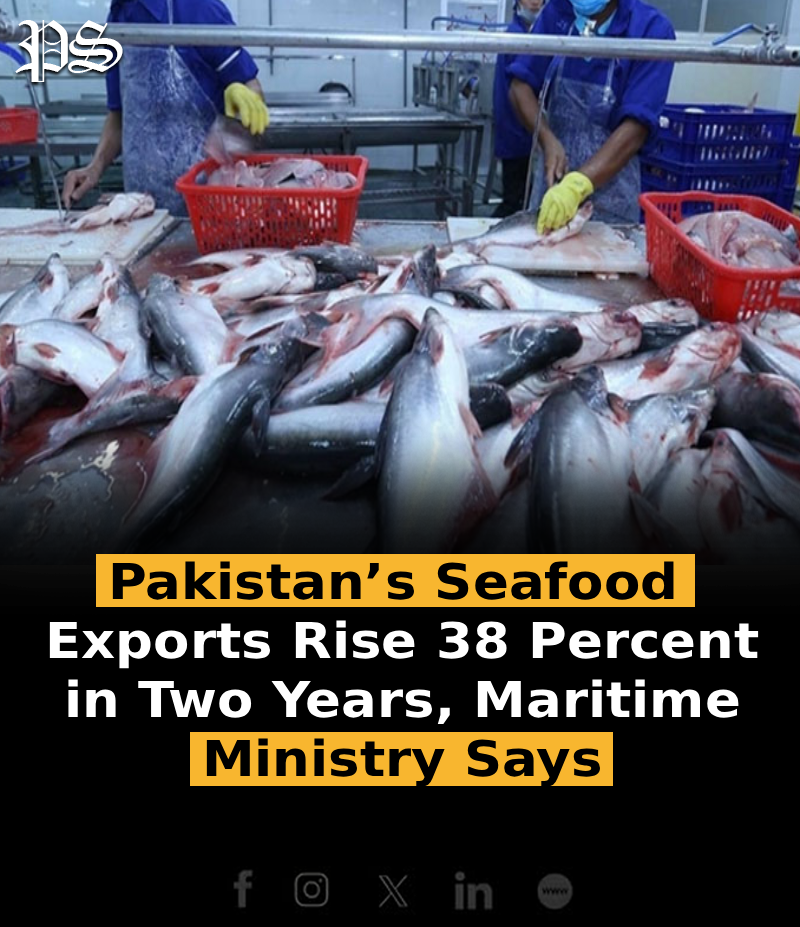
ISLAMABAD: Pakistan has recorded a significant increase in seafood exports, marking what the Ministry of Maritime Affairs has described as major progress in the country’s blue economy.
According to the ministry, Pakistani seafood exports have increased by 38 percent over the past two years, reflecting growing demand for the country’s marine products in international markets.
Official figures cited by the Ministry of Maritime Affairs show that seafood exports stood at approximately $406 million in the 2023-24 financial year. By 2025-26, the value had risen to around $568 million, representing a substantial increase in export earnings from the sector.
The growth has been welcomed as an important development for Pakistan’s blue economy, which includes economic activities linked to oceans, seas, fisheries, marine resources and coastal development.
The ministry said Pakistani seafood products are increasingly reaching major international markets, including China, Japan, Saudi Arabia, the United Arab Emirates and the United States.
China has emerged as an important destination for Pakistani seafood, with exports to the Chinese market showing continued growth. The increasing demand from international buyers is providing new opportunities for Pakistani fisheries and seafood exporters.
Officials believe the expansion of seafood exports could contribute to higher foreign-exchange earnings and create additional employment opportunities in coastal communities. The sector supports a wide range of economic activities, including fishing, processing, packaging, transportation and export-related services.
Pakistan has a long coastline along the Arabian Sea and possesses significant marine resources. Karachi and other coastal areas are important centers for the country’s fishing and seafood-processing industries.
The increase in exports is therefore being viewed as an indication of the potential that exists within Pakistan’s marine economy. Better utilization of marine resources, improvements in processing facilities and greater access to international markets could further increase the sector’s contribution to the national economy.
The Ministry of Maritime Affairs also highlighted the gradual restoration of confidence in Pakistani seafood products in European markets.
Pakistan’s seafood industry had faced significant challenges in the European market following a ban imposed by the European Union in 2007. The restriction affected the country’s seafood exporters and created difficulties in maintaining access to one of the world’s major consumer markets.
According to the ministry, Pakistani seafood is now gradually rebuilding confidence in European markets after years of efforts to improve quality standards, processing practices and compliance with international requirements.
The restoration of market confidence is considered particularly important because European countries have stringent food safety, hygiene and traceability requirements.
Improved compliance with international standards can help Pakistani exporters gain access to additional markets and increase the value of seafood exports.
The latest figures indicate that the country’s seafood sector has significant potential for further growth. The increase from $406 million to $568 million in two years represents an additional export value of approximately $162 million.
The development also highlights the importance of strengthening the country’s blue economy as part of its broader strategy to diversify exports and increase foreign-exchange earnings.
Experts and industry stakeholders have frequently emphasized that Pakistan’s maritime resources remain underutilized compared with their potential. The country’s coastline, fisheries and marine ecosystems provide opportunities not only for seafood exports but also for shipping, marine tourism, aquaculture and other ocean-related economic activities.
The government has increasingly focused on the blue economy as a means of generating economic activity and supporting coastal communities.
For the seafood sector, continued growth will depend on maintaining product quality, improving cold-chain infrastructure, modernizing fishing and processing facilities, and ensuring compliance with international food safety standards.
Expanding aquaculture could also provide additional opportunities. Sustainable fish and shrimp farming can complement traditional marine fishing and potentially increase production for both domestic consumption and export markets.
The growing demand from countries such as China, Japan, Saudi Arabia, the UAE and the United States demonstrates that Pakistani seafood has a broad international market.
Officials are expected to focus on further expanding these markets while exploring opportunities in other regions.
The Ministry of Maritime Affairs said the increase in seafood exports represents a positive development for Pakistan’s blue economy and demonstrates the potential of the maritime sector to contribute to national economic growth.
The government’s challenge now will be to ensure that the recent growth is sustained and that the country can increase its share of the global seafood market while protecting marine resources.
Sustainable fishing practices will be particularly important as higher export demand could place additional pressure on marine ecosystems. Ensuring responsible harvesting and effective fisheries management will be essential for maintaining the sector’s long-term productivity.
The rise in exports also provides an opportunity to improve the livelihoods of fishing communities by creating stronger links between local producers and international markets.
With seafood exports reaching $568 million in 2025-26, the sector has emerged as an increasingly important component of Pakistan’s export economy.
The Ministry of Maritime Affairs has described the 38 percent increase over two years as a major achievement for the blue economy. The continued expansion of Pakistani seafood into international markets, alongside the gradual restoration of confidence in Europe, could provide a foundation for further growth in the country’s maritime economy.
About The Author