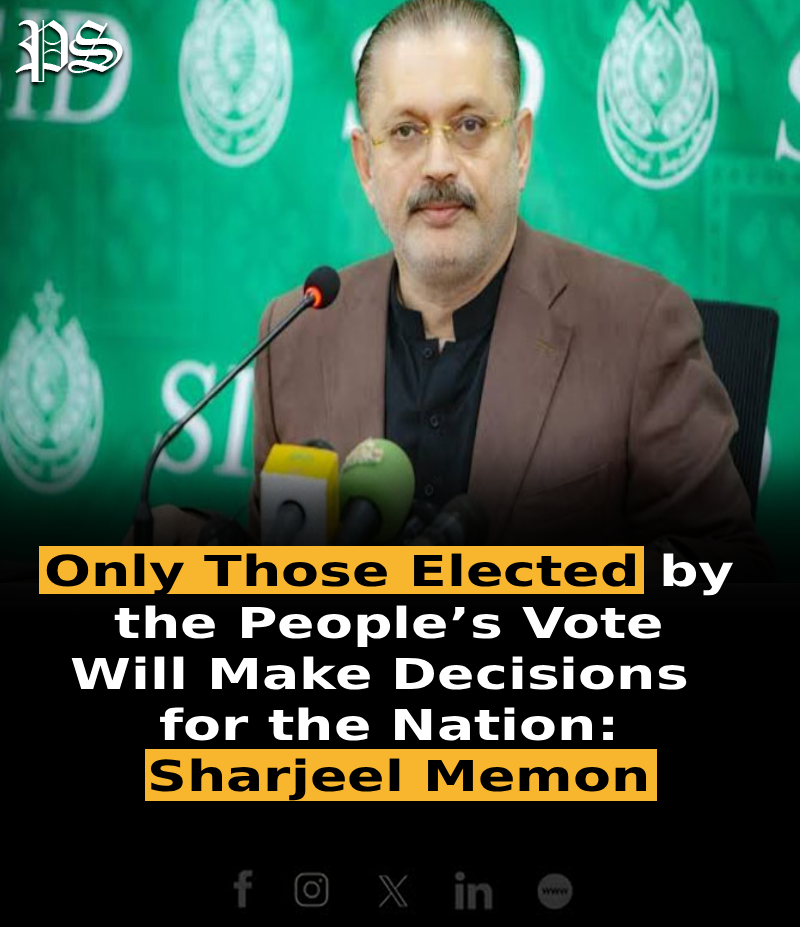
KARACHI: Sindh Senior Minister Sharjeel Memon has said that decisions concerning the nation should be made by those who have been elected by the people through their votes, while individuals sitting on what he described as “charity or artificial mandates” cannot make decisions on behalf of the nation.
Speaking in the Sindh Assembly, Memon defended the 18th Constitutional Amendment and said it had brought significant progress in several sectors, including health, education and energy.
He criticized certain federal ministers for speaking against the 18th Amendment and questioned the condition of Jinnah Postgraduate Medical Centre before the amendment and its present situation.
“Those who are products of Form 47 are lecturing us about the 18th Amendment today,” Memon said, referring to allegations of electoral manipulation made by political opponents.
Memon maintained that the devolution of powers under the 18th Amendment had enabled provinces to improve public services and undertake development in areas that had previously remained under greater federal control.
He also highlighted Sindh’s contribution to the country’s energy requirements. According to the senior minister, more than 3,500 megawatts of electricity is being generated from Thar, with energy produced from Sindh’s resources benefiting the entire country.
Memon said that if political figures such as Mustafa Kamal, Ahsan Iqbal, Khawaja Asif or anyone else had objections to Sindh’s position, they should raise the issue in Parliament.
He said the Sindh Assembly had the constitutional and legal capacity to respond to every argument put forward against the province.
“If you have an argument and a position, come to the assembly and discuss it,” Memon said.
His remarks came amid an ongoing political debate over the 18th Amendment, provincial autonomy and the distribution of powers between the federal government and the provinces.
Memon further advised federal ministers to first go among the people, seek their votes and get elected before making decisions or issuing statements about matters concerning the public.
He said political authority should come from the people’s mandate rather than from what he termed artificial or charitable support.
“Those sitting on a charitable or artificial mandate cannot make decisions for the nation,” Memon said.
He emphasized that the people themselves should determine who has the authority to represent their interests and make decisions on their behalf.
“The decisions of the nation will be made by those whom the nation has elected through its vote,” he added.
Memon’s comments reflect the Pakistan Peoples Party’s longstanding emphasis on provincial autonomy and the protection of the powers transferred to the provinces under the 18th Constitutional Amendment.
The amendment, passed in 2010, significantly altered Pakistan’s constitutional framework by abolishing the Concurrent Legislative List and transferring a number of responsibilities from the federal government to the provinces. Supporters regard it as a major step toward strengthening parliamentary democracy and provincial autonomy, while critics have periodically called for changes to the existing arrangement.
The debate has gained renewed political attention as different parties continue to disagree over the scope of provincial powers, the creation of new administrative units and the management of natural resources.
Memon also challenged political opponents to bring their arguments before the relevant parliamentary forums rather than criticizing Sindh’s policies from outside the provincial assembly.
He reiterated that representatives who possess a genuine electoral mandate are the ones entitled to speak on behalf of the people and participate in decisions affecting the country.
The senior minister’s statement is likely to further intensify the political discussion surrounding the 18th Amendment, provincial autonomy and the legitimacy of electoral mandates in Pakistan.
About The Author