


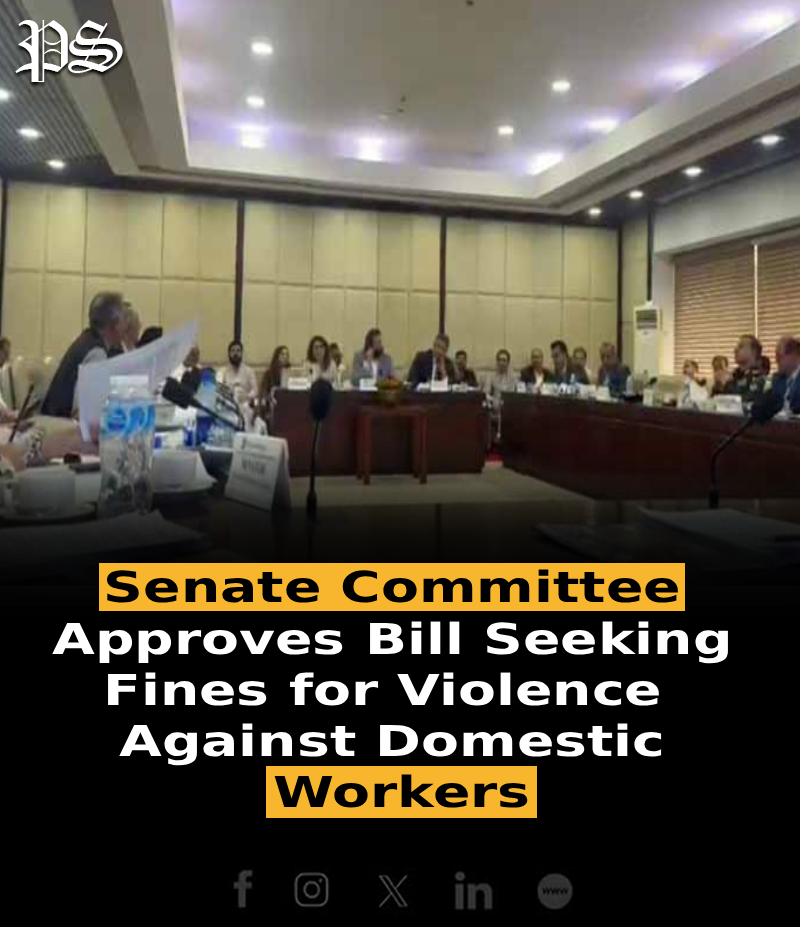
Islamabad: The Senate Standing Committee on Interior has approved the Criminal Law Amendment Bill 2026, which seeks to impose fines on individuals who subject domestic workers to violence or abuse.
The bill was presented by Senator Sarmad Ali during a meeting of the Senate committee. He argued that domestic workers frequently face problems including non-payment of wages and physical abuse, and said stronger legal deterrence was needed to protect them.
Sarmad Ali said the proposed legislation would introduce a financial penalty for those found guilty of mistreating domestic workers. He argued that even a minimum mandatory fine could serve as a deterrent and create fear of legal consequences among those who abuse or exploit household employees.
During the discussion, Committee Chairman Faisal Saleem Rehman pointed out that similar legislation already exists in Islamabad. He directed that details of the existing laws, along with a comparative chart showing how the proposed legislation differs from the current legal framework, should be presented at the committee’s next meeting.
The discussion then turned to concerns about possible misuse of the proposed law.
Minister of State for Interior Talal Chaudhry cautioned that there could be complications if fines and criminal cases were initiated solely on the basis of complaints made by domestic workers. He said that “every story has two sides” and suggested that the committee should also consider situations in which complaints might be false or motivated by other interests.
Chaudhry referred to alleged incidents involving organized groups in upscale areas of Faisalabad. According to him, some groups allegedly pay police officers around Rs2,000 to register cases against employers. He argued that such possibilities needed to be taken into account before introducing additional legal penalties.
The minister also said that the bill had been deferred while several other bills concerning women had been approved, describing the delay as unfair to Senator Sarmad Ali.
Senator Samina Zehri strongly challenged the minister’s argument, saying that determining whether an alleged group was a genuine “mafia” or not was the responsibility of law-enforcement authorities.
She also highlighted the seriousness of abuse against domestic workers, referring to an alleged incident in Balochistan in which employers reportedly subjected an entire family of workers to brutal treatment by hanging them upside down in a well.
Zehri expressed frustration over the lack of accountability in the country, arguing that people often believe they can harm others without facing meaningful consequences.
The committee chairman subsequently suggested seeking the views of all four provincial governments before proceeding further. Faisal Saleem Rehman said that the committee could obtain the provinces’ opinions on the proposed legislation, although he humorously noted that it could become difficult to determine how many other stakeholders would ultimately need to be consulted.
Despite the reservations raised during the discussion, Senator Sarmad Ali requested that the committee proceed with voting on the bill.
The committee subsequently voted and unanimously approved the Criminal Law Amendment Bill 2026.
The approval represents a significant step toward strengthening legal protection for domestic workers, who often work in private households where monitoring and enforcement can be difficult. Supporters of the legislation argue that financial penalties could provide an additional deterrent against physical abuse, exploitation and other forms of mistreatment.
At the same time, the concerns raised by the interior minister and other committee members highlight the importance of establishing safeguards against false complaints and ensuring that the law is applied fairly to both workers and employers.
The proposed legislation will now move through the next stages of the parliamentary process. Its final implementation will depend on approval by the relevant parliamentary forums and completion of the legislative procedure.
The committee’s decision has nevertheless placed the treatment and legal protection of domestic workers firmly on the parliamentary agenda, particularly the need to address unpaid wages and violence while ensuring that any new enforcement mechanism remains fair, transparent and resistant to abuse.
About The Author