

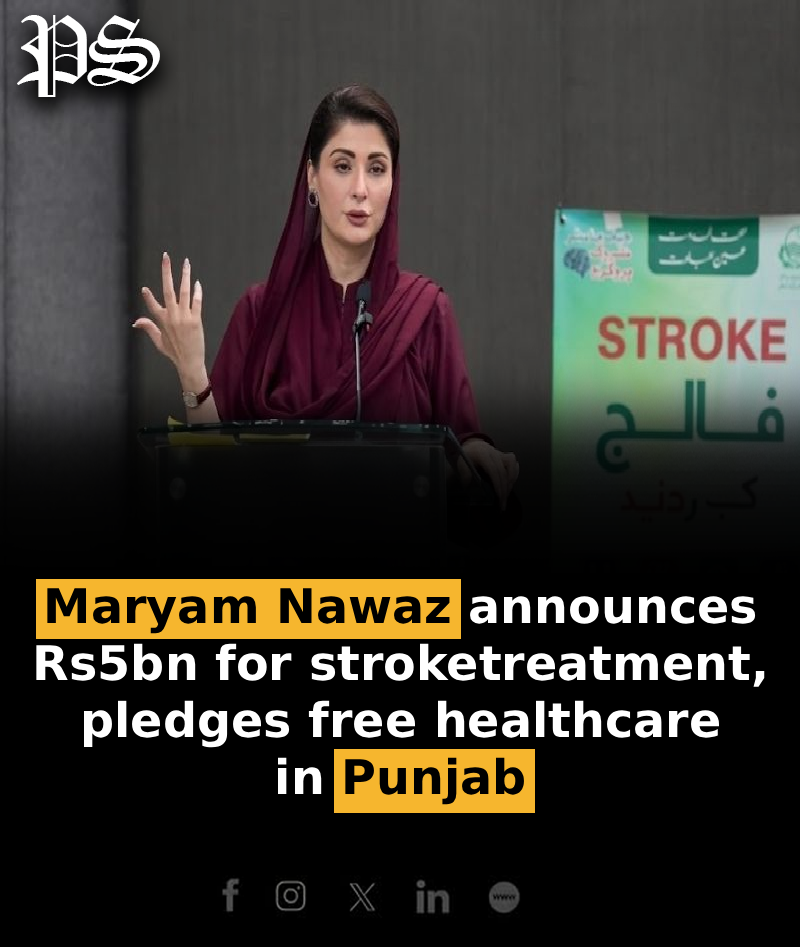
LAHORE: Punjab Chief Minister Maryam Nawaz Sharif on Thursday announced Rs5 billion for stroke treatment, directing officials to ensure that no patient is denied care because of a shortage of funds.
Speaking at an event marking the distribution of stroke cards, she said the funding would support treatment for stroke patients, stressing the need for timely intervention to prevent permanent disability and save lives.
“I don’t want anybody to suffer because you don’t have money,” she said, directing her team to transfer the funds immediately and telling doctors to approach her directly if they faced further financial constraints.
Maryam Nawaz praised doctors Qasim Bashir and Asif Bashir and their teams for treating patients and training medical staff, including nurses, in specialised stroke care.
She said her visit to the intensive care unit and operating theatres had highlighted the importance of government investment in healthcare, particularly for low-income patients who could not afford expensive treatment at private hospitals.
The chief minister described stroke treatment as a time-sensitive emergency, saying patients needed to receive a clot-dissolving injection within four-and-a-half hours of the onset of symptoms to reduce the risk of permanent damage.
She said a single tenecteplase (TNK) injection cost around Rs300,000, putting it beyond the reach of many families.
Maryam recounted meeting a 42-year-old driver who had suffered a stroke but received the injection in time and was undergoing rehabilitation. Doctors told her that without the treatment, he could have suffered irreversible damage or become bedridden.
The patient had developed symptoms while driving and was taken to hospital by friends, she said, adding that timely treatment had helped preserve his ability to move his limbs.
“Every minute matters,” she said, urging people to seek immediate medical assistance if they experienced facial drooping, weakness in an arm or leg, restricted movement or slurred speech.
Punjab expands stroke treatment network
Maryam said the number of operational primary stroke centres in Punjab had increased from 16 to 40 across 23 districts within a few months. Another 15 centres were under development and were expected to be completed in the coming months, she added.
The expansion aims to reduce the need for patients in distant districts to travel to Lahore for emergency treatment, when delays can worsen their condition.
A patient suffering a stroke in Rahim Yar Khan, for example, might not be able to reach Lahore within the critical treatment window, particularly if the family lacked its own transport, she said.
The chief minister said the provincial government was also expanding comprehensive stroke treatment facilities capable of carrying out more advanced procedures to remove blood clots.
Three comprehensive stroke centres were operational, she said, while four or five more were planned.
She identified the Punjab Institute of Neurosciences in Lahore and the Rawalpindi Institute of Cardiology among the existing facilities.
She also cited treatment carried out at Sheikh Zayed Hospital in Rahim Yar Khan, saying patients in south Punjab could now receive specialised interventions without having to travel to Lahore.
Planned facilities include comprehensive stroke centres at Holy Family Hospital in Rawalpindi and hospitals in Multan and Faisalabad, she said.
Maryam called for greater investment in specialist neurological nursing and the training of doctors and physicians, saying more trained personnel were needed to improve outcomes for stroke patients.
She also urged the government to launch sustained public awareness campaigns explaining stroke symptoms, risk factors and the importance of seeking immediate treatment.
High blood pressure, diabetes, irregular heartbeat and high cholesterol were among the risk factors she identified. She advised people experiencing possible stroke symptoms to contact emergency services or seek care at the nearest stroke centre without delay.
Maryam praised Rescue 1122, saying its head, Dr Rizwan, had informed her that the service transported about 85 stroke patients daily to the nearest stroke centre.
Cancer, cardiac and children’s hospitals
The chief minister outlined a broader expansion of specialised healthcare, saying the provincial government was working to bring treatment closer to patients and reduce the financial and logistical burden on families.
She said a 1,000-bed public-sector cancer hospital was being developed in Lahore and would provide free treatment to patients who could not afford care. She expected the facility to become operational within weeks.
Maryam said the government was also establishing cancer treatment centres at divisional headquarters, equipped with modern machinery and funding to enable patients to receive treatment closer to home.
She directed the provincial health secretary, Azmat Mahmood, to expedite the completion of the cancer facilities so patients would not have to endure further delays.
The government was also setting up catheterisation laboratories in 20 districts to improve diagnosis and treatment of heart disease, she said, adding that several facilities were already operational.
Maryam cited the Nawaz Sharif Institute of Cardiology in Sargodha and said the Jinnah Institute of Cardiology in Lahore was being developed to provide advanced cardiac care, including Pakistan’s first heart transplant programme, according to her remarks.
She urged health officials to establish at least one modern specialised paediatric centre at every divisional headquarters so parents would not have to take seriously ill children to Lahore for treatment.
The chief minister also referred to plans for a Nawaz Sharif Medical District along Lahore’s Ring Road, which she said would house specialised facilities for blood disorders, genetic diseases, orthopaedics and children’s illnesses.
She said the district was intended to address gaps in specialised treatment available in Pakistan.
Government cites free treatment and surgeries
Maryam said 100 million people had received treatment at government hospitals over the preceding year and that the provincial government had provided free medicines worth Rs100 billion.
She said government hospitals were providing free consultations, diagnostic tests, medicines and surgeries, regardless of patients’ backgrounds.
The chief minister acknowledged that improvements were still needed, particularly in reducing waiting times, maintaining cleanliness and ensuring that patients were treated with dignity.
She said cameras had been installed in hospitals and announcements were being made to encourage patients to report staff who demanded money or other irregularities.
Maryam also highlighted a programme for children requiring heart surgery, saying around 15,000 children had previously been on waiting lists. Through a public-private partnership, the government had cleared the backlog, she said, adding that further children had since received treatment.
She said the programme had also treated children from Khyber Pakhtunkhwa, Azad Jammu and Kashmir, Gilgit-Baltistan, Sindh, Balochistan and Islamabad, in addition to Punjab.
The provincial government had also funded kidney and liver transplants for patients who otherwise could not afford the procedures, she said.
She said that emergency medical services had been expanded through field hospitals, mobile clinics and healthcare facilities at workplaces, allowing patients to receive treatment without travelling to major cities or losing a day’s wages.
She referred to mobile dental units and medical facilities for workers, saying the services were designed to reduce the burden on low-income families.
The chief minister also cited an air ambulance service that had transported a woman with a spinal injury from Mianwali to Lahore for treatment.
She said the government was trying to expand access to specialised healthcare beyond major urban centres, while urging doctors and hospital administrators to improve patient management, shorten queues and ensure timely diagnosis and treatment.
Maryam said patients seeking care at public hospitals were often already facing difficult circumstances and should be treated with compassion and respect.
She called on health officials to keep waiting lists as short as possible and ensure that financial constraints did not prevent patients from receiving treatment.
“The people will be satisfied, and God will also be satisfied,” she said.
PAK SOUCH MEDIA GROUP
Daily Pak Souch Newspaper Sukkur – Daily Pak Special Newspaper Karachi – Daily Pak Today Newspaper Karachi – Daily Pak Jazbo Newspaper Sukkur
Head Office : Ayub Gate Shaikh Muhalla Near Rabbania Masjid Sukkur
Karachi Office : Office No. 1901-B, 19th Floor Saima Trade Tower (B) Block I.I Chandigarh Road Near Jung Press, Shaheen Complex & National Museum of Pakistan Karachi Sindh Pakistan.
Contact : 03009319022
Website 1 : https://paksouch.com/
Website 2 : https://sindhi.paksouch.com/
Website 3 : https://pakjazbo.com/
Website 4 : https://urdu.pakjazbo.com/
About The Author