

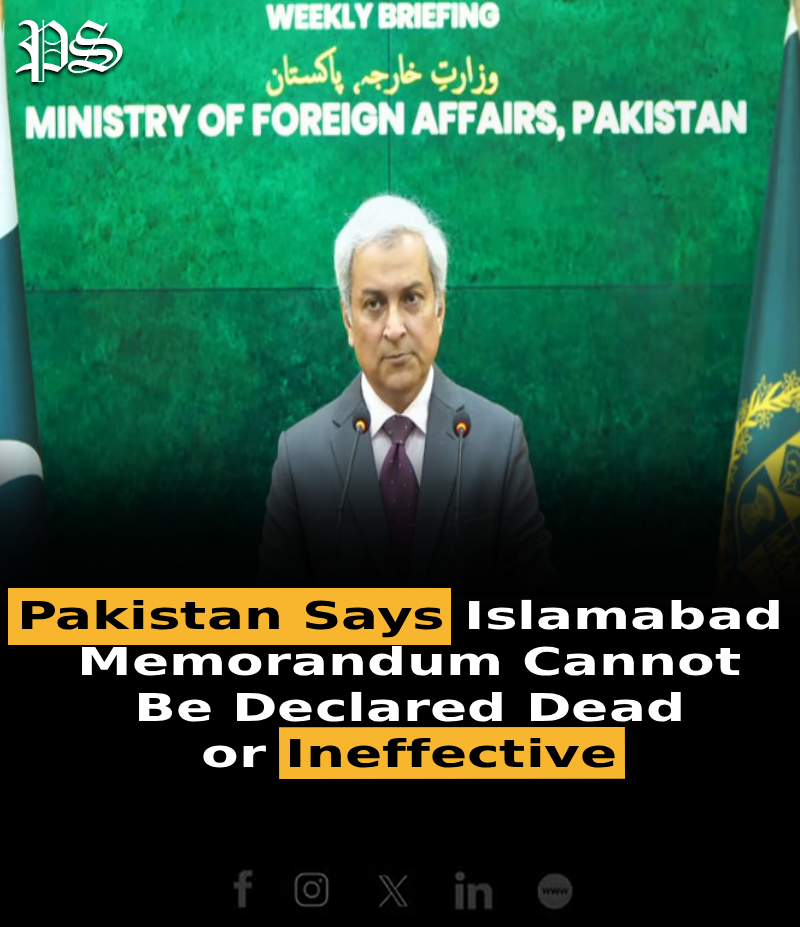
Pakistan has rejected any suggestion that the Islamabad Memorandum of Understanding could be considered dead, ineffective, or irrelevant, saying that a framework for peace remains in place and that Islamabad continues to hope that the parties involved in the US-Iran conflict will eventually return to negotiations.
Foreign Office spokesperson Tahir Hussain Andrabi made the remarks during his weekly press briefing, where he discussed the ongoing tensions between the United States and Iran, as well as several other regional and international issues.
Andrabi acknowledged that the current situation between Washington and Tehran was concerning and undesirable. He said that both sides had carried out armed attacks and retaliatory actions, and that Pakistan was closely monitoring developments.
Despite the escalation, the spokesperson said Pakistan had not lost hope in the peace process. He rejected the idea that the renewed tensions should be interpreted as a failure of Pakistan’s mediation efforts.
According to Andrabi, Pakistan remains sincerely engaged in efforts aimed at finding a peaceful solution to the US-Iran dispute. He stressed that Islamabad’s diplomatic efforts were being pursued with complete sincerity and that the existing peace framework had not disappeared.
“The question of declaring the Islamabad Memorandum dead or ineffective does not arise,” he said, emphasizing that the mechanism for pursuing peace remains available.
Pakistan has repeatedly expressed its desire to play a constructive diplomatic role in reducing tensions in the region. Islamabad’s position is that dialogue and negotiations remain the best way to resolve disputes and prevent further escalation. The Foreign Office spokesperson said Pakistan remained hopeful that the parties would ultimately recognize the need to return to talks.
Indus Waters Treaty
During the briefing, Andrabi also addressed developments concerning the Indus Waters Treaty between Pakistan and India.
He said India’s decision to reject a ruling by the Court of Arbitration could not free India from its obligations under the Indus Waters Treaty. Pakistan, he said, continues to call on India to return to full implementation of the treaty.
The spokesperson stressed that India must comply with international law and honor its treaty obligations under all circumstances. According to him, unilateral actions concerning an internationally recognized agreement could have consequences beyond the immediate dispute.
Andrabi said India’s conduct undermines confidence in the system of treaty compliance and established mechanisms for resolving international disputes. He warned that such behavior could set a negative precedent for other regions where shared natural resources are managed under legally binding agreements.
He particularly highlighted the sensitivity of South Asia, where water resources have significant importance for both countries. He said unilateral approaches to managing transboundary water resources could damage peace and stability in the region.
Pakistan has long maintained that the Indus Waters Treaty provides an established legal framework for the management of shared rivers between the two countries. Islamabad has argued that disputes related to the treaty should be addressed through the mechanisms provided within the agreement and applicable international law.
Yasin Malik Case
The Foreign Office spokesperson also commented on the case involving Kashmiri leader Yasin Malik.
Andrabi said Pakistan had completely rejected the proceedings and sentence imposed against Malik by India. He described the case as being contrary to the fundamental requirements of justice.
Pakistan, he said, would continue to raise the issue of Yasin Malik at international and multilateral forums. Islamabad has also called on the international community to take notice of the case and examine the circumstances surrounding Malik’s prosecution and imprisonment.
The spokesperson expressed concern about Malik’s well-being and said Pakistan remained hopeful regarding his health and long life. He also referred to the late Kashmiri leader Syed Ali Shah Geelani, saying that he remained in Pakistan’s prayers.
The Foreign Office reiterated that Pakistan would continue to highlight issues concerning Kashmir and the rights of Kashmiris at international forums.
Pakistan’s Diplomatic Position
The statements made during the briefing reflect Pakistan’s broader diplomatic position of supporting negotiations and peaceful dispute resolution while opposing unilateral actions that it believes undermine international agreements.
On the US-Iran issue, Islamabad appears determined to keep diplomatic channels open despite the latest escalation. Pakistan considers the current tensions worrying but does not view them as proof that diplomatic initiatives have failed.
On the India-Pakistan water dispute, Islamabad continues to insist that existing international agreements must be respected and that disagreements should be resolved through established legal mechanisms rather than unilateral measures.
Meanwhile, Pakistan’s position on Yasin Malik remains firmly linked to its wider diplomatic stance on the Kashmir dispute. Islamabad says it will continue raising the matter at international and multilateral forums and urging the global community to take notice.
Overall, the Foreign Office briefing emphasized Pakistan’s preference for dialogue, international law, treaty obligations, and peaceful mechanisms for resolving disputes. Despite the difficult regional environment, Pakistan says it remains committed to diplomatic engagement and believes that negotiations can still provide a path toward de-escalation and lasting peace.
About The Author