

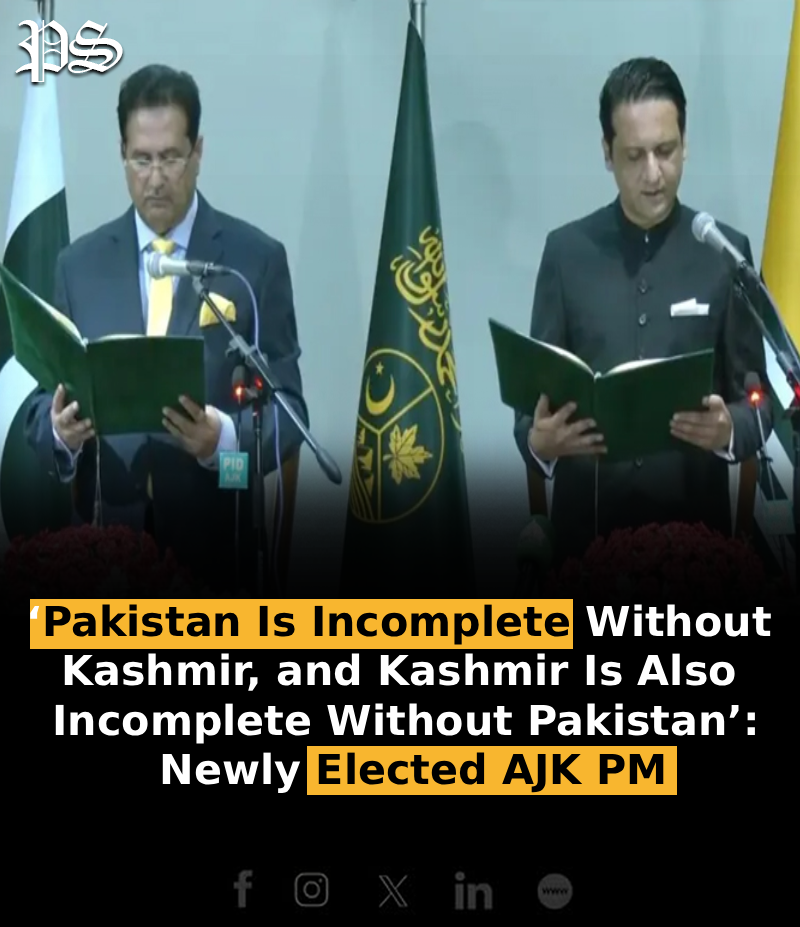
MUZAFFARABAD: Newly elected Prime Minister of Azad Jammu and Kashmir (AJK), Barrister Iftikhar Gilani, has said that Pakistan is incomplete without Kashmir and Kashmir is also incomplete without Pakistan.
Addressing the AJK Legislative Assembly for the first time after being elected prime minister, Barrister Iftikhar Gilani said the Kashmir dispute was not merely a matter concerning a piece of land. Instead, he described it as a question of the Kashmiri people’s right to self-determination under the resolutions of the United Nations.
The newly elected AJK prime minister said the people of Kashmir had a fundamental right to determine their political future and that the issue should be viewed in the context of international commitments and the United Nations framework.
He stressed that the Kashmir dispute could not be reduced to a territorial conflict between India and Pakistan. According to him, the central issue was the right of the Kashmiri people to decide their own future.
Barrister Iftikhar Gilani also strongly condemned the measures taken by India on August 5, 2019, when the Indian government revoked the special constitutional status previously granted to Jammu and Kashmir.
He said legislative measures and constitutional changes could not change the disputed status of Kashmir or make the territory an integral part of India.
The AJK prime minister argued that unilateral legislation could not override the political and legal dimensions of the Kashmir dispute. He maintained that the aspirations of the Kashmiri people remained central to resolving the issue.
His remarks came during his maiden speech in the AJK Legislative Assembly after being elected prime minister. The address focused heavily on the Kashmir dispute and its political significance for Pakistan and the people of Azad Kashmir.
Barrister Iftikhar Gilani emphasised the close relationship between Pakistan and Kashmir, saying that the two were deeply connected politically, historically and emotionally.
“Pakistan is incomplete without Kashmir, and Kashmir is also incomplete without Pakistan,” he said, highlighting what he described as the inseparable connection between the people of Kashmir and Pakistan.
The newly elected prime minister reiterated Pakistan’s traditional position that the Kashmir issue should be resolved in accordance with the aspirations of the Kashmiri people and the relevant United Nations resolutions.
He said the international community should recognise the importance of the right to self-determination and play its role in resolving the long-standing dispute.
The Kashmir issue has remained a major point of contention between India and Pakistan since the partition of British India in 1947. Both countries have administered different parts of the disputed region and have fought multiple conflicts over Kashmir.
The dispute has also remained on the agenda of the United Nations for decades. Pakistan has consistently maintained that the Kashmiri people should be allowed to exercise their right to self-determination in accordance with relevant UN resolutions.
India, on the other hand, maintains that Jammu and Kashmir is an integral part of the country and has rejected internationalisation of the issue.
The situation changed significantly in August 2019 when India revoked Jammu and Kashmir’s special constitutional status and subsequently introduced a series of administrative and legal changes in the region.
Pakistan strongly opposed those measures and has repeatedly called for their reversal.
In his speech, Barrister Iftikhar Gilani reiterated the AJK government’s opposition to the Indian actions of August 5, 2019. He argued that changes made through legislation could not determine the final status of a disputed territory.
His comments also underline the importance that the AJK leadership attaches to maintaining the Kashmir issue as an international dispute rather than allowing it to be treated solely as an internal Indian matter.
The newly elected prime minister is expected to face a range of domestic governance challenges in addition to his focus on the Kashmir issue. The AJK government is responsible for managing the region’s administrative, economic and social affairs while also maintaining its political position on the Kashmir dispute.
Gilani’s first address to the assembly provided an opportunity to outline his position on one of the most important issues associated with AJK’s political identity.
He stressed that the Kashmir issue was fundamentally about the rights and aspirations of the Kashmiri people rather than territorial acquisition.
The prime minister’s remarks are also likely to reinforce the AJK government’s diplomatic and political messaging regarding developments in Indian-administered Kashmir.
Pakistan has repeatedly called on the international community to take notice of the situation in Kashmir and support efforts aimed at finding a peaceful resolution to the dispute.
Barrister Iftikhar Gilani said the people of Kashmir would continue to seek recognition of their right to self-determination and rejected the idea that unilateral constitutional or legislative measures could settle the dispute.
His statement that Pakistan and Kashmir are incomplete without each other reflects the longstanding political position of Pakistan and the AJK leadership regarding the relationship between the two sides.
The newly elected prime minister’s maiden speech therefore combined a strong political message on Kashmir with criticism of India’s 2019 actions.
He reiterated that the Kashmir dispute must ultimately be addressed through a process that takes into account the aspirations of the Kashmiri people and the principles reflected in the relevant United Nations resolutions.
The AJK government is expected to continue highlighting the Kashmir issue at both domestic and international forums, while calling for greater international attention to the dispute.
For now, Barrister Iftikhar Gilani has made it clear that the Kashmir dispute will remain a central issue of his government’s political position, with the right to self-determination and opposition to India’s August 5, 2019 measures forming key elements of his message.
About The Author