

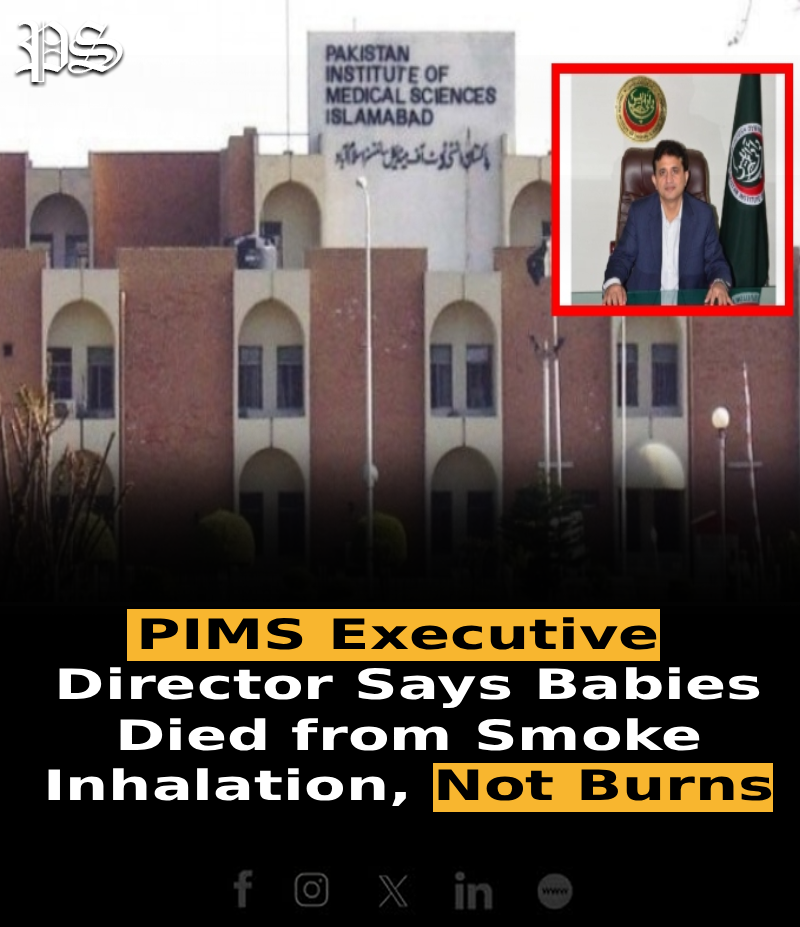
ISLAMABAD: Pakistan Institute of Medical Sciences (PIMS) Executive Director Rana Imran Sikandar has claimed that the newborn babies who died in the hospital fire did not die from burns, but from inhaling smoke and soot.
Speaking about the incident, the PIMS executive director said the deceased infants were identified through identification tags placed around their wrists. He maintained that the identification tags remained intact, which was why DNA testing was not considered necessary.
According to Rana Imran Sikandar, DNA tests would only have been required if the bodies had been so badly damaged that they could not be identified through other means.
The statement comes amid questions raised by some family members over the identification of the deceased infants without conducting DNA tests. Some relatives had expressed concerns about whether the bodies were correctly identified and handed over to the respective families.
According to PIMS officials, 15 newborn babies were present in the nursery when the fire broke out. One infant was successfully rescued, while the remaining babies died in the incident.
Hospital officials said staff members attempted to enter the nursery to rescue the infants after the fire broke out. However, their efforts were reportedly hampered when an explosion occurred and the ceiling collapsed.
The incident has generated serious concerns about the circumstances surrounding the fire, the hospital’s emergency response and the safety arrangements in the neonatal and paediatric facilities.
The latest statement by the PIMS executive director provides the hospital administration’s explanation for the cause of death of the infants. According to him, the babies were not killed by direct burns but suffered fatal effects from smoke and soot entering their respiratory systems.
Smoke inhalation can be particularly dangerous for newborns because their respiratory systems are highly vulnerable. In a confined hospital environment, exposure to dense smoke can rapidly compromise breathing and oxygen levels.
However, the circumstances of the deaths and the exact causes remain matters of public and official scrutiny. The claims made by PIMS management are likely to be examined as part of the inquiry into the tragedy.
Questions about the number of babies present in the nursery have also emerged.
On the previous day, Dr Shazia Sobia, a member of the National Assembly’s Standing Committee on Health, claimed that during her visit to PIMS she was informed that the number of babies in the nursery may have been significantly higher than the figure provided by hospital officials.
According to Dr Shazia Sobia, there were allegedly 40 to 50 babies in the nursery rather than 15.
She questioned how the deceased infants could have been handed over to their families without DNA testing if there were doubts about the number of children present and the circumstances surrounding their deaths.
The discrepancy between the two accounts has added another dimension to the controversy surrounding the tragedy.
PIMS officials have maintained that 15 newborns were present in the nursery at the time of the fire, with one child rescued alive. The claim by the parliamentary committee member, however, raises questions about whether the hospital’s records accurately reflected the number of infants present.
The issue of identification has also become a sensitive matter for the affected families. Relatives who questioned the decision not to conduct DNA tests are seeking greater clarity regarding how the identities of the deceased children were established.
Rana Imran Sikandar said the wrist identification tags were intact and provided sufficient information to establish the identities of the babies. He therefore maintained that DNA testing was unnecessary in the circumstances.
The controversy surrounding the identification process is likely to remain an important part of the broader investigation into the incident.
The fire has already raised questions about the hospital’s preparedness to deal with emergencies, the availability of safety equipment, evacuation procedures and the ability of staff to respond quickly to a fire in a critical-care area.
The fact that staff members reportedly attempted to enter the nursery but were prevented by an explosion and subsequent collapse of the ceiling has also prompted questions about the condition of the facility and the effectiveness of emergency response arrangements.
The deaths of newborn babies in a hospital setting have generated considerable public concern, particularly because such patients are among the most vulnerable and require specialised care.
The latest statements from PIMS authorities and members of the National Assembly’s health committee have presented differing accounts on key aspects of the incident. These include the number of babies present in the nursery and the need for DNA testing.
A detailed investigation will be required to establish the exact sequence of events, determine the causes of death and clarify whether the hospital’s records accurately documented the number of infants present at the time of the fire.
The inquiry is also expected to examine whether adequate safety measures were in place and whether hospital staff had the necessary equipment and training to respond to such an emergency.
For the families who lost their children, establishing the identity and cause of death of each infant is of critical importance. Any uncertainty surrounding these issues could further deepen their distress.
The PIMS administration has maintained that identification through wrist tags was reliable and that the condition of the bodies did not require DNA testing. Meanwhile, concerns raised by relatives and a member of the National Assembly’s health committee have highlighted the need for greater transparency.
As the investigation into the PIMS tragedy continues, authorities will need to reconcile the differing accounts and establish the facts through hospital records, eyewitness statements, forensic evidence and other available evidence.
The final inquiry findings are expected to provide greater clarity regarding the number of infants present, the circumstances of the fire, the cause of the deaths and whether any administrative or safety failures contributed to the tragedy.
About The Author