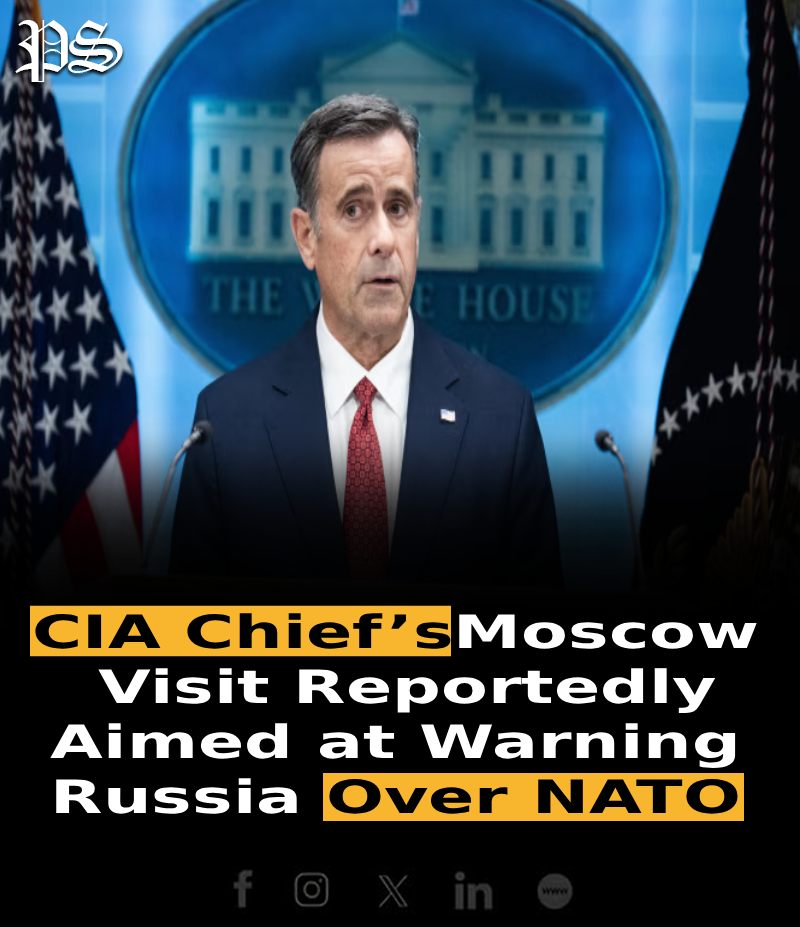
According to a report by the American newspaper The Wall Street Journal, CIA Director John Ratcliffe made a surprise visit to Moscow this week with the reported purpose of warning Russia against attacking NATO member states. The visit is being viewed as a significant development because direct communication between senior American and Russian officials has remained highly sensitive amid continuing tensions between Russia, the United States and European countries.
The report said that Ratcliffe’s visit was his first publicly acknowledged trip to the Russian capital. Although details of the meeting and discussions have not been made public, the reported purpose of the visit was to send a clear message to Moscow about the possible consequences of military action against NATO countries.
According to the newspaper, the visit followed new assessments by US intelligence agencies regarding Russia’s possible future intentions. These assessments reportedly suggest that Russian President Vladimir Putin could, in the coming years, consider testing NATO’s commitment through a limited military attack against one of its member states.
Such a scenario would create a major international crisis because NATO operates on the principle of collective defence. Under Article 5 of the NATO treaty, an armed attack against one member is considered an attack against all members, although the specific response can vary. Any direct Russian attack on a NATO country could therefore have consequences far beyond the countries directly involved.
The reported warning from the CIA chief highlights Washington’s concern about the possibility of a future confrontation between Russia and NATO. The United States has repeatedly emphasized the importance of protecting its European allies, while Russia has strongly opposed NATO’s expansion and its growing military presence in Europe.
The situation has become particularly sensitive since Russia’s invasion of Ukraine, which dramatically increased tensions between Moscow and Western governments. NATO members have strengthened their military capabilities, increased defence spending and improved cooperation along the alliance’s eastern flank. Russia, meanwhile, has continued to criticize NATO policies and has warned against what it describes as growing Western military pressure.
The reported Moscow visit may also demonstrate the importance of maintaining communication channels even during periods of severe political tension. Intelligence and diplomatic contacts can sometimes be used to deliver sensitive warnings and reduce the risk of misunderstanding. However, such communication does not necessarily mean that relations between the two sides are improving.
The possibility of Russia testing NATO through a limited attack is particularly concerning because a small-scale military operation could create difficult decisions for the alliance. NATO members would have to determine how to respond while attempting to prevent the situation from developing into a wider conflict.
For the United States and its European allies, deterrence remains an important part of their strategy. The reported warning from Ratcliffe could therefore be intended to make clear that any attack on a NATO member would carry serious consequences. At the same time, the exact nature of the message reportedly delivered to Russian officials remains unclear.
Russia has not publicly confirmed all the details surrounding the reported visit or the alleged warning. Therefore, claims about the exact discussions should be treated cautiously until additional official information becomes available.
The report nevertheless reflects the continuing uncertainty surrounding relations between Russia and Western countries. While the immediate focus of international attention remains on the war in Ukraine, officials in Washington and European capitals are also considering possible security challenges in the years ahead.
The reported CIA assessment does not necessarily mean that Russia has decided to attack a NATO country. Rather, it suggests that American intelligence officials are considering possible future scenarios and preparing policymakers for different outcomes.
The reported visit by the CIA director therefore carries significance beyond the meeting itself. It highlights the importance of intelligence assessments, strategic communication and deterrence in preventing a potential conflict between major military powers.
For NATO, maintaining unity among its members will remain crucial. For Russia, avoiding a direct confrontation with the alliance could also be an important strategic consideration. Any military clash between Russia and NATO would carry enormous risks for Europe and the wider international community.
The reported Moscow trip ultimately demonstrates that, despite deep disagreements, communication between Washington and Moscow remains important. Whether the warning will influence Russia’s future calculations remains uncertain, but the message reportedly delivered by the US intelligence chief appears aimed at preventing a dangerous escalation before it happens.
About The Author