

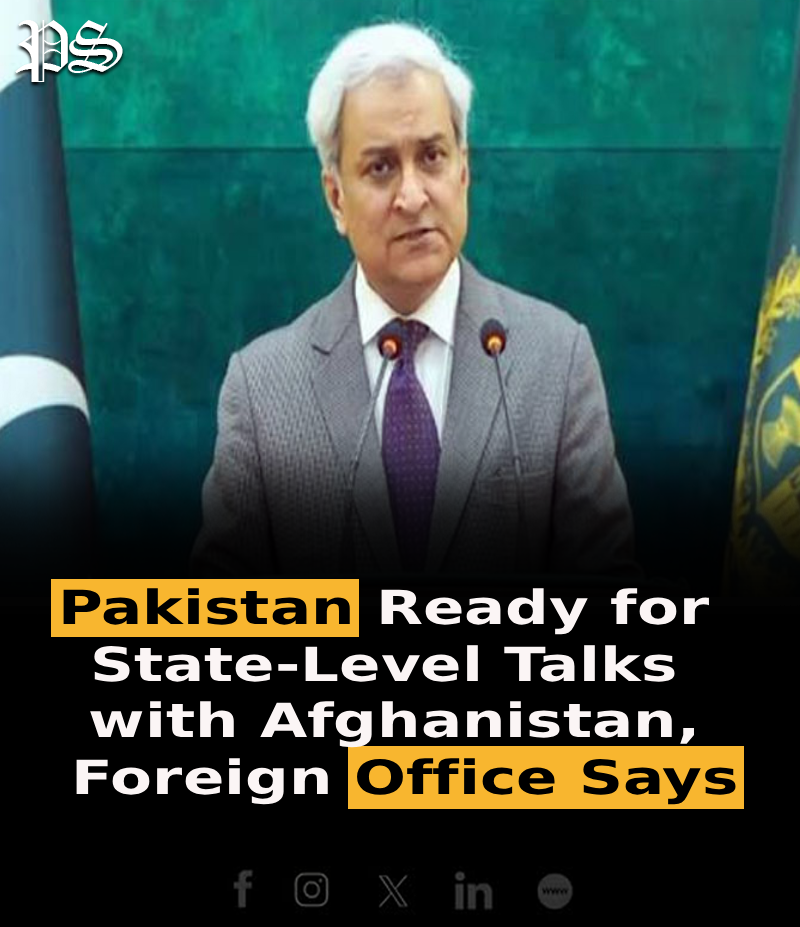
ISLAMABAD — Pakistan has expressed its readiness to engage in state-level negotiations with Afghanistan, while making it clear that any meaningful dialogue must be accompanied by concrete and verifiable action against terrorism originating from Afghan territory.
During a weekly briefing in Islamabad, the spokesperson for Pakistan’s Foreign Office firmly rejected allegations by the Afghan Foreign Ministry that Pakistan was interfering in Afghanistan’s internal affairs. The spokesperson stressed that Pakistan’s concerns are primarily related to cross-border terrorism and regional security.
Pakistan has called on Afghanistan’s interim government to ensure that its territory is not used for terrorist activities against Pakistan. Islamabad specifically demanded that Afghan authorities prevent groups such as the Tehreek-e-Taliban Pakistan (TTP) and the Balochistan Liberation Army (BLA) from operating against Pakistan from Afghan soil.
The Foreign Office spokesperson said Afghanistan must also fulfill its international obligations, including commitments associated with the Doha framework. Pakistan believes that compliance with these commitments is essential for building trust between the two neighboring countries.
Despite ongoing tensions, Islamabad said it remains open to institutional engagement with Kabul. The spokesperson emphasized that Pakistan is prepared for state-to-state dialogue and institutional-level contacts with Afghanistan, provided such engagement produces verifiable counterterrorism measures.
Pakistan’s position comes amid continued concerns over militant activity along the Pakistan-Afghanistan border. Islamabad has repeatedly urged Kabul to take effective action against militant groups that it says use Afghan territory to plan and carry out attacks inside Pakistan.
The Pakistani Foreign Office also stressed the importance of effective border management. According to the spokesperson, Pakistan wants both improved control of the shared border and measurable steps to prevent terrorist organizations from using Afghan territory against Pakistan.
Islamabad has maintained that dialogue remains an important avenue for resolving disputes with Afghanistan, but it wants negotiations to result in practical outcomes rather than remaining limited to political statements. Pakistan therefore considers verifiable progress on counterterrorism a key condition for sustaining any future diplomatic process.
The spokesperson further stated that Pakistan would attach greater importance to practical and verifiable progress in any negotiations with Afghanistan. This suggests that Islamabad is seeking a results-oriented framework in which commitments made during talks can be independently assessed through concrete actions.
Relations between Pakistan and Afghanistan have faced significant strain in recent years, particularly over security concerns and allegations involving militant groups operating from Afghan territory. Pakistan has consistently called on Afghanistan’s interim authorities to take stronger measures against groups it view diplomatic engagement as closed. Rather, Pakistan appears to be considers a threat to Pakistani security.
At the same time, Islamabad’s willingness to pursue state-level talks indicates that it does not view diplomatic engagement as closed. Rather, Pakistan appears to be linking continued engagement with specific security requirements and measurable progress.
The latest statement from the Foreign Office therefore reflects a dual-track approach: Pakistan is willing to maintain diplomatic and institutional channels with Afghanistan, while simultaneously demanding effective border controls and ver that Afghan territory is not used to conduct attacks against Pakistan. The Foreign Office has made clear that any future dialogue will be judged largely by whether it produces tangibleifiable counterterrorism measures.
For Islamabad, the central issue remains ensuring that Afghan territory is not used to conduct attacks against Pakistan. The Foreign Office has made clear that any future dialogue will be judged largely by whether it produces tangible improvements in this area.
Pakistan’s readiness to negotiate could provide an avenue for reducing tensions between the two countries, but the success of such an effort will depend on the willingness of both sides to address their longstanding security concerns through sustained diplomatic engagement and practical measures.
About The Author