

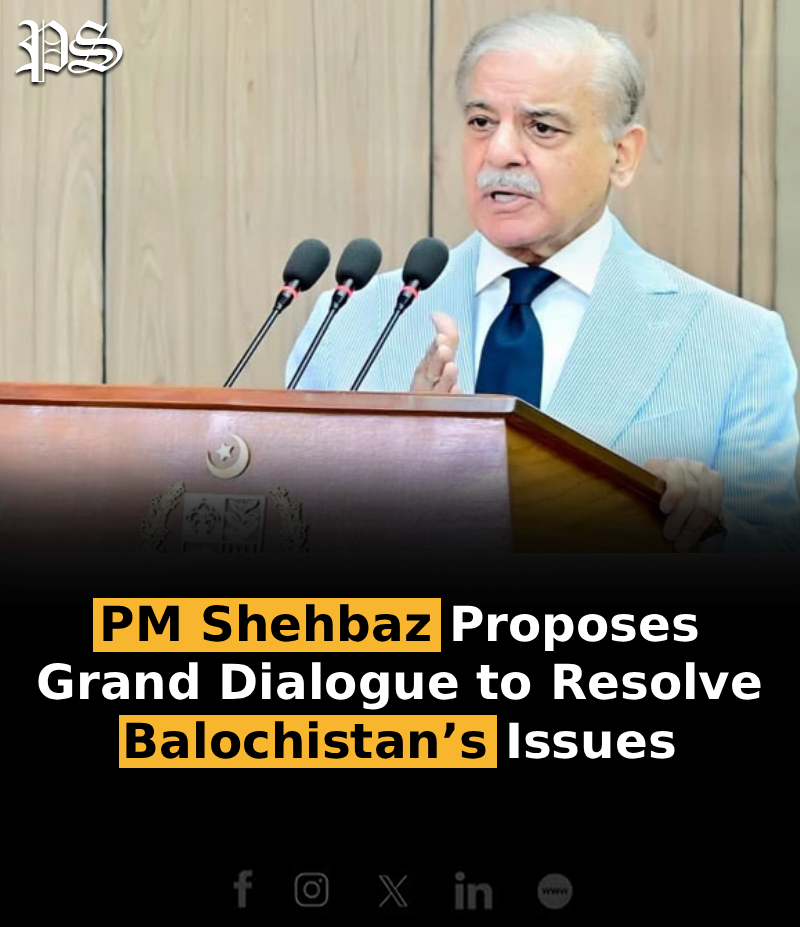
Islamabad: Prime Minister Shehbaz Sharif has proposed a grand dialogue to address the political, economic and social challenges facing Balochistan, saying that meaningful consultation and dialogue are necessary to resolve the province’s problems.
Addressing participants of the Balochistan National Workshop, the prime minister said the purpose of dialogue should be to listen to the concerns of the Baloch people and find practical solutions through consultation.
He emphasized that the problems of Balochistan should be addressed through dialogue rather than confrontation. According to the prime minister, consultation and mutual understanding provide the best path toward resolving long-standing challenges.
Balochistan’s Resources
Shehbaz Sharif said the people of Balochistan have the first right over the province’s resources.
He said that if there are genuine grievances and challenges, they should be addressed through mutual discussion. He stressed that a fair distribution of resources and consultation among stakeholders were essential for resolving disputes.
The prime minister also linked Pakistan’s broader development to cooperation among all four provinces. He said the country could progress only when Punjab, Sindh, Khyber Pakhtunkhwa and Balochistan move forward together.
His remarks indicate an emphasis on addressing economic and political grievances through greater provincial participation and a more equitable approach to resource distribution.
Rejection of Violence
While advocating dialogue, the prime minister strongly rejected the use of violence as a means of addressing political or regional grievances.
He said that no patriotic person could take up arms in the name of a problem or grievance. He referred to incidents in which people had allegedly been identified on the basis of their regional identity before being killed.
Shehbaz Sharif also claimed that hostile foreign countries were behind terrorism in Balochistan and Khyber Pakhtunkhwa.
The prime minister’s comments therefore combined an offer of political dialogue with a firm rejection of armed violence. His message was that legitimate grievances could be discussed and addressed, but violence against citizens and the state could not be justified.
Karachi-Chaman Highway
Shehbaz Sharif also spoke about infrastructure development in Balochistan and said that work was being carried out on the Karachi-Chaman National Highway (N-25) in cooperation with Field Marshal Asim Munir.
He expressed regret that workers engaged in development projects on the highway had been killed in attacks.
The prime minister praised workers operating in difficult and mountainous areas, saying that they were contributing to the economic development and prosperity of Balochistan.
He said that laborers working in remote areas were not merely building roads but were working for the future prosperity of the province.
The deaths of workers involved in infrastructure projects, he suggested, were particularly tragic because such projects are intended to improve connectivity and economic opportunities for local communities.
National Unity
Shehbaz Sharif also referred to what he described as national unity during the Marka-e-Haq, saying that the entire nation stood together as one.
He emphasized the importance of national solidarity in confronting challenges and promoting development.
The prime minister also mentioned Gwadar International Airport, describing it as a gift from China. The airport is considered an important component of infrastructure development in Balochistan and is linked to the wider China-Pakistan Economic Corridor.
The reference to Gwadar reflects the government’s emphasis on infrastructure, connectivity and economic development as potential drivers of prosperity in Balochistan.
Dialogue as a Way Forward
The proposal for a grand dialogue comes amid longstanding political, economic and security challenges in Balochistan. The province has significant natural resources and strategic importance, but it has also faced persistent concerns over development, resource distribution, political representation and security.
Shehbaz Sharif’s proposal suggests that the government wants dialogue and consultation to play a greater role in addressing these issues.
The prime minister’s position is that Balochistan’s grievances should be heard and addressed through political engagement, while violence and attacks on civilians and development workers should not be tolerated.
He also stressed that a stronger and more prosperous Pakistan requires all four provinces to work together.
The proposed grand dialogue could therefore provide a platform for discussing Balochistan’s political and economic grievances, resource distribution, development needs and security concerns. Its success, however, would depend on the participation of relevant stakeholders and the government’s ability to translate dialogue into concrete measures.
For now, the prime minister has made clear that dialogue, consultation and equitable resource distribution should be central to resolving Balochistan’s problems, while armed violence cannot be accepted as a solution.
About The Author