

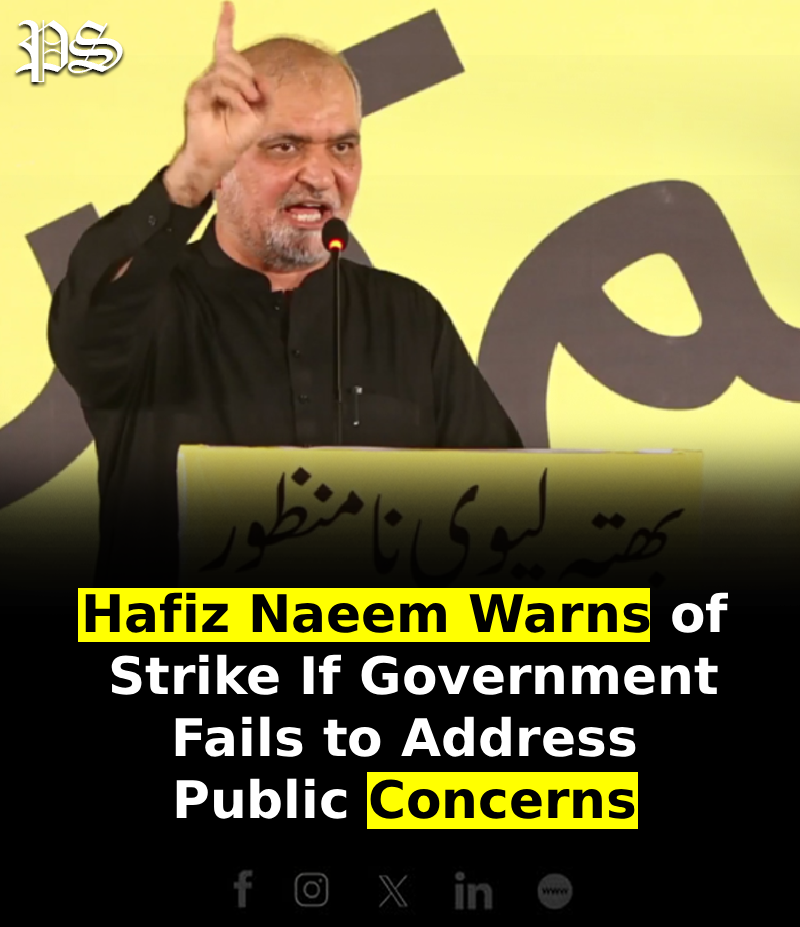
Islamabad: Jamaat-e-Islami Pakistan chief Hafiz Naeemur Rehman has warned that his party could soon announce a strike if the government fails to respond to public demands concerning petroleum levy and rising inflation.
Addressing a sit-in being held against the petroleum levy and inflation, Hafiz Naeem said the government must listen to the concerns of ordinary citizens. He warned that if the authorities did not accept their demands, the Jamaat-e-Islami would move toward a nationwide strike.
Responding to the government’s position on the petroleum levy, Hafiz Naeem said, “Ministers say they cannot abolish the levy; we say we cannot end the sit-in.”
He made it clear that his party intends to continue its protest campaign until the government takes steps to address the issues being raised by protesters.
The Jamaat-e-Islami chief said the party would continue putting pressure on the rulers and would not abandon the public’s demands.
Hafiz Naeem also referred to the party’s previous campaign against independent power producers (IPPs), describing it as a successful struggle. According to him, the campaign contributed to a reduction of around Rs8 to Rs10 per unit in electricity costs.
He said the experience of the IPP campaign had demonstrated that sustained public pressure could force authorities to reconsider policies affecting consumers.
The latest warning comes as Jamaat-e-Islami sit-ins against the petroleum levy and inflation continue in Karachi, Lahore and Peshawar.
The protests are focused on the rising cost of living and the financial burden imposed on consumers through fuel-related charges. The party has been demanding relief for the public and changes to policies that it says are contributing to inflation.
Hafiz Naeem’s statement suggests that the protests could enter a new phase if the government does not respond to the demands. A strike call would potentially expand the campaign beyond sit-ins and could increase political and economic pressure on the government.
The Jamaat-e-Islami leadership has emphasized that its current campaign is centered on economic issues affecting ordinary people. Petroleum prices, taxes and levies have become particularly sensitive issues because changes in fuel costs can affect transportation, electricity generation, food prices and the overall cost of living.
The warning also comes amid broader public concerns about inflation and household expenses. Consumers have faced pressure from rising prices of essential goods and services, while political parties continue to debate the government’s economic policies.
Hafiz Naeem said his party would not withdraw from the campaign simply because the government claims that the petroleum levy cannot be removed. Instead, he indicated that the protest would continue until meaningful relief is provided.
The Jamaat-e-Islami has also sought to build on the momentum of its previous campaign against IPPs. By highlighting the claimed reduction in electricity costs, the party is presenting its earlier campaign as evidence that sustained political pressure can produce policy changes.
For now, sit-ins remain underway in Karachi, Lahore and Peshawar. The next stage of the campaign will depend on the government’s response to the protesters’ demands.
About The Author