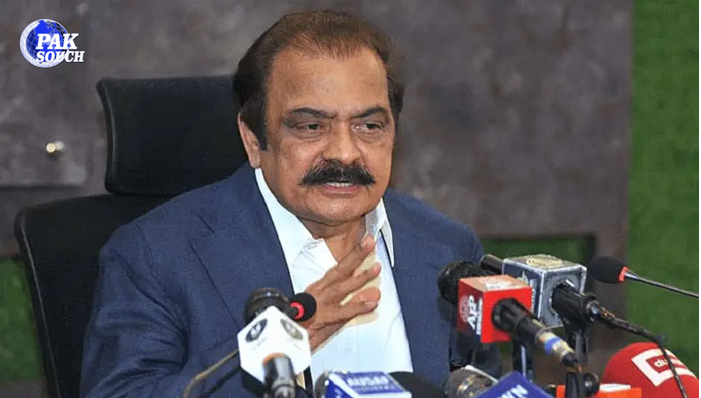
ISLAMABAD: Prime Minister’s Adviser on Political Affairs Rana Sanaullah has said that if Pakistan Tehreek-e-Insaf (PTI) does not have confidence in the Pakistan Institute of Medical Sciences (PIMS), it has the right to raise the matter before a court of law instead of politicizing the issue.
Speaking on Geo News program “Aaj Shahzeb Khanzada Kay Sath,” Rana Sanaullah said that PTI should behave like a responsible political party and adopt legal and constitutional means to present its concerns. He emphasized that courts are the appropriate forum for addressing grievances related to medical treatment or institutional trust.
“If PTI does not trust PIMS, it can express this lack of confidence before the court,” Rana Sanaullah said. “They should go to court and present their position rather than creating controversy outside the legal framework.”
His remarks came amid ongoing political debate over medical facilities and treatment related to PTI leadership. Rana Sanaullah stressed that legal institutions exist to resolve such disputes and political parties should respect judicial processes instead of resorting to public pressure or political campaigns.
The prime minister’s adviser urged PTI to conduct itself in a democratic and mature manner, stating that politics should be based on dialogue, law, and constitutional norms rather than confrontation. “PTI should behave like a political party,” he said, adding that repeated allegations without legal backing weaken democratic traditions.
Rana Sanaullah also rejected reports claiming that the government had offered PTI early elections about a year ago. He termed such claims false and misleading, saying they were being circulated to create confusion among the public.
“These reports about offering elections a year ago are completely baseless,” he said. “No such offer was made.” According to Rana Sanaullah, the prime minister had instead proposed a national consensus initiative on Pakistan’s Independence Day.
He explained that on August 14, the prime minister had presented the idea of a Charter of Stability for Pakistan (Misaq-e-Istehkam-e-Pakistan), aimed at bringing political forces together to address the country’s economic, political, and security challenges.
“The prime minister extended an offer for a Charter of Stability, not elections,” Rana Sanaullah clarified. “The purpose was to encourage political stability and continuity of policies so that Pakistan could move forward.”
He criticized PTI for what he described as contradictory political behavior, alleging that the party on one hand claims to support democratic values while on the other hand undermines state institutions.
Rana Sanaullah further accused PTI of launching an international campaign against Pakistan, particularly in the United States, through meetings and interactions with foreign individuals and groups. He claimed that such actions damaged Pakistan’s image at the global level.
“Through meetings and visitors, PTI ran a campaign in the United States,” he said. “This approach reflects an attempt to exert pressure on the state rather than resolving matters internally.”
He alleged that PTI’s political strategy was based on coercion rather than dialogue. “PTI’s attitude is to bulldoze and blackmail the state,” Rana Sanaullah said, adding that such tactics were harmful to democratic governance and national interests.
The adviser emphasized that political disagreements should be settled through Parliament, courts, and dialogue rather than by creating instability or seeking foreign support. He said that responsible politics required patience, compromise, and adherence to constitutional limits.
Political analysts note that tensions between the government and PTI remain high, with both sides exchanging strong statements over institutional trust, governance, and political legitimacy. Issues related to medical treatment, elections, and political dialogue have become flashpoints in the broader power struggle.
Rana Sanaullah reiterated that the government remains open to political dialogue but only within the framework of the Constitution and the law. “No one is above the law, and no issue should be used to pressure state institutions,” he said.
He concluded by urging PTI leadership to reconsider its approach and engage constructively in the political process. “If there are concerns, the courts are open, Parliament exists, and political dialogue is possible,” he said. “But politics cannot be run through threats, pressure, or misinformation.”